65 Years Later: The Fire at Our Lady of the Angels School

Memories From a 5th Grader

“I did it,” whispered the boy sitting behind Ricky, as he poked him in the shoulder, “I did it.” Ricky did not dare turn around, as he knew it would result in certain punishment from the nun at the front of the classroom and he did not want to suffer the consequences of taking the bait from a kid who had a history of getting himself and others in trouble. Ricky ignored the whispers and pokes from the boy everyone called a “fire bug” as best he could.

Ricky is now Rick, a 75-year-old man who has lived in suburban Villa Park for almost five decades, but in 1958, he was a fifth-grader at Our Lady of the Angels Catholic School in Chicago’s Humbolt Park neighborhood. The “it” that his classmate was referring to was the December 1 school fire that occurred on that frigid day in 1958 resulting in the deaths of 92 children and three nuns, all teachers.
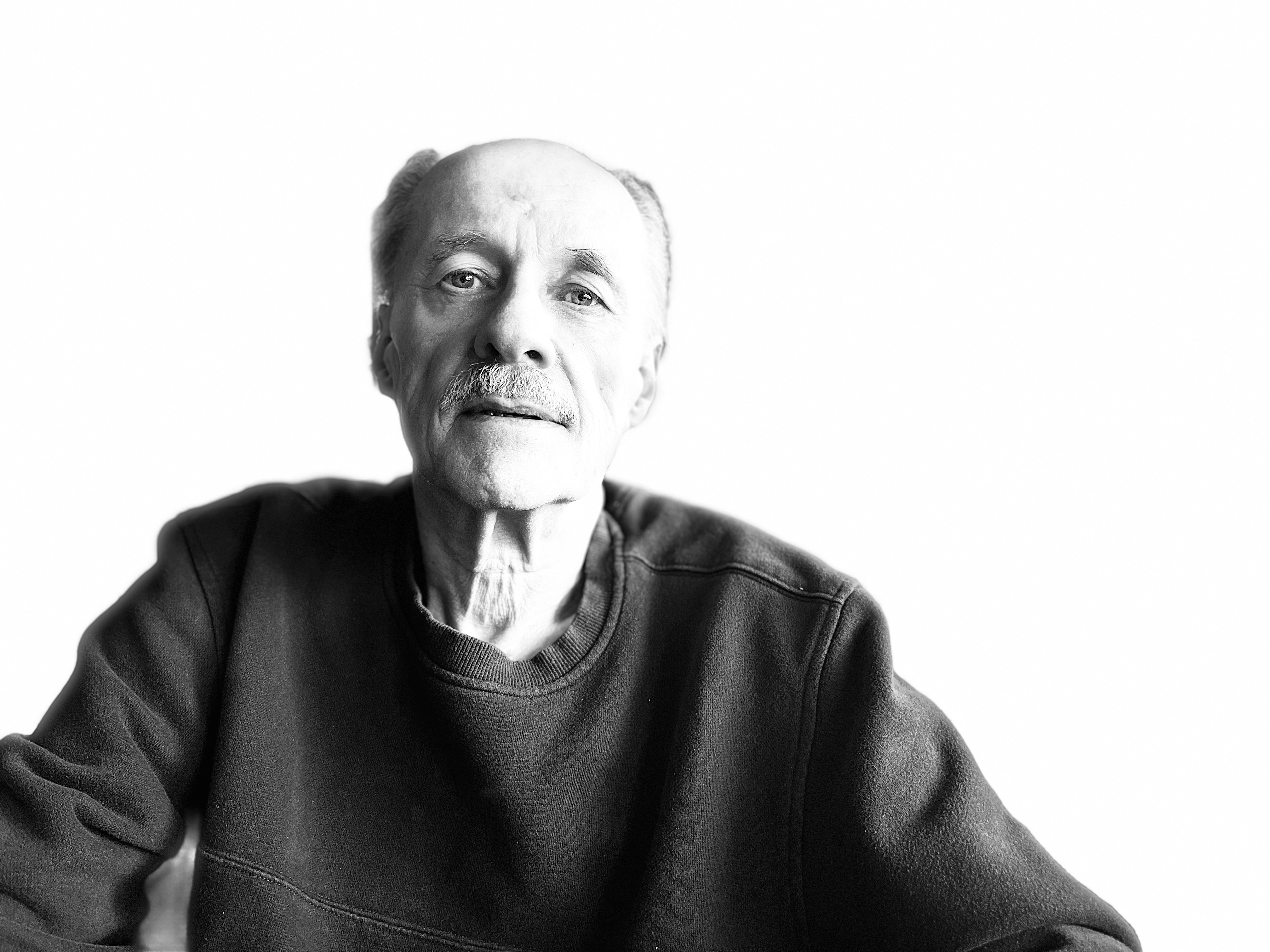
Rick, taken in October 2023, photo by Sheila Quirke.

It remains one of the worst school fires in history.

Officially, a cause of the fire was never determined, but that 10-year-old classmate who whispered into Rick’s ear would later confess to starting the fire during questioning from a polygraph expert and in front of several witnesses. Ultimately, the boy recanted his confession, and a judge threw out the case.

Today marks the 65th anniversary of that terrible fire, that terrible day. For Rick, it still feels like it happened yesterday. He wells up as he talks about it, memories pouring out, clear and detailed.
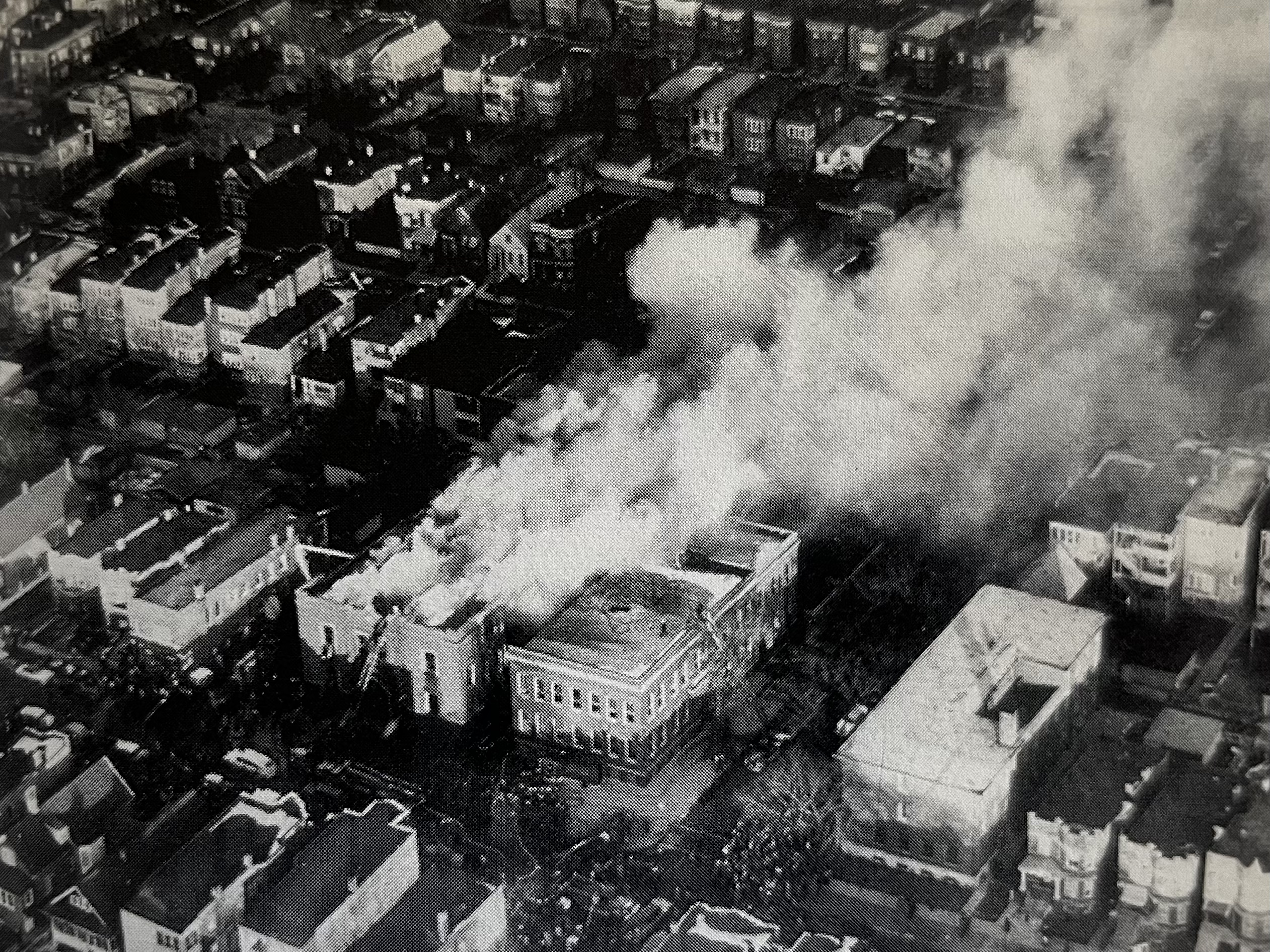
Photo from To Sleep with the Angels, of the OLA School.

Like any other day, Rick woke up and got ready for school on December 1, 1958. He had a slight limp from a recent football game and a large bruise on his leg. His mother decided he should stay home. Rick was mad – he had perfect attendance and if he missed a day, he would lose out on the attendance prize, but his mother insisted, “You can help me clean the house for Christmas,” she told Rick.

Rick remembers wiping the blinds in their apartment on North Trumbull when he first heard the sirens in the afternoon. They were deafening. His mother wondered aloud, “What the hell happened? Did the school burn down?!” Rick cheered at the idea, “YEA! Two weeks off of school!,” just as you would imagine a fifth-grade boy might.

Moments later the phone rang. It was his mother’s friend telling her that, yes, in fact, the school was burning down. “My mom went white and dropped to her knees,” remembers Rick, “She begged for forgiveness.” She ran out to the school, telling Rick to stay home, “Your father will be calling and I want him to know you are safe.”

Rick’s childhood home on North Trumbull Avenue, photo by Sheila Quirke.

Rick’s father did call. He heard about the fire while riding the bus home after work. A friend gave him a dime so he could call from a pay phone. Just as his mother wanted, Rick stayed to answer that call, reassuring his father that he was safe, though he wished he could have gone with his mother. It was his school that was burning and he was worried about his crush — was she okay? How bad was it? How were his friends?

It was bad. Very, very bad.

Later, Rick’s mother would tell him she saw Fr. Joe (Rev. Joseph Ognibene) “punching out windows,” working to free children from the smoke and flames. She saw many other children jump from the high second story windows, trying to escape.

A history of the fire was documented in the 1996 book, To Sleep with the Angels, by David Cowan and John Kuenster. Rick bought two copies of the book the day it was released, one for himself and one for his mother. He has never read it, but it sits on a bookshelf, an important document of one of his most formative experiences, “Maybe one day I’ll be able to take it down and do more than look at the pictures.”

Because he was not in school the day of the fire, Rick has mixed feelings about it, guilt being primary. His teacher, Miss Pearl Tristano, was the one who pulled the fire alarm, alerting those within the school to the danger. All of her 60+ students would evacuate the school safely. Other students in other rooms would not be so lucky.

“The school was immaculate,” recalls Rick, “There must have been an inch of wax on the linoleum.” It was things like the wax and linoleum that contributed to the conditions that made the fire so deadly. In one of the classrooms that had over two dozen deaths (there were three that logged numbers that high), those who died succumbed to smoke inhalation, not flames.

In the days that followed, Rick’s family, just like the rest of the Humboldt Park neighborhood, the larger city, and the whole country, grieved. “We were sad,” remembers Rick, “Mother and Grandmother were crying. Mom took me to four funeral homes to pay our respects, but after the fourth one I heard her say, ‘What are we doing? This is no good for Ricky.’” They stopped going to funeral homes.

Within a couple of weeks, the 1500+ surviving school children of Our Lady of the Angels (OLA) were back learning, tucked away in a patchwork of schools across the near Northwest side. “School and Church didn’t mess around,” says Rick, “We got back to class very soon after the fire.”

Chicago Public Schools and the Archdiocese partnered in opening classrooms to absorb the kids of OLA. Rick was reassigned to Our Lady Help of Christians on Iowa Street. His teacher, Miss Tristano, was gone and did not return. A nun he does not really remember replaced her.

“Everybody was sad,” recalls Rick of those days, “The whole neighborhood was down. Everybody knew somebody who was hurt or who died.” The mood, he says, was somber.

Rick also remembers that no one really talked about the fire or the deaths. He recalls hearing about one nun who “completely flipped out” and was quietly removed from her teaching duties. Rick describes one night he himself broke down, “I started bawling, crying like a baby on our living room floor, sitting in PJs, cross legged doing homework.”

Now, sixty-five years later, Rick believes he still has PTSD. “There was no discussion of the fire ever. ‘Offer it up to God,’ is what we were told. It kind of bugged me,” says Rick. “For my own sake, I would like to get over it.” To this day, Rick never uses candles and is extremely careful in locating fire exits when he is in public spaces.

“I’ll never forget it, ever,” says Rick, “I think about all the people. They were just too young. That fire was the turning point, for people and for the whole neighborhood. It was never the same again. The togetherness was gone. It’s still an open wound, but December 1 is like a holiday for me, a day to just remember.”
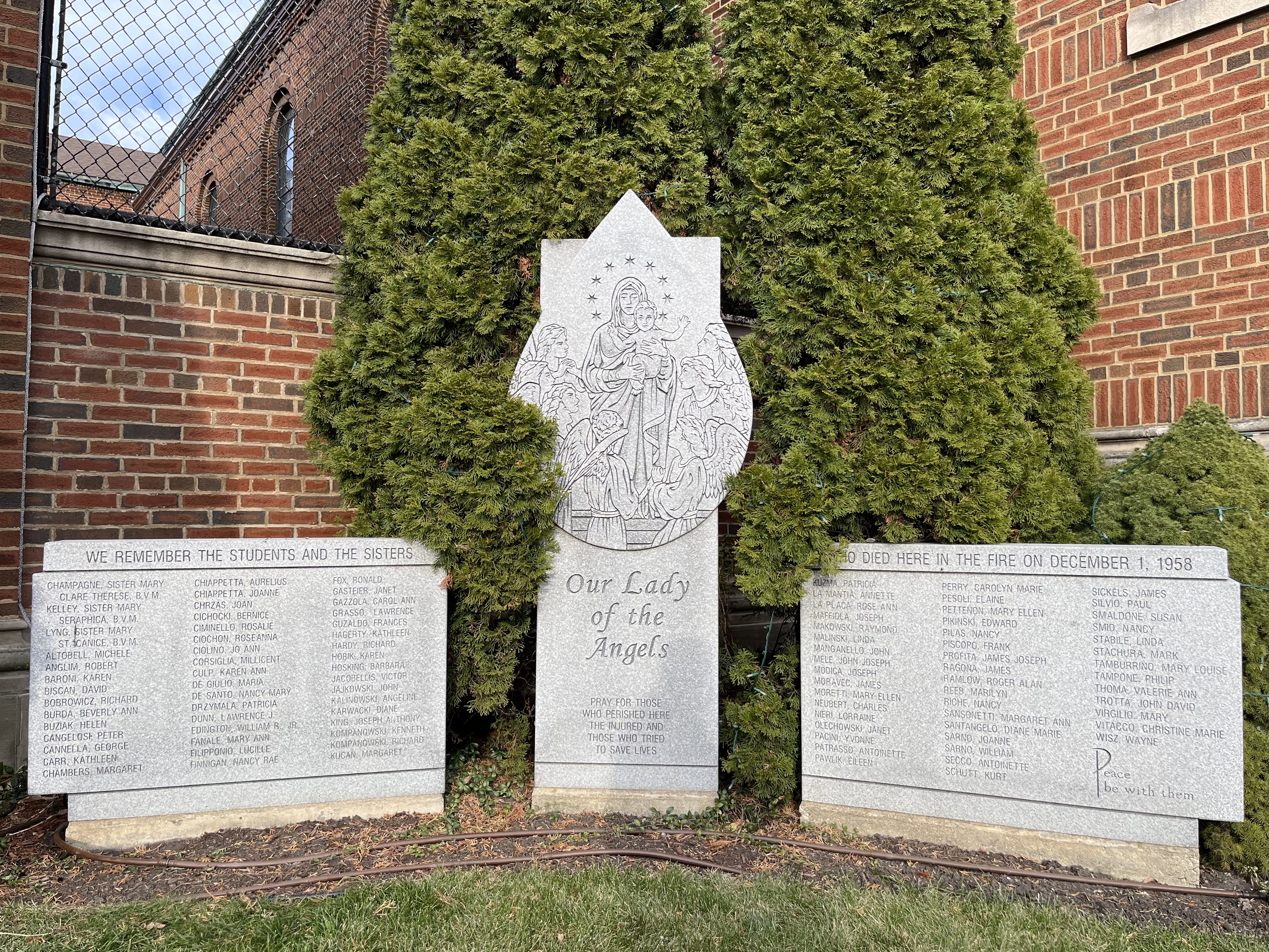
A memorial outside the OLA Rectory, photos by Sheila Quirke.

_______________________________________________________________

Author’s Note: I extend my grateful thanks to Rick. I grew up hearing stories about the fire at Our Lady of the Angels School, so it was always on my Chicago Catholic upbringing radar. I interviewed Rick on a completely unrelated matter and, as we are both prone to do, we got to talking. Before I knew it, Rick was recounting his memories of that fateful day. For me, he was like a history book come to life. I am honored to have been his audience in recounting his memories and humbled he agreed to let me capture them.

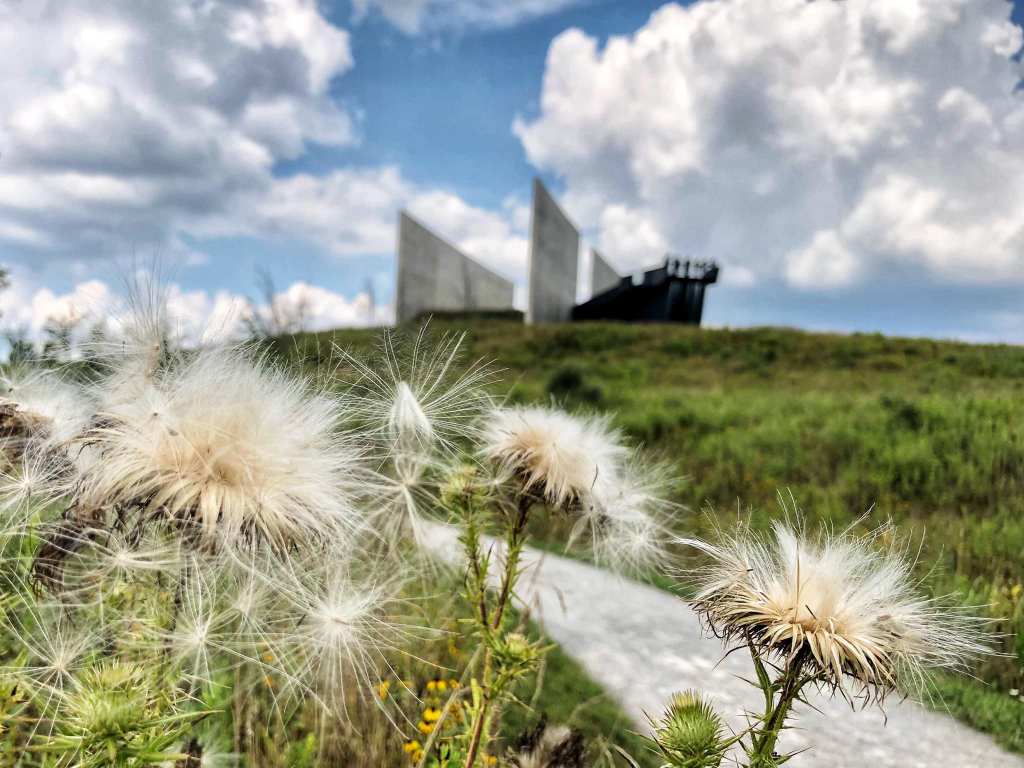
Visiting the Flight 93 Memorial

Last month we took a road trip that tried to give us some semblance of a vacation in the continued midst of this pandemic while also preserving our safety. Our eight year old is still too young to be vaccinated, so we continue to be cautious.

We spent a week in Massachusetts with the grandparents, then a week based in Annapolis, Maryland where we could soak up some history and outdoor time along the Chesapeake Bay. Our kiddo who is really interested in the Founding Fathers got to visit Mount Vernon, the Maryland State House (where POTUS 1 resigned his military commission after the Revolutionary War), and a few hours in the Smithsonian National Museum of African American History and Culture to provide some much needed historical context about those same Founding Fathers.

The original plan was to stop at Gettysburg on the way home, heading west through Pennsylvania. With COVID numbers rising in the area and too many folks not wearing masks, we made a last minute call on the advice of a cousin (Hi, Avram!) to visit the National Parks’ Flight 93 National Memorial in Somerset County, PA.

All photos taken by Sheila Quirke on 8.21.2021. Not to be used without permission.

I am glad we did.

The memorial is a fitting and moving tribute to the forty people whose lives were taken and whose family and loved ones will never again be complete. The space itself is a perfect melding of architecture and landscape that soars in every direction.

Designed by Paul and Milena Murdoch of Paul Murdoch Architects with landscape architecture from Nelson Byrd Woltz Landscape Architects, the space is contemplative, informative, peaceful, reverent, and honors the lives lost, using nature and strong geometric structures as the tools that both tell the story of those lives, while also acting as the final resting place of random strangers who, when called upon, changed the trajectory of one of America’s darkest days.

Driving to the Flight 93 Memorial is a necessity, as it is in a rural locale. The local scenery is gorgeous and hilly, an area of many former mines. You drive into a winding road, passing the turn off for the Tower of Voices (we hit that on our exit from the memorial), and heading to the main Visitor Center.

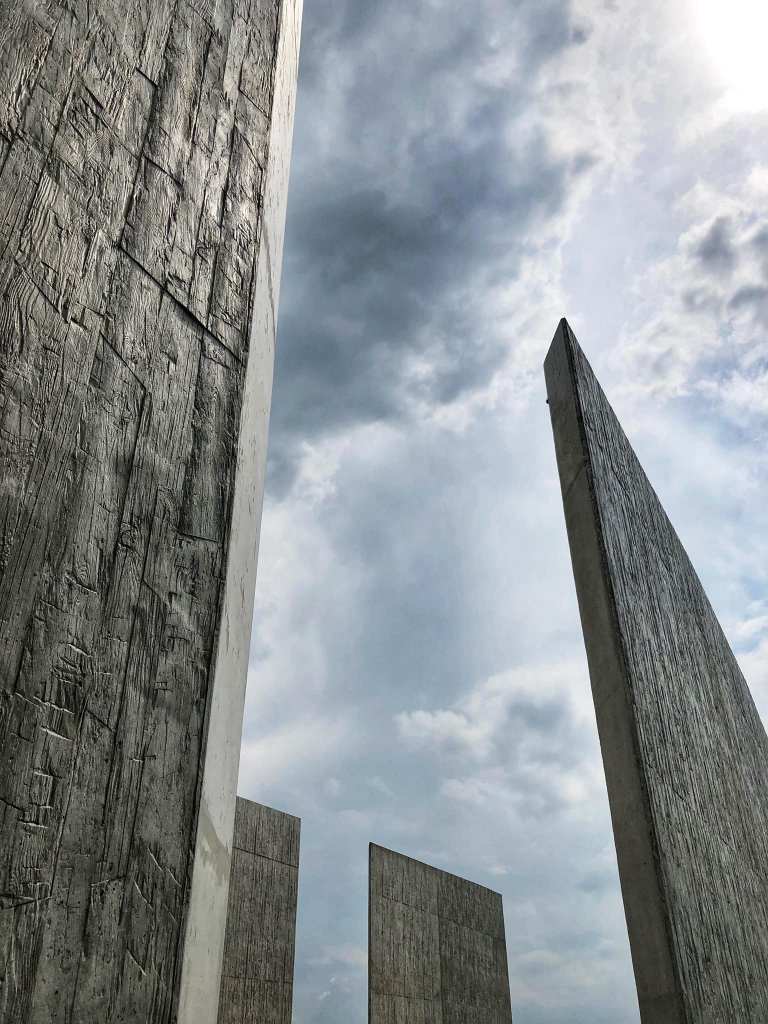
Here there are soaring concrete pillars that were sharp and strong against the blue skies. The museum itself is quite small. Visitors wind through a few aisles of displays that house remnants of the crash, the other attacks, and the belongings of the victims. If wanted, you can listen to recordings left by passengers to their families and loved ones. On the day we visited, people were quiet and respectful.

Walkway to the main Visitors Center and Museum
Another view of the main Visitors Center. The concrete here reminded me of the texture of the hemlock used in the gate that leads to the site of impact.

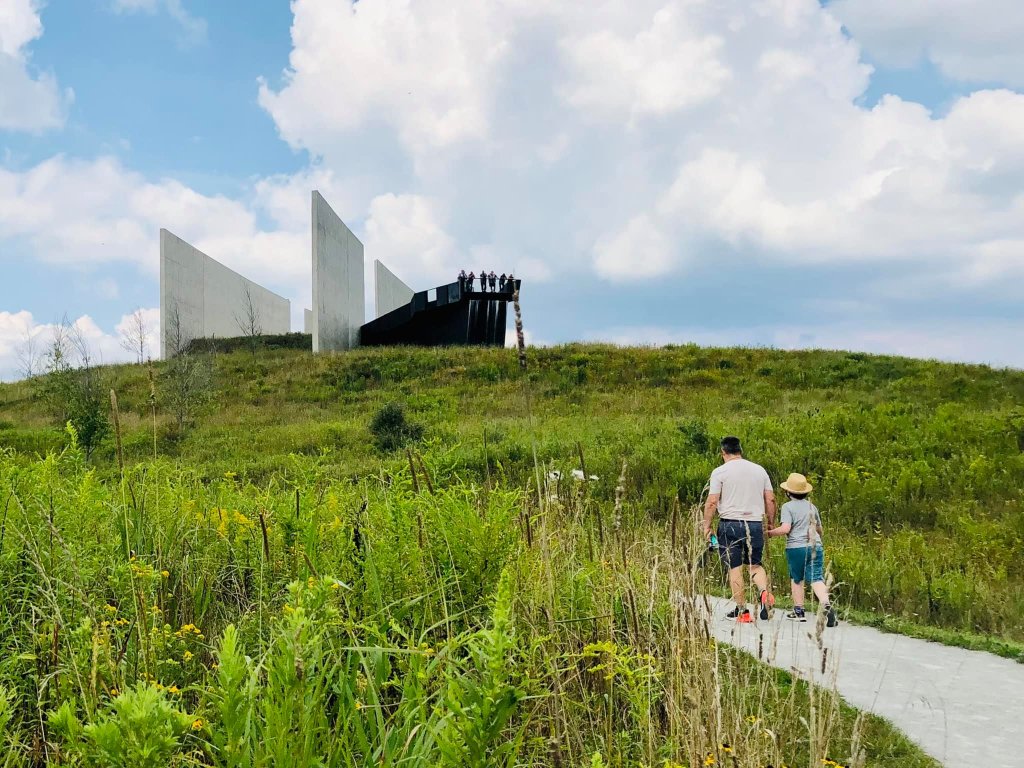
At the end of that, you walk out to a circular path that is just shy of two miles. Alternately, you could drive down to the memorial site for a much shorter walk to the wall of names. We opted to walk along the path and feel grateful we did.

There are wildflowers dotting the hills along the path and they look natural and unintentional, which is a mark of how successful the landscape architects were with their work. In a small sign, there is commentary that the whole place is meant to feel healing, both from the devastation and loss of Flight 93, as well as all of the mining that has occurred in the surrounding areas.

We all felt a sense of calm and peace as we walked towards our destination, that wall of names of crew and passengers. The beauty of the setting is undeniable. In the far distance, you can see the tree line where the plane crashed, the crater it created now just a memory. The only people allowed near the actual crash site are family members and loved ones of the deceased. That area is only visible from a far distance. That feels fitting for a sacred space. A large boulder marks the site of impact.

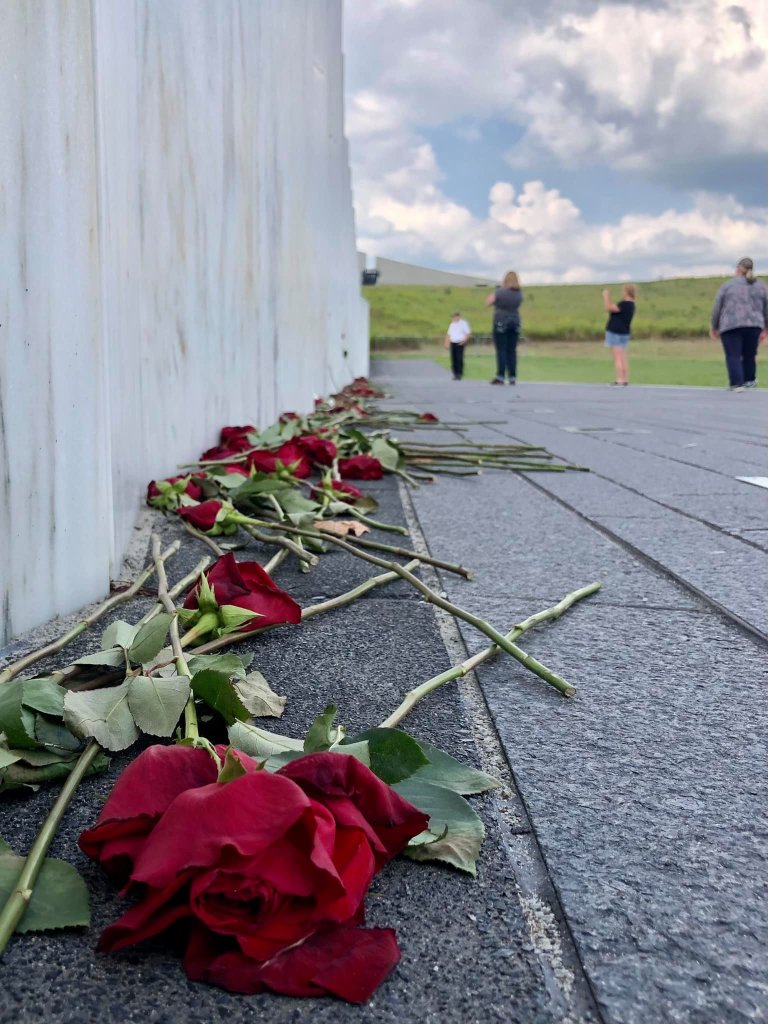
Park Rangers are available at the lower visitor area to answer questions and provide daily programming. The wall of names is quiet, both in design and volume. People leave roses, mementos, offerings. There is a large square gate made of local hemlock. This is how family members gain access to the impact site.

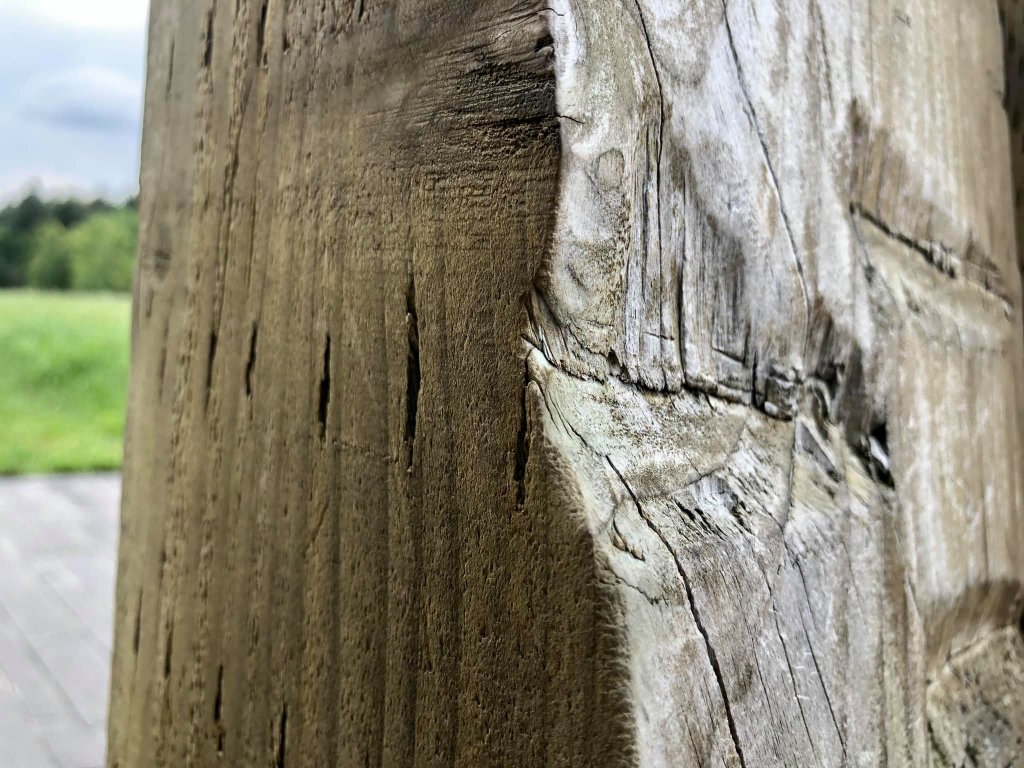
Gate used to access the site of impact, reserved for family and loved ones only.
Detail of the hemlock gate, which, to me, is mimicked in the concrete structures at the Visitor Center.

After paying our respects, we completed the circular path back to the main visitor center. There we walked back to the overlook where there is a glass railing inscribed with the words, “A common field one day. A field of honor forever.” I think about that word, ‘honor,’ and what it means. When you look to define it, you get a lot of hits about respect, high regard, and admiration.

“A common field one day. A field of honor forever.”

When you dig deeper, you might find these words, “honor is the idea of a bond between an individual and a society as a quality of a person that is both of social teaching and of personal ethos, that manifests itself as a code of conduct, and has various elements such as valour, chivalry, honesty, and compassion.” This definition feels more complete to me.

The crew and passengers of Flight 93 were a random collection of people — young and old, urban and suburban, Black and white and Latino and Asian, with different religions and political affiliations and experiences and points of view. They learned the fate of other commercial planes used by terrorists that day and some reached out to call their loved ones to say goodbye. They made a plan about how to proceed, then voted on that plan.

That detail really gets to me. This random selection of strangers came together under catastrophic conditions and voted about what to do, how to proceed. All within a 32 minute period. There is a lot of the best of humanity in those few minutes, that scant half hour. Learning your probable fate, making a plan not to submit, changing the course of history. These were not soldiers or first responders. These were middle managers and cubicle workers and college students and grandparents and moms and dads.

They are honor personified. I don’t know how much my kids will remember about our visit to the Flight 93 Memorial, but I hope they remember that.

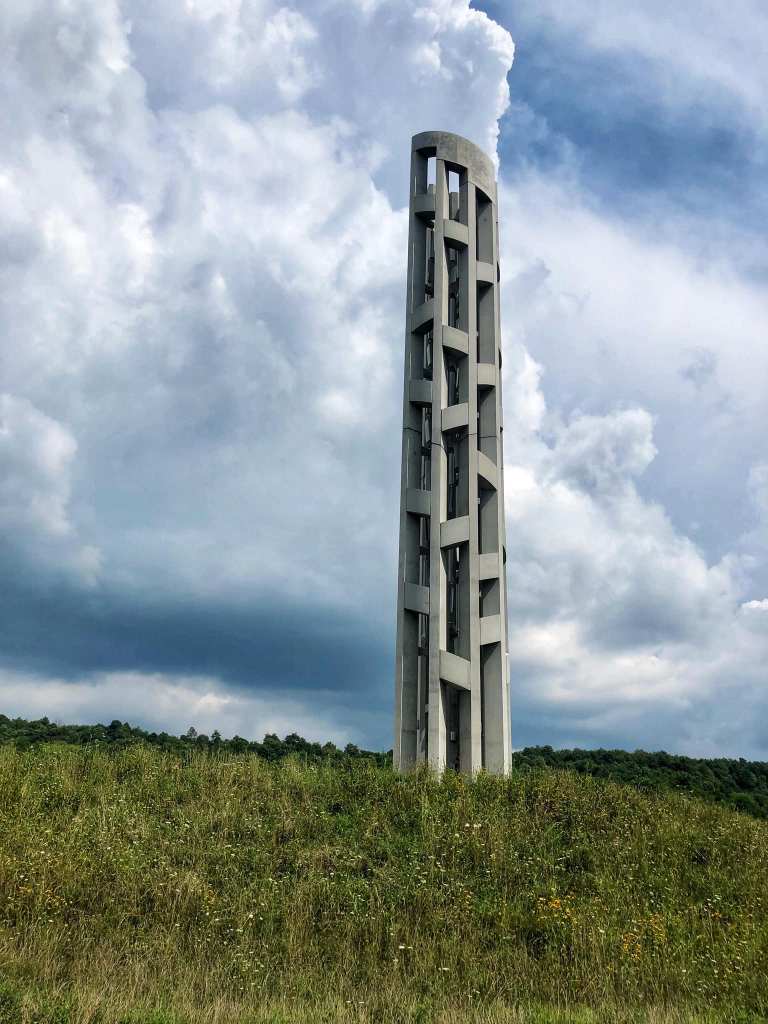
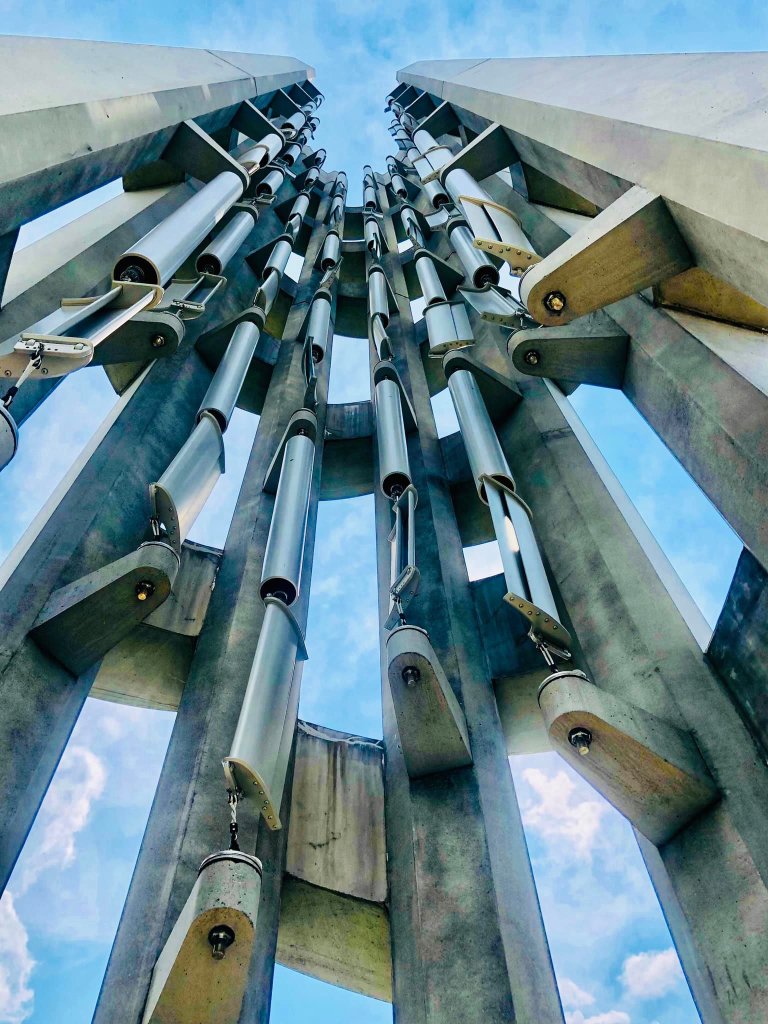
After getting back in our car, we again drove down the winding path back to the Tower of Voices, a 93′ structure of 40 individual wind chimes. The air on the day we visited was calm and mostly unmoving. No chimes to hear, though the structure, recently completed, was no less powerful, jutting into the air, creating a different kind of tower.

Detail of the forty wind chimes, one for each who perished aboard Flight 93.

Visiting the Flight 93 Memorial is something I would highly recommend. So many people came together to design a physical place made to memorialize and contemplate the values that are best about our American culture that the crew and passengers of United 93 exercised on that morning twenty years ago today — choosing to engage in collective, democratic action meant to help others in a time of great peril.

I wish all Americans would do this daily.

______________________________________________________________

NPR ran a moving podcast this week about Flight 93, the days that ensued, and the creation of the memorial. It is a must listen and you can do that HERE.

The New York Times Uses the President’s Grief to Exploit Political Divisions

In yesterday’s Sunday edition of the New York Times, where all the news is “fit to print,” they saw fit to run an article about President Biden’s grief. The lede involved the anger felt by the father of one of the soldiers killed in Afghanistan last month upon his meeting with Biden at the Dover Air Force Base. Only one of those bereaved parents was judged for their grief.

Spoiler Alert: It was President Biden.

The original headline of the article written by NYT reporter Katie Rogers looked like this:

After getting justifiably slammed on social media about the wording, the headline was changed to read, “In Invoking Beau, Biden Broaches a Loss That’s Guided His Presidency.” Sadly, the original headline was much more reflective of the actual text. The reporter seemed to revel in the anger felt towards Biden from a Gold Star father.. There was a glee and breathlessness to her writing that felt more like click bait than Sunday paper above-the -fold commentary.

The article was actually as much about how Biden’s grief rubs people the wrong way as it was about how it guides his presidency, which he himself has acknowledged time and again. And, here’s another spoiler alert for you, the people that Biden’s grief seems to rub the wrong way are all people who are of the GOP voting variety.

Surprise!

I tweeted yesterday minutes after reading the article, “It feels fair and predictable to me that Biden would use his grief in this way. It also feels fair and predictable to me that newly grieving parents would not give a fig about Beau, esp. if they voted for Trump.”

Just as it is understandable to me that Biden is compelled to bring up his son, it is equally understandable that a newly bereaved parent would not want to hear about that son. Both of those things can be true and neither of those grieving parents is wrong in that regard.

This NYT article serves to amplify the profound and destructive political division that exists within America today. Parental grieving, both fresh and less fresh, simply becomes the latest arena where Americans can be angry at one another. To what end? There was also the clear undercurrent, highlighted with quotes from unnamed sources, that Biden should simply move on already.

For better or worse, I am someone who knows grief intimately. I worked as a clinical social worker in a retirement community for a decade and during that time one of my duties was to act as the bereavement counselor/coordinator for the onsite hospice. Later, I would gain more personal insight into grief with the loss of my mother, father, and daughter, who, like Beau Biden, died of an aggressive brain tumor.

My grief is a defining part of who I am. It has altered and informed my parenting, my relationships, my career, my life choices, my perspective, my joy, and my sorrow. This is true of President Biden, as well, I am sure, just as it will be true of that Gold Star father who met Biden with his heavy and angry heart.

Shame on the New York Times and reporter Katie Rogers for exploiting parental grief, in all its many forms, to leverage and magnify our current political climate of deep and extreme division. I generally expect better from them than hit pieces you would more commonly find on FOX or in the pedantic op-ed pages of the Wall Street Journal. We should expect better than hot takes dripping with cynicism meant to slyly critique the grief of a bereaved parent, whomever that grieving parent may be.