Rosen v. Romney: The Mommy Wars Continue

Last night, Democratic political strategist Hilary Rosen referred to Ann Romney, wife of Mitt and mother of five sons, as, “never having worked a day in her life.”  For a political strategist, that was an incredibly impolitic thing to say.  I understand what her point was, but because of Rosen’s unfortunate language, her point is not really the point anymore, is it?  

I’m going to leave the politics aside, and focus on this decades long debate of the so called “Mommy Wars,” the tension, spoken and unspoken, between stay-at-home moms and working moms.  Technically speaking, though, I am already stepping in the Mommy Wars myself by referring to “working moms.”  To be clear — I know that ALL MOMS WORK.  Okay?  For the purposes of this post, Imma keep it simple and refer to these two camps with this language.

And the sad truth is that it does feel like two separate camps much of the time.  Mary Tyler Mom was started as a blog about “working and mothering simultaneously.”  It’s evolved a bit, but being a woman who works outside the home absolutely influences my perspective of mothering.  Just as being a stay-at-home mom influences others.

I am grateful to have a strong following on facebook (join the fun here, yo), with an active page of 5,300 plus followers, 96% of whom are women.  My facebook community is an anthropologist’s dream — a slice of life of today’s woman.  Most are moms, some are not.  Some of us work outside the home, some do not. 

With those demographics, one can glean quite a bit about how the Mommy Wars play out.  The ladies are often ready to rumble.  If I unthinkingly refer to myself as a “working mom,” I will quickly be reminded that all moms work.  My bad.  Mea culpa, SAHMS.  If I post about an interesting article I read looking at young Queen Elizabeth II as a working mom, some will quickly point out that QEII, with her army of nannies, was not a working mom. 

It’s a tight rope sometimes. 

What seems to be the common denominator is that women closely identify with their employment/mothering status and are quickly ready to defend it.  I often hear, “I wish I could clock out at 5 PM!” Or this one, “When does the stay-at-home mom get a weekend?” 

Really, guys?  Really?  Does anyone actually think that the working mom clocks out at 5 PM and her work is done?  Not a chance in dinner and bedtime hell.  Working moms clock out, race home to reunite with their kids, cook dinner, do laundry, shop for groceries, and clean their homes.  And weekends?  Forget weekends when you’re a working mom.  Those are reserved for all the things you were supposed to do after 5 PM, but chose to ignore so that you could read those books, drive to lessons, and snuggle at bed time.  The household duties claim much of the weekend for many a working mom.  It sucks. 

Alternately, there is some confusion from the working mom, too.  A fellow blogger wrote a humorous piece this week about being a “house frau.”  She talked about drinking wine in her yoga pants and organizing activities for her kids.  This gal got slammed and labeled a, “princess.”  Staying at home with the responsibility for two young kids under 5 is nothing that a princess would engage in.  As the QEII thread established, royals have nannies.  Most SAHMs do not. 

When I read divisive comments like that, flung from one woman to another, I cringe.  There is such a profound lack of empathy towards our fellow moms.  Ultimately, I think it relates to our own feelings about whatever circumstance we find ourself in. 

Who among us that is a SAHM does not fantasize, or at least wonder, what it might be like to leave the little ones with someone else for a bit and go out into the world.  Alone.  Untethered.  Inversely, don’t many of us working moms want to live in a wardrobe of yoga pants and enjoy the quiet of a napping child from time to time?  Of course, I generalize, but my point is that its human nature to wonder how green another’s grass is.

A better approach would be to understand and empathize that no matter what your responsibilities are and where they play out, a mother’s kids are most likely the center of her universe.  Not always, but that’s another post entirely.

Stay-at-Home Moms:  I challenge you to think about everything that you do over the course of your day.  It’s a lot, right?  You are one freakishly busy gal.  Now think about trying to squeeze that in after a long day outside the home.  Think about that working mom that wants more than anything to help her kid bring homemade cupcakes for the school fundraiser, and will be doing it alone, at midnight, rather than with their kid as a bonding activity, missing those cute patches of flour in one another’s hair.  Think about a child falling on their knees and crying for their Daddy when their Mommy is right there.  That working mom is going to feel intense stabbing pangs of guilt, thinking (illogical as it is) that a child is supposed to cry for the mother, not their father when they need comfort.  “Why doesn’t my child cry for me?,” she wonders, feeling inadequate.   

Working Moms: I challenge you to think about the sisyphean nature of child, child, child all the time.  The unending need to fill their time, keep them safe, teach them well, feed them, comfort them, clothe them, diaper them, entertain them, ALL THE TIME.  No lunch hour (or often even 15 minutes).  No commute home to clear your head for a few minutes as you shift gears.  No shifting gears most of the time.  Think about the 45 minutes it takes to get a toddler dressed, pottied, and out the door.  Now think about doing that 3-5 times daily.  Oy.  Think about not talking to another adult between the hours of 8 AM and 6 PM, and when you do talk, all you talk about are child issues or household issues that the other adult might not be very interested in.  That hurts.

We are all mothers.  Some of us made choices to stay at home and mother.  Some of us made choices to work outside the home in addition to working in the home.  For others of us, choice is a luxury reserved for mothers like Gwyneth Paltrow.  You work because you have to, not because you want to.  You stay-at-home because it is what was expected of you, or what you thought you should do, not what you wanted to do.  We are all guilty.  We all think we could be doing it better.  We are all mothers.

Easter for Heathens: Religious Holidays When You’re Not Religious

Apple Blossom Tree
Yesterday was Easter, which also happened to coincide with Passover — two of the highest of Holy Days in Judeo-Christian traditions.  For many, these days hold extreme relevance, for others, they are another day on the calendar.  For me, well, it’s complicated.

I was raised Catholic.  Irish-Catholic.  Parochial school education, Church every Sunday, Midnight Mass on Christmas Eve, fish on Fridays, two aunts who were nuns Catholic.  Hard.  Core.  Catholic.

Mary Tyler Dad was raised outside religion.  Jewish father, Christian mother, 1970s progressive New England parenting.  Outside religion, indeed.

Together, we are not religious.  You’ve heard the phrase, “There are no atheists in a fox hole?”  Yeah, well, Mary Tyler Dad and I sort of set up camp in the closest thing I could imagine a fox hole feels like, our Donna’s cancer diagnosis.  We spent over two years in that fox hole.  I came to believe that if you haven’t found Jesus Christ when your daughter is dying of cancer, well then, you’re probably not going to find Him.   And that’s okay.

I capitalize Him intentionally, because while I am not religious, I respect and appreciate those that are.  I never aim to antagonize others with my lack of belief.  On the contrary, I completely respect those with religion and faith. Sometimes I think my life would be easier if I did believe in one thing or another.

But that’s neither here nor there.  This is not intended to be a defense of atheism or agnosticism or faith.  What I want to consider is this idea of raising children without religion in a religious culture, specifically, how in the H-E-double hockey sticks (respectful, see?) do you explain religious holidays to a child when his family does not subscribe to a religion?

There is no easy answer.  What works for me may or may not work for you, which, oddly, is a bit like religion itself, isn’t it?

Easter Bunny

Let’s talk about the Easter Bunny.  For three year old Mary Tyler Son, the Easter Bunny is where it’s at.  He is a big fan.  Last week I asked him what he thought Easter was about.  “The Easter Bunny bringing me chocolate!”  Yes, his reply was about what one would expect from a toddler boy.  Chocolate and treats.  Of course.  And equally unsurprising is that chocolate and treats were just about my favorite thing about Easter growing up, too, despite my very religious upbringing.  Kids are kids.  Chocolate and treats are good and fun and yummy and special.  And for a three year old, chocolate trumps most anything else.

Knowing that in the absence of faith, I would not be providing a religious explanation of Easter, I tried to broaden young Mary Tyler Son’s perspective a bit in talking about Easter being a celebration of Spring, and more specifically, the return of life and growth after a long, cold winter.  Yeah, my three year old boy wasn’t too interested in that, preferring the treat bearing bunny with his basket of goodies.  And you know what?  That’s okay.  Mary Tyler Son is three.  He is allowed to fixate on sweet treats a few times a year.

As his parent, what’s important to me is  that in addition to this annual sugar rush on a Sunday morning courtesy of a fictional bunny, is the intentional and structured teaching of the appreciation of life, of the return to life, of the cycle of life that Spring confirms.

Egg Dyeing

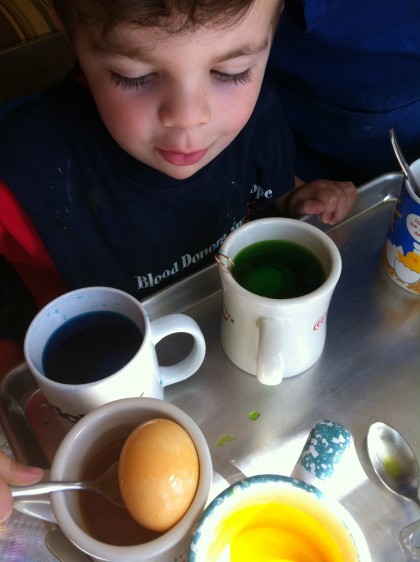
One way to do this, I learned this week, was the coloring of eggs.  Dyeing eggs was never on my radar.  My Mom never did it and quite honestly, it seemed a bother.  I mean, seriously?  Willingly introducing your toddler son to sloshing glasses of dye?  Are you kidding me?  And then arming that kid with eggs to fling in those sloshing glasses at will?  Well, I could not have been more wrong.  What better symbol of life than the egg?  It’s where we all started.  Each and every one of us.  And the wonder of taking something so basic as the egg and submerging it until it reveals itself in all its Easter glory — bright and lovely and colorful and wondrous.  Lesson learned — life can be messy, but so amazing, too.  (Thanks, Grandma.)

Another way to convey this is on a simple walk to the park.  We took a few long walks this past week and had some opportunities to see new growth in all its glory.  The Spring light is amazing — clear, fresh, intense, vibrant, bright. The color of the sky is different in April and May than it is in January or July. The light and changing green on the trees is more brilliant on that first day you look up from your winter stupor and realize that, yes, those green things on the branches are leaves that have indeed returned.  The four hundredth time you see those same leaves in August, I guarantee, you won’t even notice them.

Spring is a beautiful and profound and sacred return.  It is confirmation that light and warmth follow cold and dark.  Always.  Spring is our annual reward and promise as human beings that things do, in fact, get better, even in nature.  As a family who has buried one of our children, this promised and expected annual return to life and growth and hope is so very needed.  It’s why we planted tulips and daffodils and hyacinth and iris bulbs at Donna’s grave.  Even though, no doubt, the deer will eat them before I see them, the reality of that brilliant growth at the physical marker of Donna’s death is necessary and provides comfort.

Crocus

A facebook friend of mine, educated as a linguist (yes, I am blessed with amazing facebook friends; you can check out her super cool blog here), posted this yesterday:

Easter: from the Old English Easterdæg (meaning ‘Easter Day’), named for a Germanic goddess of fertility and spring. Her name (probably Austron, thought we have no written example) in turn indicates the celebration of the spring equinox, from the Proto-Indo-European *aus-, *austra- ‘to shine, sunrise, dawn’. Ultimately related to ‘east.’ Early Christians in England adopted the pagan goddess’s name and many of the practices surrounding her celebration, and grafted them onto the Mass of the Resurrection. 

Most other West Germanic languages — and Middle English — use(d) a derivation of Latin/Greek Pascha, from Aramaic Pasha, related to Hebrew Pesah or Pesach, ‘to pass over.’

So, looks like this heathen in is good company.  If the celebration of Spring was good enough for ancient cultures, it’s good enough for my family.

Long story short, if I am doing my mothering job properly, Mary Tyler Son will some day come to recognize and appreciate the glory of Spring himself.  He will teach his own children to love the light, trust the warmth, and plant those bulbs.  He will know that life is universal and that its cyclical nature is confirmation of something to be celebrated.

Maybe even with chocolate from a bunny.

Tulip, Lilacs, Eggs


If you like my stuff and want it hot off the proverbial press . . .

Type your email address in the box and click the “create subscription” button. My list is completely spam free, and you can opt out at any time.

Live Organ Donation: The Real March Madness

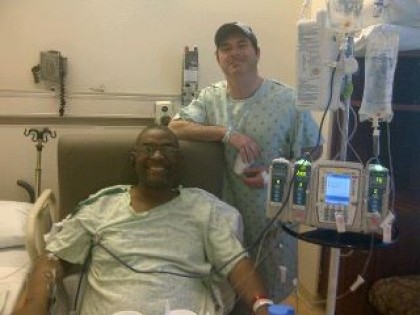
When last we left our heroes, Andy and Jeffrey were preparing to enter the hospital to remove one of Andy’s two healthy kidneys and place it in Jeffrey’s body.  When it is put like that, the blunt removal of one’s organ to insert in another, it sounds like an amazing feat.  And it is.  But it is also a well honed procedure and process.  Two weeks later, both men are doing well.

Andy and Jeffrey were admitted for the transplant on Friday morning, March 16, bright and early.  Andy was discharged on Saturday and Jeffrey on Sunday.  Think about that.  Amazing.  A little zip, a little zap, some pain meds and BAM, you are home on your sofa either having saved a life, or having received a new lease on life.  Amazing.

Checking in with Andy, our donor hero, discharged just a day after the transplant surgery, he says it took just over a week, eight days, to feel more himself.  He was prescribed narcotic strength pain meds through Sunday — 48 hours post surgery — and then some over-the-counter pain meds did the trick.  In that week there were lots of naps, lots of itching from healing wounds, and a sense of , “having eaten ten thousand pounds of Taco Bell every day.”  Andy describes pretty intense nausea and indigestion.  But again, eight days later, Andy had a busy day, out of the house all day and returning to his schedule.

For Jeffrey, our recipient hero, recovery has been a little more complicated. Two weeks later, Jeffrey is feeling fine and resting at home.  He was originally discharged 48 hours post surgery and describes the initial recovery as more painful than he thought it would be.  There has been a blip, as there often are with major surgeries, and Jeffrey was rehospitalized last weekend for intense pain and signs of rejection.

When I first heard the news, in a text from Andy, my stomach dropped. Rejection is the worst possible word a transplant patient could hear.  It’s like relapse for a cancer patient.  Jeffrey himself texted me a couple days later, as he was being discharged.  Both men, in their inimitable low key way downplayed the situation.  I got these texts and assumed the worst.  Our heroes knew better.

Through routine, scheduled blood tests, Jeffrey’s transplant team detected the first signs of rejection with changing blood levels.  They were able to admit Jeffrey and reverse those troubling signs.  This, apparently, is not uncommon.  Jeffrey, ten days out from the surgery reported to friends and family on Facebook, “Good morning Facebook family. I am truly on the mend. I’ve had back spasms, insomnia, nausea, vomiting, lack of appetite, serious constipation, fatigue, and constant pain in my side for a little over a week, plus the need to urinate every 45-60 minutes since Friday and you know what? I’d take ALL of this over kidney dialisys 8 days out of 7.”

In talking with Andy and Jeffrey about their experiences, both pre- and post-surgery, I was again struck by just how easy they seemed to be about a major, life-altering surgery.  The way they communicate about it is similar — few words, low-key approach, sensible, matter-of-fact language, and non-emotive.  They have that in common.  Another thing they have in common is the bond of sports.

Me?  I don’t know from sports.  They’re lost on me, but my interest was piqued.  Is this the thing that brought these two men together?  I mean, there’s over a decade that separates them, their kids even more than that. There’s the finance thing, too, but not having worked together for five years, it’s easy to lose touch.  But these men didn’t.

When they first met, they found a common denominator in their love of sports.  Andy describes that they had similar communication styles and work ethic.  They talked baseball.  They soon learned that they both had side jobs with sports, too.  Andy was a freelancer for ESPN, covering high school sports, and Jeffrey is a referee for IHSA football games.

As they talked more about sports and their connection, I started to get it.  It’s like shoes for women.  I hate to be so reductive, and you know I am not down with gender stereotypes, but I can’t tell you how often I have opened up a conversation with a female stranger or acquaintance with a shoe comment or compliment.  There is a shorthand with shoes and sports that instantly bonds those who get it.  You know exactly what I mean, don’t you?

Andy describes it as being, “easier to engage someone who likes sports.” Their mutual appreciation transcends boundaries and cliques, which I was interested to learn happen just as frequently in male social culture.  When Andy revealed to Jeffrey that he was a soccer fan, that told Jeffrey something about Andy.  And when Jeffrey states his preference for the Cubs over the Sox, that tells Andy something about Jeffrey.  It’s like me preferring closed toe kitten heels over peep toe platforms!  Seemingly, what is the bonding factor is not so much Cubs over Sox or soccer over football, but the fact that there is the appreciation for the sports in the first place.

When I asked Andy if he and Jeffrey had lacked the sports connection, would there still have been a kidney transplant, he didn’t hesitate to say, “Yes.”  When I asked Jeffrey the same question, he was a bit more circumspect, “I would like to think my personal magnetism was what did it, but in all truth, sports was the basis of a lot of our connection.”

Also interesting was the role sports had played for both men growing up and as adults.  Not only are sports a social outlet and extra stream of income, but something that helps both men define themselves and cope with the struggles of everyday life.  Andy found solace in watching professional baseball after 9/11.  The orderliness and predictability of the play brought comfort.  There’s also that sense of the universal appeal of simple things — baseball, hot dogs, apple pie, and Chevrolet.  It’s why someone like me who is not interested in sports can be captivated by Rocky or Bull Durham or The Fighter.  There is a humanity in sports that is accessible to all.

For Jeffrey, his football officiating played a role in his kidney disease and how he coped with it.  Diagnosed with kidney failure in July 2010, he had to sit out the entire football season, which started just a few weeks later.  Early on, he went to a game and saw his crew doing their thing.  It was too painful to sit on the stands, so he left.  He describes the “severe withdrawals” he felt on Friday nights.

Things had stabilized by the 2011 season, so Jeffrey went back and to his humble delight, reclaimed his white hat.  He was back on the field doing something he loved.  He recounted his own high school coach, “He taught me to be a man before I knew what a man was.”  Now that’s deep.  When he said that, I kind of instantly understood how and why Andy and Jeffrey were drawn to one another.  There is immense humanity in that statement.

Jeffrey went on to describe officiating high school football and working with kids and coaches.  He described how the game is not about an individual player, but the team as a whole and that the best coaches get that and are able to teach that.  “The game is not about kids.  The game is about the team and doing the right thing the right way,” Jeffrey said.

And then, in a flash, it all makes sense to me.  It makes sense to me that despite not socializing, or maintaining close contact through the years, or having loads in common, Andy would donate a kidney to Jeffrey.  For these men, with their similar styles and approach to life, it’s about the big picture. It’s about doing the right thing.  It’s about making decisions that are right for the whole rather than the one.  It’s about supporting a teammate.

Kidney Friends

Good Lord, they may have made me a sports fan.