
This will be the first of several posts covering the live kidney donation of Andy to Jeffrey.
“It was the best of times, it was the worst of times,” wrote Charles Dickens in A Tale of Two Cities. Live organ donation is a bit like that, too. Come to think of it, life is a bit like that. Funny how dichotomies work that way.
On Friday morning, my friend and fellow blogger Andy will be donating one of his healthy, functioning kidneys to his former colleague, Jeffrey, who has not been quite as lucky in the healthy, functioning kidney department. Both are husbands, both are fathers, both are sports fans, both work in finance. And that’s pretty much it — the ties that bind them together aren’t especially strong. Andy and Jeffrey are not what you’d call, “tight.” Nor are they in the midst of a torrid bromance. The extent of their connection is a phone call every eighteen months or so, catching up on professional matters.
So how do you get from there to here? How do you get from infrequent phone contact to settling down to the business of donating a vital organ?
Well, it starts with a need. Jeffrey needs a kidney. In early 2010, through routine medical tests, docs started to notice some changes in Jeffrey’s kidneys, though nothing alarming. After several months of tests, that alarm did sound in July 2010. Jeffrey got a message to stop by the doctor’s office for a blood test on the way home from work. Later that evening, the doc phoned Jeffrey at home and told him to high tail it to the hospital first thing the next morning. Do not pass ‘GO,’ do not collect $200. Jeffrey’s kidneys had entered acute failure.
Kidney failure is not pretty. It is, in fact, quite ugly. Their function is two-fold: to clean our blood and remove excess fluids and waste through our urine. They absorb the good and get rid of the bad. Simple as that. But there is nothing simple when they fail. Managing kidney failure as a chronic condition is tedious, arduous work. It involves dialysis, the medical-mechanical miracle of removing our blood, cleaning it, then returning it back to the body. Additionally, dialysis also removes the excess fluids and waste that many kidney patients do not void naturally. Well, that’s the blogger’s version of dialysis, at least.
When Jeffrey went into acute renal failure, his life changed in an instant. Snap. Just like that. In order to function, he was now dependent on three times weekly, four hour dialysis sessions. He described it to me as, “both a treatment and a disruption.” Because of my Cancer Mom street cred, I totally got it. It is a complicated thing to live amidst illness. There is a constant need to balance hope and fear and fatigue and worry and symptoms and optimism and realism. It’s a tough gig.
From everything I’ve heard from and about Jeffrey, he walked that medical tight rope well. He described entering the crowded waiting room at the dialysis center, every chair filled with people waiting on kidneys, dependent on machines to keep them at certain degrees of functional. Jeffrey being one of the more functional, “I thought, ‘Why am I here?'”
Think about it. Four hours of dialysis, three days a week. Four hours of being hooked to a machine that is the bane of your existence, but the only thing keeping you alive. Then there is the travel time back and forth to said machine. The settling in and getting accessed — someone’s got to manage those tubes that carry the blood. And we haven’t even discussed the 8-12 hours of debilitating side effects that follow every session. Conservatively, that’s 14 hours, three days a week. Damn.
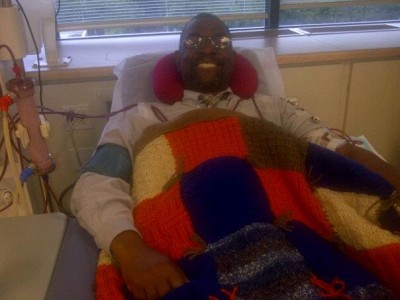
Jeffrey talks about the burden of managing chronic illness when you don’t look ill. It’s hard to appear healthy and able, but not feel it. He has been living with dialysis for almost two years now. Early into his kidney failure and new to the dialysis grind, he got some advice that has served him well: “Don’t hate it; embrace it.” Jeffrey works to follow that sage little nugget daily. “I handle it the way my parents would have wanted me to,” he told me. He also talks about the simple necessity of doing what you need to do, “Be a man, face it, and move forward. Don’t let it overcome you.” And then he quietly brings up living with your mortality, “You see it and you know it’s there.”
Like I said, it’s a tough gig.
Enter Andy and his healthy, functioning kidney. Said kidney was kind of burning a hole in his pocket. You see, Andy had been approved and scheduled to be a live donor to another individual in January. Days before that operation, fate intervened and the intended recipient was gifted not only a kidney, but several other necessary organs after the untimely death of a stranger. Organ donation, yo. It is serious business.
In the midst of prepping for his first recipient, Andy learned about his former colleague’s need for a kidney. When his first recipient received another kidney and all looked well with her recovery, Andy contacted Jeffrey and made the offer of a lifetime. Literally. For Andy, it was simple math — he had two and Jeffrey needed one.
I’ve spoken with Jeffrey and Andy and what struck me most about how they’ll be spending their Friday morning in dueling ORs, is how stereotypically male they’ve both been in brokering this exchange. Andy does not wish to be lauded for his offer of a kidney, to the contrary, he is the reluctant hero of this tale, “I’m not a pay-it-forward kind of guy, not altruistic, or with a grand philosophy.”
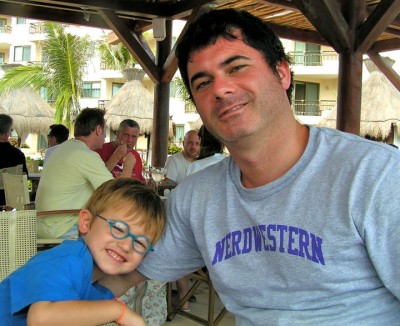
It’s hard to believe that, but having spoken to him a few times about it now, I do. “I’m not bringing fears and emotions into this,” says Andy, “I feel like people should step up and do what’s important.” So that is precisely what Andy is doing. No bells, no whistles, no ticker tape parade. Andy is simply doing a good thing. And doesn’t want the fanfare that most would gladly heap upon him.
On Friday morning, two men will travel to Northwestern Memorial Hospital’s Kovler Organ Transplantation Center and their lives and organs will intersect. Ordinary people are capable of extraordinary things, folks. Andy will prove that with the surgery. Jeffrey has spent the better part of two years living that. We never really know what we are capable of until we are faced with it, or until we challenge ourselves. And I remember again Dickens’ words, “It was the best of times, it was the worst of times . . .” Through bad we can know good. Through challenging circumstanes, good can come. I wish both these gentlemen well.
If you are interested in learning more about live kidney donation, it starts with a questionnaire that you will find here. Read about the life saving work of the Kovlar Organ Transplantation Center here. And Andy will fill you in on some pretty impressive kidney recipients here.


 Mary Tyler Mom