Reading this Stranger’s Obituary Will Make Your Day

Janet Tuck was born in in Aurora, Illinois in December 1931.  She died two weeks ago, surrounded by family, in North Carolina.  I don’t know Janet or any of her family, but came across her obituary this morning while I was scrolling through Facebook.  A friend, also unknown to Janet or her family, had posted it after reading it in the Chicago Tribune.  Janet’s story moved her enough to share it. Hours later, I am still thinking about Janet and her life.  Man, what a good life.  Read it HERE, then come back so we can discuss.

Janet Tuck, 1931-2017, courtesy of obituary published in Chicago Tribune
Janet Tuck, 1931-2017, from obituary published in Chicago Tribune

Are you crying?  I cried the first time I read it, too.  As far as obituaries go, it is lovely and beautiful and sweet and such a touching tribute to memorialize Janet’s well lived life.  The sensitivity in which memory loss is treated felt like a gentle guiding hand of loving reassurance.  I spent a decade working in a retirement community, each day talking and interacting with older adults at various stages of dementia.  If you love someone with Alzheimer’s or dementia, you could only hope this type of compassionate empathy was offered them as they navigated through the shards of what is no longer a life they always recognize.

The wording of Janet’s obituary is like an invitation into her life, a dream sequence, a premonition of comfort.  It reads like settling in with a good book on a cold rainy day, blanket around your shoulders, cup of tea steaming at your side.  I salute the author who clearly wrote from a place of deep love and respect, a daughter I presume.  Having someone like that write your obituary is just another sign of a well lived life.

Janet seems so damn likable.  A perfect combination of artist and friend, equal measures of capable and adventurous.  We get to know her, albeit so briefly and superficially, as a daughter, a sister, an independent young career woman, a wife, a mother, a gifted artist and partner.  I want to know Janet more.  I want to be her daughter and her friend and her partner, too. Full disclosure, I kind of want to be Janet.

Us voyeurs only get a glimpse of her, a smiling young-ish face, head tossed back in wide smile.  She looks happy.  Genuinely happy. She looks free and self-possessed.  Reading about her life gives a window into how and why Janet is able to be all those things.  Are there lessons we can learn from reading about Janet’s life after her death?  Or is it merely enough to read about such a satisfying life and feel fortified, even via the medium of words on a screen?  I don’t honestly know.

Magic is mentioned in Janet’s obituary and that word feels especially appropriate.  Sometimes, when we’re lucky, life is magical. Reading about the life of Janet Tuck, a stranger to me, feels like a bit of magic.  I am inspired, reflective, content, just having learned about her life and the love that surrounded her.  That is, indeed, magic.

Rest well, Janet.  May you only know peace and sunshine and those who loved you be comforted by your memories.

_________________________________

You may see some of Janet Tuck’s art HERE.

When the Potatoes Stay the Same: Lessons in Change

So much in life changes.  Some changes are welcome and good, but others just plain suck.  Some changes are life altering, while others serve as a momentary nuisance.  There was that time they stopped making my favorite chocolate scented shampoo (waaahhh), and then there was the time my first born was diagnosed with cancer.

Ch-ch-ch-ch-changes . . . turn and face the strange.

Easter Sunday was an exercise in facing the strange for me.  My family enjoyed a lovely brunch with a couple of other families from my son’s school.  Such good people, such good kiddos.  The restaurant was an old favorite of mine that happened to be close to the hospital where our daughter was treated.

I had avoided the area for months, as the hospital was undergoing demolition.  It’s hard to explain the significance of that, but I knew enough to know it would hurt to see it.  Another huge part of our girl’s life just gone.  Vanished.  Poof.  Next to our home and her dance studio, Chicago’s old Children’s Memorial Hospital was Donna’s home.  She loved it there.  She grew up there.

As my family and I approached the intersection of Lincoln and Fullerton and Halsted and I saw it for the first time, now just a fenced in empty lot, we made a sharp right to get to the restaurant.  My eyes welled up and tears popped out, but it was time to eat, time to be social, time to celebrate Easter.  I took a deep breath and drove on.  Ch-ch-ch-ch-changes.

Cafe Ba Ba Reeba! is a sprawling tapas joint that is owned by one of those restaurant conglomerates that creates dining experiences. When I went there in my 20s I thought it was exotic and sophisticated.  In my 40s I know it is really more like a Spanish lite experience with delicious food and wine.  And that’s okay.

There are smaller, more authentic tapas restaurants, but this was my first and I am partial to it.  Also, I am about as provincial an eater that exists, so, truth be told, eating there still feels a wee bit exotic and sophisticated to my narrow palate.  It is the first place I drank sangria and shared small plates and tried goat cheese.  Goat cheese!  It’s now a staple in my three year old’s diet, but I was well into my 20s before I tasted it.  Who knew?  Turns out, a lot of folks did.  So good.

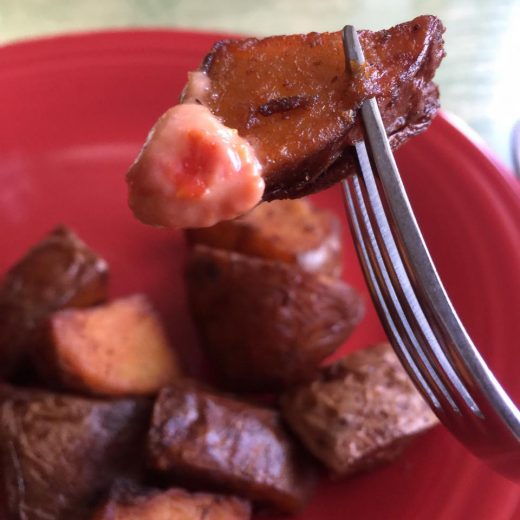
Anyway.  I knew when the restaurant was chosen that I would order the “patatas bravas,” described on the menu as, “spicy potatoes with tomato alioli.”  I first ordered these when my college roommate and I, now both single and living our best young adult lives in the big city, would go to Ba Ba Reeba! for after work happy hours.

Patatas bravas, Cafe Ba Ba Reeba!

For under fifteen bucks we could order a plate of these most delicious potatoes that would fill up our bellies and a half carafe of sangria, a full carafe if we were feeling rich or reckless.  All the major food groups were covered — starch, alcohol, fruit, and dairy.  We sat in the front window by the bar, looking fresh and cute in our early 20s version of office chic, and talk about the rest of our lives. There was tremendous comfort in those potatoes and camaraderie.  They were good days.

As the years passed and I started graduate school and met my husband and spent less time with my college roommate (Ch-ch-ch-ch changes . . .), I continued to eat those potatoes, albeit not as frequently.  They were always the same.  Always perfectly cooked.  Always just the right size (I hate too large potatoes).  Always spiced the way I like them, with a bit of heat, but not too much.  Always served with the creamy alioli, that I quickly learned was just a fancy word for mayo with flavor.  Life changed, but the potatoes stayed the same.

With two young boys, my dining in restaurants that don’t qualify as “fast casual” and exist within a 12 minute drive from our front door is fairly limited.  Cafe Ba Ba Reeba! is not especially close to our neighborhood, so it’s an intentional drive.  And, possibly, my husband doesn’t have the same emotional attachment to starch that I do.  That’s why this Easter brunch with friends felt extra special — a built in reason to eat my favorite potatoes with folks I love.

The patatas bravas did not disappoint.  And just like I did in my 20s sitting at the bar, I ate a whole order to myself.  I do now, as I did then, demonstrate the worst of tapas etiquette.  And my friends now, as they did then, forgive me.  There is a tremendous comfort to be found in knowing that those perfect little potatoes exist over two decades of my life.  My whole formative adult years have been made just a little bit better and spicier and creamier because of those particular potatoes.

My life has been challenging and blessed in so many ways.  Ways I never, ever could have anticipated sitting at that bar eating and drinking with my college roommate.  The life I have today is entirely different than the one I imagined for myself.  That doesn’t make me special or unique.  It does make me human and being human can be hard.  And that is why, precisely, the unexpected pleasure of potatoes that are as comforting and delicious in 2017 as they were in 1994 is a gift — a time machine fueled by starch and memories and anticipation and acceptance.

Nothing better.
Nothing better.

Here’s to patatas bravas.  May they never change.

8 Life Lessons From My Son’s Sensei That I Could Use Myself

I’ve been meaning to write about the benefits of my older boy taking karate lessons for a few months now.  It was going to be a sweet little post about how young kids benefit from the discipline that is encouraged at a dojo.

As a mom in this era of “respectful parenting,” where empathy is seemingly valued above all else, sometimes to the exclusion of discipline and boundaries, I’m not going to lie, there is a certain thrill in watching a sensei (gently) chew out a kid who is acting the fool.

Full disclosure, I was a little kid in the 1970s with an authoritarian father, so discipline is my jam.  When expectations around behavior are clear and understood, even knowing they will not always be achieved, I think the whole parent-child relationship is easier.  Kiddos need boundaries.  Heck, we all need boundaries.

And, lest you respectful parents who are reading this get angry that I am missing the point — that of course there are boundaries at use in respectful parenting, that’s cool, but in so many of the threads I read online, holy moly, the roles and boundaries seem very confused, like allowing a child to refuse shots at the doctor.  Nope.

Anyway.  Ahem.  What were we talking about?  Oh, yes.  The wisdom of my son’s sensei.

In preparation for that post I thought I was going to write, I started recording some of what the sensei says in class.  Sensei Ray is old school.  He requires discipline, respect, and focus in the dojo and believes a room chock full of five to twelve year olds is capable of achieving those things.  It’s quite inspiring, actually, because, for the most part, the kids do.  “Spirit and focus,” is his mantra and I use it often when we get to the drudgery of homework, tooth brushing, and chores.  Trust me when I say that a kid who is brushing his teeth with spirit and focus is bound to get fewer cavities.

Spirit and focus! Thanks for the lessons, Sensei Ray.

Here are eight of the lessons Sensei Ray regularly talks about in karate class that I would be wise to apply to my own middle aged mom life.  Spirit and focus, ladies, spirit and focus.

  1. If you want to learn more, listen more.  This is a universal.  It works everywhere — at home, at work, at school, at your place of worship, in your parenting, in your relationships.  Start exercising those ears!
  2. Strive for perfection knowing it is impossible.  One of the potholes of motherhood is thinking perfection is attainable. Pinterest makes millions off this false belief.  The value is in the trying, not the flawless end product.  And I think our kids realize when we are beating up ourselves or them for not achieving perfection.  Be gentle with yourselves, be gentle with your kiddos. Try hard.  Always try and never stop trying, but know the trying is what is important, not the perfection.  And for my bright boy who gets frustrated with things that don’t come easily, this is key.
  3. The class trains together and gets stronger together.  For me, this one is about family.  I think I don’t always do a good enough job of bringing us together.  Older boy does this, younger boy does that, dad does this, mom does that.  The inspiration I take from this lesson is to engage in more family time.  Oh!  And yes, exercising as a family can only be a good thing.  More this.
  4. Be amazing.  We are all amazing.  The real question is whether or not you believe it.  You should.  You are amazing.  Believe it. Act accordingly.
  5. If you’re comfortable, you’re not doing it right.  This is good stuff.  When I used to mentor social work grad students, I always knew that the tasks that made them the most uncomfortable were the ones we needed to focus on.  They hated me, but it made them better social workers.  A bit like my son, when I deem something too challenging, I tend to avoid it.  At all costs.  That’s not good.  To keep growing and changing and developing, even as a 47 year old gal, I need to endure the challenge.  Welcome it, invite it, get comfortable with it.
  6. Be loud to make your presence known.  I love this.  Writing this blog for the past six plus years is a way that I shout and am heard by hundreds and thousands without even leaving my living room.  Gun violence, social justice, public education, racism, feminism, kindness and empathy, pediatric cancer advocacy, and neck moisturizer — these matters are all so important to me. They influence my life and through my keyboard, I am able to influence others.  Don’t ever be afraid to be loud, ladies. And don’t ever allow yourself to be silenced.
  7. Even in a stance, you should be sweating.  This one is deep.  And deceptively complicated.  And somewhat overwhelming. What I take from it as a mother is to remember to be strong and engaged even in the down times.  Mothering is hard on the bad days, but it’s hard on the good days, too.  Be present, be engaged, focus.  If you’re making a peanut butter and jelly sandwich for lunch, if you’re wiping off the pee in front of the kid’s toilet, if you’re turning clothes inside out before they hit the laundry, if you’re taking a walk with your three year old and frustrated that it takes 30 minutes to get to the corner, can you find a space in those moments where you see the beauty in those things?  Refer to lesson number 2 above when you need moral support with this one.
  8. The minute we stop following traditions, they go away.  As someone who was raised in a strong Catholic family of six, with none of us kids practicing the faith as adults, I know this to be true.  As someone who was raised as the granddaughter of four European immigrants who worked so hard to assimilate to their new American home, I know this to be true.  As someone whose parents are both dead and gone, I know this to be true.  When traditions die, it is a loss that can be impossible to reverse. The passing of some traditions is a good thing (slavery being a prime example), but the loss of other traditions puts us at risk for becoming too homogenized.  Think carefully about integrating and celebrating traditions while living your best woke life.

There they are — some of Sensei Ray’s best life lessons that will help you as much as your kids.  And whenever you’re in doubt, just remember, spirit and focus, ladies!