When Choosing Hope is Hard: Some Thoughts On Modern Life

These days . . .  they are hard.  Brutal days, for so many people.  Being gay isn’t easy.  Being black isn’t easy.  Being Latino isn’t easy.  Being Muslim isn’t easy.  Being a police officer isn’t easy.  Being a woman isn’t easy.  Hell, even being a Trump supporter isn’t easy these days.  Nothing seems easy these days.  We are angry.  So many of us feel angry these days, myself included.  It is exhausting.

When my daughter was going through her cancer treatment, my salvation was hope.  The trick, though, was in having to choose hope.  I learned quickly that when I chose hope, in whatever manner that presented itself, my life was made easier.  That active choice to hope, to believe, helped make my unbearable life bearable.  Hope guided me to savor the moments with my girl, to keep the focus on her, to believe we would be okay, despite the wreckage of cancer.

In my grief, choosing hope guided me, too.  In every way.  Hope allowed me to put my feet on the floor first thing in the morning, change diapers for my surviving son, find joy in places large and small.  Hope is what brought us to adopt our youngest son.  Hope is what allowed us to heal when our open adoption was closed.  Hope saw me through six months of illness with my Dad when there were days he was full of rage and vile insults, a cancer growing in him, changing him, that we had no idea existed.

Hope has been my religion, in a very literal sense.  An external structure, a faith, that provides support and comfort in difficult times.

These days, though, choosing hope is hard.  Really hard.

My son is a student in a Chicago public school.  There are constant threats of cuts, closures, and strikes.  Literally every day of his formal education has been a challenge on some level.  Gun violence in Chicago staggers the mind.  The numbers have a numbing effect.  We live in Illinois, a State that has existed without a budget for two years now.  Our elected officials spend more time blaming and posturing than governing.  Social service agencies that have existed and served vulnerable people for over 100 years are closing their doors and no one seems to care.

There has been great strife in my son’s school since January.  Grown adults acting like horrible, ill behaved children.  I have been the subject of rumors and mean girl campaigns that have had me in tears more often than I care to admit.  Acquaintances literally stop talking when I approach, then walk away.  Others challenging me with lies and accusations about me, not wanting to accept the truth I offer.  It has made me realize that if a community of local parents with a common interest can not make things work, why should we expect more from the politicians in our capitals?

I spend too much time on the Internet for professional reasons, and the imbalance skews me, perhaps hardens me.  There is so much outrage on the Internet, leaving not a lot of room for nuance.  There is an Old West “good guy” or “bad guy” mentality that develops.  People want to know and label where you fall on any number of issues.  We take one another’s temperature with close screenings of words and status updates that may or may not be accurate, then judge accordingly.  It is easy to become jaded and defensive.  Too easy.

Guns and rape and gorillas and religion and politics divide us.  I honestly have started to consider the possibility of a modern civil war erupting in the US, as it feels we are hurtling in that direction at an alarming rate.  So many of us seem to live in a place of fear.  We fear difference.  We fear violence.  We fear authority and the government.  We fear one another.  We fear guns.  We fear gun control.  As someone who lived in fear for two and a half years, I can tell you that it messes with you. Living in fear is not a healthy state of mind.  It changes you in ways that are potentially devastating.

This weekend a dear friend, in confidence, told me I was not handling myself well online.  That I was making myself a victim instead of listening to others who had been victimized.  Her words stung.  Still do, honestly.  I keep thinking about them.  This morning, wallowing in this sense of helplessness and hopelessness I feel, I appreciate that I feel victimized.  It’s no one’s doing.  It’s simply a consequence of living in the world today, feeling victimized, feeling powerless, living in fear. Allowing that fear, that sense of victimhood to bleed into my day-to-day, well, that ain’t cool.  It’s paralyzing and counterproductive and proof of an absence of hope.

Dammit.

So now what?  Now I have to work at choosing hope.  I have to try hard.  Then, I have to try harder.  I have to, perhaps, step away from online stimulation.  I have to take nature walks.  I have to play with my boys.  I have to dance.  I have to remember the people I love who have left me and the lessons they taught.  I have to believe. I have to find faith.  I have to go to the joy.  I have to remind the people I love that I love them.  I have to revel in the snuggles of my toddler and the clever of my young son.  I have to commit to change.  I have to use my voice.  I have to surround myself with art.  I have to read other people’s words, swim in their stories.  I have to appreciate a rain drop and a flower and the curve of a branch.  I have to pay attention.  I have to take care.

There is an artist from Kentucky that speaks to me.  Charles M. Laster, C.M. to his friends.  From the moment I first saw his art at an Outsider Art Fair in Harbert, Michigan back in 2009, in the days when my girl was still alive, but we knew she was dying, his art moved me.  I have felt, in looking at his work, that he is a fellow traveler in life who sometimes stumbles, but whose hope keeps him going.  His art is eternally hopeful, I think.  Today, in the midst of my wallow over Orlando and Stanford and Chicago and all places touched by violence, I glanced at a piece of his art I was lucky enough to purchase this winter.  This is it:

The back of this piece says, "If the little creatures can find a meal always, you will also be fed.  Always.  Believe."
The back of this piece says, “If the little creatures can find a meal always, you will also be fed. Always. Believe.”

C.M. reminds me to believe.  To believe is my responsibility, one that, I hope, leads to a better quality of life.  One that allows me to raise my sons to be kind and compassionate men.  One that allows me to power through times of uncertainty.  One that allows me to forgive and ask for forgiveness, whatever is called for in any given moment.  One that I can breathe and sleep and experience and live.

I needed a sign today, a reminder to hope, to choose hope.  I found it on my bookshelf.  I am grateful.

The Dao of Da: “That’s What Bumpers Are For!”

This is the second in an occasional series where I will try and capture some of the life lessons my Dad (Da to his grandchildren) taught me through the years, the goal being to preserve them for his children, grandchildren, nieces and nephews. 

Lesson 2:  “That’s What Bumpers Are For!”  

My Dad loved to drive.  Loved it.  He was proud of his driving abilities, enjoyed the independence a car symbolized, and had a knack for finding used Cadillacs being sold by little old ladies who only drove their Sevilles and DeVilles to church on Sunday mornings.  He spent most of his working years in the railroad and public transit.

When I was an itty bitty little girl, my Dad drove a bus in Chicago for a short while.  One summer day, much to the surprise of the entire neighborhood, he pulled up in a city bus in front of our suburban home.  Kids across the neighborhood packed onto that bus for the joy ride of their five and six and seven and eight year old lives. Liability be damned.  Aaaahhh, the 1970s were an awesome time to be a kid.  My Dad was a certified hero that day.

CTA bus, or 1970s childhood fairy tale?

The truth is, I have dozens and dozens of stories about my Dad and transportation.  It was his jam, you know?  After my Mom died and he began his life as a bachelor, his walls were littered with framed prints of steam engines, buses, trains, carriages, depots.  Going places and how to get there were matters of great interest to him. There was not a neighborhood in Chicago he couldn’t drive through with authority, maps an unnecessary nuisance to him.

While it was a high school gym teacher that taught me the specifics of driving, watching my Dad throughout my lifetime provided the nuances of driving.  He added the art to the science.  After I moved to Chicago in my early 20s, my Dad gave me a lesson on parallel parking.  To this day, I think of his instruction every time I put my car in reverse.  It was all about lining up the backseat passenger window with the rear winshield of the car in front of the spot you wanted.  “Cut the wheel and don’t be afraid to tap the bumpers — that’s what bumpers are for!,” he would exclaim, frustrated by my initial timidity.

Twenty some years of living in the city has erased any timidity I had in those early days of city driving.

I can recall, with great clarity, watching my Dad fit into tight spaces with literally one inch on either side of his bumper.  And he always drove old boats, none of these foreign compacts.  Cadillacs and Crown Vics were his style.  I still marvel at the experience.  How did he do it?  It was as if a magnet had gently pulled his car into the seemingly too small spot.  But you know how he did it?  He tapped those damn bumpers, that’s how he did it!  Why?  Because, “That’s what bumpers are for!”

Of course.

Equal parts white man entitlement and total confidence (perhaps those are one and the same?) are what got my Dad into those tight spaces.  He was always a bit of a bull in a china shop, uncareful and uncaring of what damage might occur due to the space he took up.  It was his space to take, you know?  He and his Cadillac were entitled to that space, dammit (thought he would never swear, but that’s another post).  Now, mind you, that didn’t mean ripping apart or damaging those cars that straddled his parking spaces, but it did mean that they would get close and personal with his bumper.  Those bumpers were all up in one another’s business.

Da had three daughters, all of whom have grown into strong women, both in temperament and accomplishments.  He wanted the same things for his daughters as he did for his son — to know their place, to own their place, to push boundaries, to not always cede to authority (except, of course, his authority) which, as it turns out, is a lot like tapping bumpers to ensure you get your space.

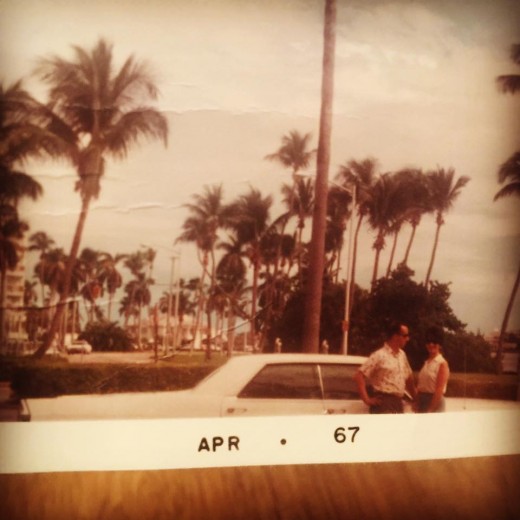
A man, his bumper, and 2 of 3 daughters.
Da, his bumper, and 2 of 3 daughters.

His message to us, in driving and in life, was to not be afraid to tap those bumpers — push for what you want, what is possible, what is available to you.  Don’t be restricted by the idea of something, don’t hesitate because you worry you won’t make it, don’t stop yourself without trying.  Make it happen, carve that spot out for yourself, use your resources, tap those bumpers.  Bumpers are meant to bump, it is their function.

It’s a worthwhile lesson, both in and out of the car.  Thanks, Da, for helping me always find my space.

Da and my Mom.  You don't ever parallel park a car this long without tapping a few bumpers along the way.
Da and my Mom. You don’t ever parallel park a car this long without tapping a few bumpers along the way.

Harambe’s Death and Mom Shaming Unite the Internet!

It started with a zoo, a young boy, a gorilla, some untamed curiosity, and ended with a gun shot heard ’round the Internet.  Harambe, the 17 year old Silverback gorilla from the Cincinnati Zoo was dead and the young boy who worked his way into his habitat was safe, but the story was not a happily ever after one.

Some folks complained about zoos being sinful bastions of man’s evil. Some folks complained about a gun being used on the gorilla instead of a tranquilizer or another form of pharmacological restraint.  Some folks wondered where Dad was.  Lots and lots and lots of folks agreed that Mom was a sorry excuse for a parent, clearly negligent and at fault, and personally responsible for the death of the gorilla.

Sigh.

Mom shaming has become the newest national past time, universally practiced (often by fellow mothers), and cheap entertainment.  Grab the popcorn, prop up the feet, and read the comments. Who can use the most vile language to speculate what a horrible person mom must be?  Who can get the most “likes” on their comment describing the massive flaws of a woman who nearly watched her child die an unspeakable death?

Here’s my POV about what happened in the Cincinnati Zoo over the weekend:  I officially have no opinion because I wasn’t there.

I did not personally witness a mother’s negligence, so have no ability to comment on that.  I did not personally witness or debrief the team of zookeepers who opted to fatally harm the gorilla in question, so have no ability to comment on that.  I will not personally cast any blame whatsoever having not been anywhere near the events in question or having stood in any of the important shoes in question, namely those of parent, child, or zookeeper.  I would add gorilla to that mix, for all you folks who love animals more than humans (and I know this exists and is a thing — no judgment from me, as humans suck much of the time), but, you know, gorillas don’t wear shoes, yo.

See how easy that is?

Sadly, so much of the Internet doesn’t see the merit in my restraint.  Mom has quickly become this week’s online public enemy number one.  In my own circles, I saw shade thrown mostly by fathers or women without children.  In other online circles, the hatred towards mom was much more democratic — young, old, mothers, fathers, those with kids, those without kids.

I read a little, but for the most part just kept scrolling.  What is it about us that we need to proclaim, in writing and publicly, how awful we think other people are, especially in the face of their personal tragedy?  It’s not enough to assume that mom is already feeling, no doubt, horribly responsible for a child that could have easily died on her watch, we need to revile her openly, aggressively, gleefully, almost.

It’s like the Walk of Atonement from Game of Thrones.  This mother was metaphorically forced to walk amongst her Internet commenters and simply absorb the hate that was thrown her way.  And as awful as that endless mob of ugly was in King’s Landing for Cersei Lannister, I wonder if a single commenter that cast judgment about the Cincinnati Zoo mother’s parenting abilities might consider that she would be aware of the hate cast her way.

We shame moms openly, without concern.  Where was Dad?  Not on the radar, as it was Mom at the zoo with the very active and curious four year old, not Dad. Though, full disclosure, I did see a friend post a UK story about how Dad has a rap sheet for gang violence and drug use.  Somehow, this news, too, is more reflective of what a horrible parent mom is, for choosing such a man to father her children.

Every one of our transgressions is only a click away, folks, which is sort of my point.  Let thee without sins cast the first stone.  Isn’t that what Jesus taught?  Man, I’m not even religious and know that.  For every commenter who speculated about how qualified the Cincinnati Zoo mom is to be a parent, take a deep breath and consider your own parenting flaws.  For every commenter who posted about how mom is personally responsible for the death of Harambe and should be made to literally pay for his death, take a deep breath and consider the concept of flow charts and chains of command.

Let’s stop engaging in the gleeful mom shaming that is so rampant on the Internet.  When you are baited by news outlets craving the next big story, have your thoughts and opinions, by all means, but perhaps refrain from sharing them online, adding to this growing culture of mom v. mob.  For all you know, the next time a mistake is captured on someone else’s cell phone, it might be yours.  And you know when it is, you’re moments away from that virtual Walk of Atonement.