Breasts, Bottles, Babies, and the Internet: A Cautionary Tale

I was a formula fed baby.  My Mom also smoked throughout all four of her pregnancies. Somehow, she was not demonized for these sins of motherhood while her kids were in utero.  These days, other mothers on the Internet will cut a bitch for the choices she makes.

Motherhood for me started ten years ago.  A lot has changed in that time.  With my first, I felt very much on my own.  The Internet was not yet something I turned to for advice, guidance, or direction.  It was there, for sure, but I didn’t rely on it the way I do today.

Man, am I grateful that my first go around at motherhood was pre-Internet crutch.

There is too much damn information these days.  Way, way, way too much.  And too many other mothers happily willing to step up to the screen and keyboard to tell you how to do it right, how you’re doing it wrong, how to do it better, and everything in between.

It’s exhausting and overwhelming and truly complicated to navigate.  Ten years into this motherhood thing, I know enough to turn off the computer, step away from the screen, and rely on my instincts.  But I know from some online motherhood groups I am in that not all new mothers can do that.

Every rash, every poop, every belly button stump is photographed and slapped online for other new moms to weigh in on.  Seriously.  People photograph their newborns seedy poop diapers and slap that shit online.  Literally and figuratively.

Is this normal?  What should I do?  I’m so worried! — these are the choruses of modern motherhood.  Women are reaching out to their peers, equally new and freaked out for their answers.  Part of me wants to step up and provide comfort and support for these worried moms.  The other part of me just scrolls on by, fast as I can, grateful not to feel that unsustainable level of anxiety.

My own Mom died when I was first pregnant.  I never had that wisest of ears — the woman who raised me — to lean on for advice and support.  I did my best, and fumbled through the rest.

Almost a year into breastfeeding I remember wondering about weaning.  How to do it, when to do it, was I putting my needs over my babies if I weaned too soon?  I called up my aunt, a mom I knew had opted to breastfeed in the 1960s and 1970s, for advice.  “Oh,” she said, “I don’t remember that.  It was so long ago.”

Honestly, that was the best unintentional mothering advice I had ever gotten.

“I don’t remember,” became something of a soothing mantra for me in those early years of motherhood.  Choices and decisions in those early days that seemed so dire, so consuming in the moment, would someday be forgotten.  I was reassured by the idea that everything would be okay, all would work out, and someday, even forgotten — not even significant enough to remember.
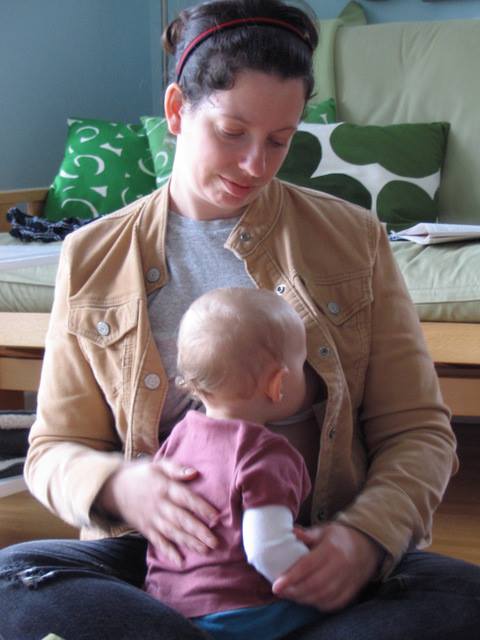
Mama and Donna, nom nom nom.

My aunt’s admission of forgetting the details of something as MONUMENTAL as breastfeeding absolved me of so much of that fear and anxiety I see in online motherhood groups today.  It’s important now, it passes quickly, and most things work out.  You move on.

I remembered my aunt’s words, too, when our third baby came to us through adoption. Not wanting to go through hormone therapy to attempt breast feeding a child I had not conceived, I embraced the idea of having a bottle fed baby.  Hell, my husband would now be able to handle overnight feedings on his own!  That right there was revolutionary.

The truth is that I completely enjoyed breastfeeding my first two babies.  It was powerful and empowering and lovely and intimate.  It came to me easily and felt natural.  In the end, my oldest weaned herself at eighteen months.  I was more sad about it than she was.

But all those months of breastfeeding didn’t protect her from the cancer that would take her life a few years later.  My second was breastfed through ten months when my milk supply dried up overnight, coinciding with the death of our girl.  He is now a healthy, growing six year old.  Those few months of formula that bridged him to his first year don’t seem to have negatively impacted him one bit.

When our youngest was born, formula it was.  I worried I would miss the connection breastfeeding provides.  I worried that the bottle would just be one of many things different about raising a child who had come to us through adoption, a compromise, somehow second best.

Turns out, I didn’t have to worry.  The tenderness of providing for a baby through a bottle felt just as lovely and sweet to me as providing for a baby through my breast.
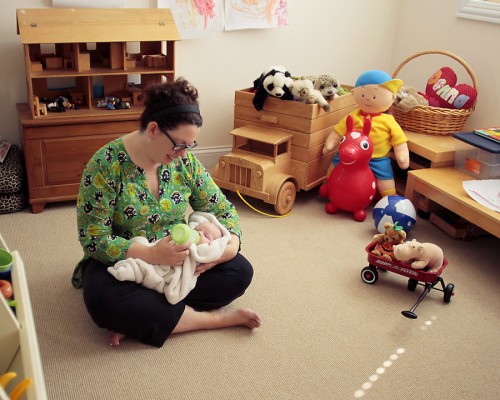
Photo courtesy of bum bul bee photography.

I think the moral of this story is that motherhood is so very much a personal phenomenon.  Others have done it since the dawn of time, but when it happens for us, it is a once in a lifetime (or five in a lifetime, depending on how big your brood is) kind of thing.

Trust yourself.  Let your own instincts guide you.  Believe me when I say that you know just as much as that stranger on the Internet who has the same questions you do. You’re alright, Mama.  You’re doing just fine.

A Tale of Two Chicagos

NOTE:  This blog post was honored with the Peter Lisagor Award for Best Individual Blog Post, Independent 2015 by the Chicago Headline Club and the Society of Professional Journalists.  

One of my potent memories of childhood is packing into whatever used Cadillac my Dad was driving at the time for a weekend day trip, Montovani or Percy Faith playing on the 8 track. We lived in the southern suburbs and would snake up the Dan Ryan, the most infamous of Chicago’s expressways, and head north.  My Dad was always behind the wheel and the windows were usually down, as both my parents smoked.

It was not uncommon for my Dad to exit at the Robert Taylor Homes, in the Bronzeville neighborhood.  These were a collection of high rise housing projects made warm and fuzzy by the 1970s sitcom, Good Times, but in actuality were a vertical concentration of poverty, unemployment, crime, and violence.  And, yes, the windows went up, and the doors were locked.  My young heart beat faster in the few minutes we drove down State Street before re-entering the expressway north.  The buildings were enormous and barren and monolithic and terrifying.  Even as a child, I recognized the disparity between “us” and “them.”  Even as a child, I thought in those terms, “us” and “them.”

Was that racist?  Yes, I think so.  How could it not be?  Every face staring back at me from the other side of the window was black.  I never recall my parents or any of us saying much of anything as we drove down those intimidating streets.  There were no racial slurs on those drives.  Just quiet and heaviness.  I have no doubt that we all breathed a sigh of relief as we got back on the expressway.  Was that racist, too?  Yes, it was.

Those drives would continue all the way north, eventually winding through the posh, leafy suburbs of Chicago’s North Shore.  Places with names like Lake Forest, Kenilworth, Glencoe, Winnetka.  The juxtaposition between the extremes of Chicago’s poverty stricken south side and its tony North Shore estates were jarring then, just as they are jarring now.  Chicago’s disparity of wealth has not changed, other than becoming more intractable.

An important point to make, too, is that my heart raced as fast in those leafy wide lanes along Lake Michigan’s shore, just as they did in the Robert Taylor Homes. The sense of “us” and “them” was absolutely no different as I watched the people in tennis skirts, Lily Pulitzer prints, and pink oxford cloth on the other side of the window.

Was that classist?  Yes, I think so.  How could it not be?  Every face staring back at me from the other side of the window was rich.  I never recall my parents or any of us saying much of anything as we drove down those intimidating streets.  There were no class slurs on those drives.  Just quiet and heaviness.  I have no doubt that we all breathed a sigh of relief as we got back on the expressway.  Was that classist, too?  Yes, it was.

When my Dad died last spring, I prepared a eulogy for his service.  Those long drives on rainy or sunny weekend afternoons would factor prominently in how I remembered my Dad.  I thought of those drives as a lesson my Dad was giving, not in words, but in drives, about some people having more than us and some people having less than us and that we should be grateful for what we had, modest as it might have been in a working class suburb filled with ethnic whites with Polish and Irish and German surnames.

My sister had a completely different take on those drives.  For her, they were about my Dad laying Chicago at our feet — all of it — the good and bad, posh and poor, ugly and beautiful, dangerous and refined, black and white, that Chicago had to offer.  All of it was ours.  We had as much stake in what happened at the Robert Taylor Homes as we did with what was going on in Wilmette.  All of it was Chicago and all of it was our home. Ours.

Thinking about our conversation, I believe that my sister’s sense of why those drives happened was more likely.  My Dad owned every room he ever walked in.  Every single room was his.  Wealth did not intimidate him.  Poverty did not intimidate him.  Color did not intimidate him.  A person’s circumstances, blessed or damned, did not intimidate him.  He was just as likely to strike up conversation with the black man on the street corner as he was the white man dining al fresco and find value in both.

I thought of my Dad last week as I made a drive down that same Dan Ryan expressway, this time headed south, not north, with the Englewood neighborhood as my destination.  I was hoping to talk with Tamar Manasseh, founder of Mothers Against Senseless Killings (MASK).  I had read a news report about Tamar and her efforts to create a grassroots network of moms patrolling violence plagued intersections on the south side in an effort to discourage gun and gang violence.  The mere idea astounded me and galvanized me simultaneously.  Motherhood is a powerful thing and Tamar was proving that.  (You can read my companion interview with Tamar HERE.)

Tamar Manasseh, founder of Mothers Against Senseless Killings (MASK) and the activist behind Moms on Patrol.

I’m not going to lie, as I exited the expressway, that rapid heartbeat I had felt as a girl on those drives returned.  I don’t recall ever feeling quite that well intentioned or quite that white — the embarrassing stereotype of the Lake Shore Liberal come to life.  Yep, that’s me.

It was easy to spot the volunteers dressed in their hot pink t-shirts.  I turned onto Stewart and parked my ridiculous mom car.  True to form, I had brought along water and cupcakes to share.  WHO DOESN’T LIKE CUPCAKES?  Again, the stereotype I am makes me cringe at times.  I was grateful when a young man approached me.  It was clear that he was familiar with the somewhat pensive looking white lady type that I was.  With increasing coverage, more and more volunteers and donations are coming in to support the efforts of MASK.

Armed with a notepad and my iPhone, I set about the business of finding people who would talk to me.  It was easier than I thought.  The legit reporters with trucks and microphones and fancy cameras were across the street, panning the scene.  I was crouched on my knees, something no 45 year old woman can do for too long. People were happy to talk with me.

Tracy, PR Coordinator for MASK, and volunteer Mary.

There was Mary, a volunteer since the effort started on June 29th after the shooting death of a young woman.  Mary’s son was murdered in 2001.  She runs a weekly grief support group at Mercy Hospital.  There was Tracy, a PR executive who volunteers for the campaign every night and manages their social media.  She wanted me to know about the transformation of the young men with gang affiliations who were now regularly coming by to be a part of the nightly watch.  As a sign of respect and cooperation, they were pulling up their pants and wearing shirts.  These things made them less threatening to their neighbors.

Tamar and her cousin Eddie.

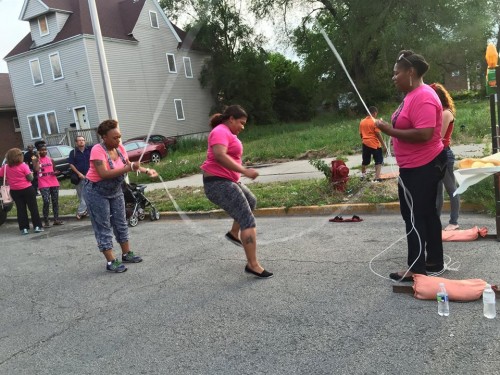
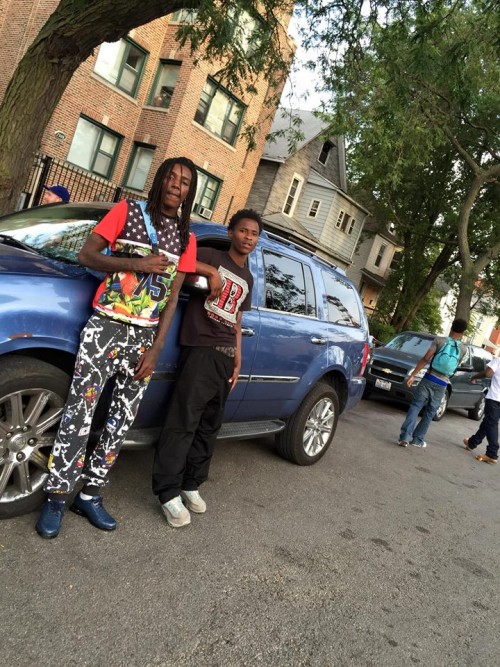
There was Eddie, Tamar’s cousin, who joined the Nation of Islam at 15 years old, three years after his own father was murdered.  There were two young men with dread locks who would not give me their names, but who believed that it would be “business as usual” once the moms packed up and went home.  There was the family down the street who did not want me to photograph them as there were drugs on the porch, but they talked to me about being able to let their little ones up and down the street this summer — something that had not been possible before.  There were the double dutch jumpers, middle aged women just like me, enjoying the pastime of their childhood, if a little more rusty at it.

Double Dutch on the corner of 75th and Stewart.
Dreads and cool threads.

There is no question to me that Chicago is deeply divided.  Talking with the good folks gathered at 75th and Stewart last week was like breathing air into a news report.  The “us” and “them” of my youth absolutely exists, but in those 90 minutes I was there, it was suspended.  What separates us is color and opportunity and school quality and access to resources and lack of hope and fear and racist institutions and drugs and crime and so many other factors that are too many to name.

Just as my Dad taught me on those drives so many years ago, this is “our” Chicago, not “theirs.”  When we acknowledge that what happens in Woodlawn and Englewood is just as relevant as what happens in Lincoln Park or North Center, and that the tragedy of one neighborhood is the tragedy of our entire city, only then can we truly call ourselves a Chicagoan.

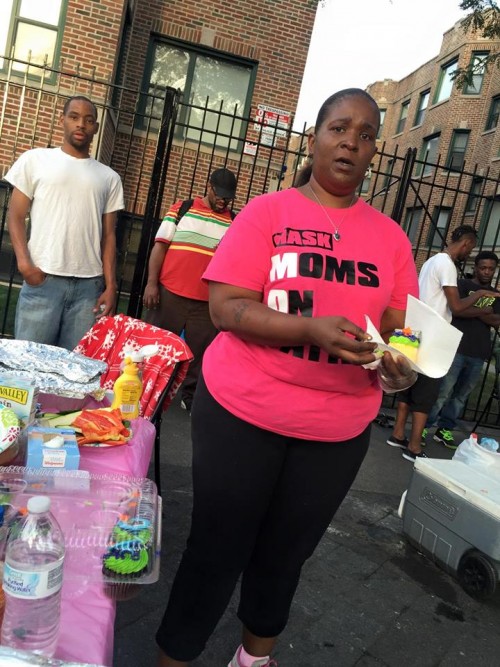
Kim D, manning the food tables that provide a nightly dinner for volunteers and local neighbors.

If you would like to help the efforts of MASK, click here.

**********

You know who can subscribe to my blog?  ANYONE!  You don’t even have to be from Chicago.  Here is how:

Type your email address in the box and click the “create subscription” button. My list is completely spam free, and you can opt out at any time.

When Family Trees Get Complicated

Out of the blue this morning, on the way to day camp, Mary Tyler Son said, “It’s great that Mary Tyler Toddler (I assure you he does not call his brother this in real life) is the fifth member of our modern family tree.”

“How sweet,” I thought, “This guy is thinking of both his gratitude for his brother being a part of our family as well as including his dear sister, Donna, who died when he was just a wee sprout.”

Mary Tyler Son went on to explain his conception of the family tree from his vantage point as a six year old.  “There’s Mom and Dad and me and Mary Tyler Toddler!  Oh wait!  That’s just four members of our family tree — not five.”

I gently corrected him and reminded him that even though she was no longer with us, Donna was still very much a part of our family and therefore part of our family tree. It’s important for me to convey to my sons that even when people are not with us day-to-day, they are still a part of us.  He got it, it seems, as he gleefully replied, “OH!  You mean like how Da is dead, but still a part of our family!”  Yes, exactly, with perhaps a tad less glee.

Family Tree2

We were driving down a tree lined street and I looked up and saw that more than a few trees had dead branches lacking leaves.  Perfect visual to explain my point.  Mary Tyler Son decided that we should make a family tree to hang at home and put fabric leaves on the family members who are alive and simply remove the fabric when the person dies.

Great idea, kid.  But I really, really hope not to remove any more fabric from our family tree for a long, long time.

This little conversation got me thinking about how family trees can get complicated. Ours will be impacted by both death and adoption.  And if I thought explaining death to a little one was hard, I do not relish the conversations in our future about adoption. Those of you with blended families know exactly what I mean.  Divorce and remarriage and “half” siblings (I’ve always hated that expression) has got to be complicated, too.

I miss my uncomplicated life.  The one where both my parents were living.  The one where my kids had grandparents from both sides of their family tree.  The one where cancer only claimed older relatives in their 90s who were ready to die.  The one where I didn’t have to explain to my kids that one of them was adopted and the other was not.

Now, mind you, that “uncomplicated life” is never one I have lived.  A gal can dream, though, right?

I sometimes wish I had that easy capacity little kids have to integrate tough stuff then blithely move forward with the day.  I get bogged down way more than my six year old does with the grief and the nuances.  I mean, aren’t you tired of reading about it on my posts?  Some days it feels like every little freaking thing is a metaphor for loss or grief.

Sigh.

Okay.  Time for this little beaver to buck the heck up.

Life is complicated.  For all of us.  For some of us, those complications are more apparent.  For others, those complications are hidden or not so easy to see with the naked eye, but they are there.

It is a warm sunshiney day.  Imma stop thinking about family trees and go take a walk with the little one to find some trees.  In a park.  Which is not very complicated at all.