Don’t Worry About a Thing

It will be okay.  I know this because if you wait long enough, the sting of initial grief passes, eases, ebbs.  I’ve buried my Mom and daughter, so burying my Dad is not the shock it could have been had this been my first time at the sadness rodeo.  But it still sucks.

Today really sucked.

In a veil of light rain, I drove to my childhood hometown to finish some of the busywork of death — pick up my Dad’s death certificates at the funeral home and arrange for his headstone at the cemetery.

I haven’t lived in the south suburbs since 1992, moving from my parent’s home, my childhood home, to Chicago’s north side as a young woman of 22.  That was over half my life ago.  The area is simultaneously foreign and familiar.  It feels odd to be back there, odd to bury my Dad there, like I’m leaving him without a ride home.

He moved to the South Loop neighborhood after my Mom died ten years ago.  Like me, he, too, grew away from his south side roots, transplants both of us.  Out of the blue he bought a condo last spring a bit further north.  In typical Dad fashion, his decision was not up for discussion.  It was his decision to make and he was not one to listen to the concerns of his children.

The view was spectacular — skyscrapers and CTA tracks.  I got why he liked it so much. I wish he had had more time there.  He did, too.  When I looked for a new home for him in February, I thought he might like that the two windows in his assisted living unit overlooked a grassy area with a lot of trees.  He hated it, preferring his urban landscape to anything nature offered.

You do the best you can when your choices are limited.  I tried and my Dad tried.  We both did the best we could in the face of his changing health.  “Don’t worry about a thing, nothing will turn out all right,” was one of my Dad’s longstanding mantras. Wiser and more cynical words have never been spoken.

His point was that spending any amount of time or energy worrying was a waste of both of those precious resources.  He always said that his mother taught him not to worry, that worrying never changed anything, so why engage in it?  It seemed so simple when he said it.

When he was diagnosed with lung cancer last year, I knew he was worried.  He didn’t talk about it too much and he preferred to keep the diagnosis private.  Need to know basis, you know?  I felt his relief after going through the radiation treatment.  His radiation oncologist was the same doctor who treated my Mom and daughter.  Talk about freakishly small worlds — oncology, even in a big city like Chicago, can be fairly incestuous.

He let me go to one of his appointments with her last year.  Just one.  My Dad was very independent in most every way.  After his treatment ended, Dr. Marymount said to my Dad, “I think we got it.  Lung cancer is the least of your worries.”  She sent him on his way with an order for follow-up scans in three months.  His cancer was caught early, stage 1.  None of us were really worried.  Turns out, we should have been.

Death Certificate

Lung cancer is what is listed on his death certificate under “cause of death.”  Lung cancer.  Of course.  Freaking cancer.  Of course.

My Dad never made it to a follow-up appointment or scans.  He was too busy with other medical crises that on the surface had absolutely no connection to lungs or cancer.  I remember in January pushing, gently, for repeat scans.  My Dad was already hospitalized.  It seemed like a task that should be easy to accomplish.  Ha — in Hospitalville, “common sense is non-sense,” another one of my Dad’s favorite mantras. Perhaps I should have pushed more assertively.  Perhaps it wouldn’t have made a bit of difference.

We’re all gonna die someday.  April 29, 2015 was my Dad’s day to die.  Lung cancer is what got him in the end.  My personal belief is that he died before May 1 to spare his estate the cost of another six grand of assisted living expenses and another six hundred dollar insurance premium.  He knew.  I am convinced of that.  He knew.

I miss him.  His death has brought me back to my Mom’s death ten years ago. They are together again now, side by side, just like in the full sized bed they shared since their 1958 marriage.
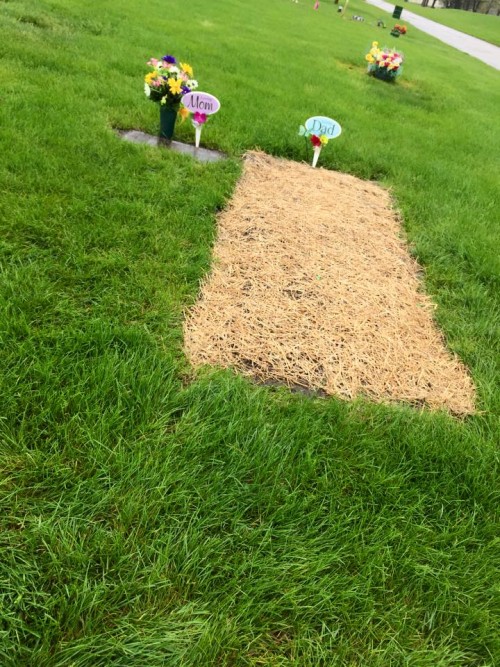
Graves

I miss them both.  It feels a bit like a Mack truck ran over me today, so I don’t even know why I’m sitting up at 8:45 at night typing these words, other than I need to. Writing is part of the way I move through grief.  Which takes me back to the first sentence of this post, “It will be okay.”  It will.  It’s not okay right now.  Right now not much of anything feels okay.  But it will be okay again.  I hope.


A Letter to My Sons on Mother’s Day

Hey Boys,

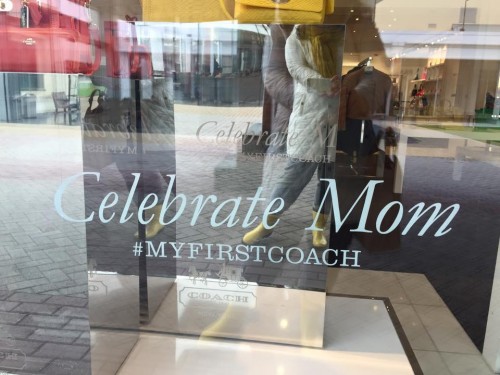
Sunday is Mother’s Day.  I know this because I have been to the mall three times in the past few weeks (through no fault of my own).  You can’t walk past a single shiny window without being bombarded with the certain way to make your mother happy come this Sunday morning —  BUY THIS.  Mom needs that.  IF YOU LOVE HER, YOU WILL SPEND A LOT OF MONEY ON HER.

MD1

MD2

MD3

Rubbish.

I wanted to let you know you are absolved from having to purchase me some or other fancy gift to commemorate this day.  You are young now, but I don’t want you growing up thinking a day like Mother’s Day is all about the bling, the shine, the bows, or the boxes.  It’s not.

A new Coach bag is not the thing that proves your love for me. I don’t need or want diamonds or a tote filled with nine scented candles.  A spa day away is lovely, to be sure, but don’t believe for one moment that I deserve that for mothering you.

I won’t speak for all mothers, but I will speak for me.  Raising you two is my honor, my joy, my sacred duty, my gift to the world.  If I do it right, you will grow into kind, compassionate, empathic, loving, productive citizens.  If I do it wrong, and know that I will make many, many mistakes along the way, well, I am sorry.  When you’re all grown up and shaving, I hope I can say I did my best.

Mothers don’t need stuff or things from their children to understand they are loved.  I see it almost every day from you two.  When you fight with one another for space on my lap while sitting on the kitchen floor.  Swoon.  When you follow me around my Dad’s wake with a box of Kleenex, just in case I start crying again.  Sigh.  When you grab me by the scruff with your not yet gentle toddler ways to pull me in for a kiss. Ouch, followed by Melt.

I know you love me.  Giving me something that a shiny store window tells you I need doesn’t ever mean that you love me more or better.  Never get things confused with feelings.  Believe me when I say it is enough to be loved by you.

And this is not me being a mommy martyr.  It’s a lesson I am trying to teach you both that things, fancy and expensive things, are never to be confused as compensation for caring for you.  I am all for gifts and symbols of your love and affection for me, but those gifts and symbols need not have dollar signs around them, your love and appreciation measured like a litmus test by how fancy the packaging is or how much your Dad shelled out.

This year and every year, if you want to treat Mother’s Day as a special day for me or an opportunity for you to show your appreciation, I will welcome your efforts with open arms.  Please, in fact, do!  Everybody loves days set aside where they get to feel special and loved.  Like birthdays or holidays are for you.  I am no different.  I would love a special day where I feel your love and appreciation in extra measures.  There are so many meaningful ways to show your feelings that don’t involve money.  Think about that.

Alright, kiddos.  That’s my lesson for the day.  I love you.  I know you love me, too. How lucky are we?

xox, Mom

Aging Parents: A Promise Kept

My Mom lived the last eleven months of her life with right sided paralysis caused by a bleed out in a brain tumor she didn’t know she had.  She could no longer walk, get out of a bed or car independently, bathe herself, or even wipe. There were cognitive changes and her communication was severely limited during that time.  It was heartbreaking.  My Dad was by her side for all of it.

I didn’t understand their relationship.  I chose a different dynamic for my own marriage. But my ignorance of how or why my folks stayed together is immaterial. There was love there.  I saw it and felt it, even if I didn’t understand it.

I promised my Dad, after my Mom died, that I would be there for him as a caregiver and advocate if he ever needed that.  The same way he was there for my Mom through those eleven months of what a brain tumor does to a person.

Promise meme

He brought in extra care when he could no longer manage himself. He negotiated hospital systems that are not easy to negotiate even for those of us who work(ed) in them.  He argued with surgeons and demanded basic care for my Mom when basic care seemed like a lot to ask for.

Caregiving is exhausting.  Advocacy is tiresome. Both are absolutely necessary in serious illness.

To be a surviving spouse is a tough, tough road.  It is lonely and quiet and empty and confusing.  The surviving spouses I worked with as a social worker taught me that.  To see what happened when they themselves came to the tipping point of aging, when their needs changed, sometimes slowly, sometimes rapidly, without a caregiver or advocate by their side moved me.  I never wanted that for my Dad.

My Dad was a guy who needed to be in control.  And he hated authority.  The irony of his own authoritarianism was not lost on any of us who knew him.  Whereas my Mom received care in a gracious manner, was pleasant, helpful, and patient, I worried that dependence and my Dad were not a good fit.  Certainly, the structure that most of our systems that accommodate older adults require — hospitals, nursing homes, assisted living communities — was not something that my Dad would ever adjust to easily.

We talked about this often, my Dad and I.  Joked about it, too.  HA HA HA!  Dad in a nursing home?  No freaking way!  “You should live with us,” I told him.  He agreed. Gratefully, so did my husband.  We all agreed to something we had absolutely no control over.  How naive we all were.  How wishful.

I imagined the perfect death, somehow, full of meaningful conversations and a hospital bed somewhere (I never quite got far enough in my dying Dad fantasy to pinpoint where that hospital bed would be in our home — living room?  guest room?  our room?) and grandchildren close by, fully aware of the sacred transition that was happening in their midst.

Sigh.

What really happened did not look at all like that fantasy I had conjured.  What really happened was sudden acute changes in my Dad that both shocked and terrified those who loved him.  What really happened was eight weeks in a hospital fighting for basic care most of the time.  What really happened was a trial discharge to my home and a re-hospitalization just 40 hours later, but not before tears fell and I heard the begging pleas of my 81 year old Dad to be allowed to stay, something that was simply not possible given the severe change in his needs.  What really happened was an unexpected move to an assisted living community that my Dad hated.  What really happened was not at all what I imagined would happen.

Most of it sucked spit.

In the end, after advocating for a palliative care consult with siblings and doctors, I got the call on a Monday afternoon that my Dad was more appropriate for hospice, not palliative care.  Cue the tears.  Again.

Things changed quickly when the decision was made to stop the cycle of health care hell.  There is a liberation, a familiar liberation I felt with the end of my daughter’s cancer treatment, of saying enough.  I knew from the many conversations my Dad and I had had about his health care in the past decade to know that he was not living the life he wanted to live.  He hated all of it — the lack of control, the confusion, the food, the new home he called a “warehouse.”  It was not the life he wanted for himself.

But he still needed an advocate and he needed more care than he ever had, now no longer walking and bed bound.  Hospice should be easy, but it isn’t always.  There are many instances of having to advocate and fight, literally argue, for more medication, stronger medication, different medication.  You think you will lose your damn mind in the process of having to justify the need for something that seems like basic human compassion.

But you don’t, you can’t, because you made a promise and your Dad needs you.  He needs you more than he ever has.  So I did what my Dad did ten years earlier for my Mom — I argued and pushed and advocated and did not give up.  “It feels like I am shouting into the wind these past three days, but I am going to keep shouting until someone hears me,” I told the hospice nurse.  Fifteen minutes later she was at my Dad’s bedside and finally, finally, someone understood my concerns.  She acted, she cajoled the doctors, the proper medications were ordered, albeit on a prn basis, which required one last advocacy push a couple of days later to straighten out.

I am tired.  I am worn.  My Dad is dead.  He no longer needs a caregiver or advocate.  I kept that promise to him, just as I told him I would.

These words are written not to solicit kudos for what a fine and loving daughter I am, but as a cautionary tale.  Every person you know and love who experiences serious illness requires an advocate and a caregiver.  You might know this, you might not.  You might have experience in health care, you might not.  Be prepared.  Trust your gut. Have a plan.  Know that your loved one needs you like never before.

When all is said and done, none of us want to live with regrets, either the person who is dying or those of us who will survive them.  I am so grateful I was able to help my Dad in his final months.  I am very sad it was as hard to do as it was.