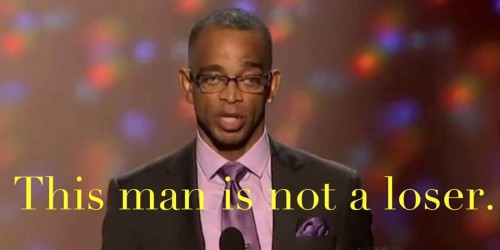
Throughout the day, anytime I dipped into a few minutes of the Book of Face, I saw status posts and articles about an ESPN anchor, Stuart Scott, who, at 49, had just died of cancer. I had never heard of Stuart Scott before this morning, but now, twelve hours later, he is one of my heroes.
People all over the media are reacting to a few choice words Mr. Scott had about cancer at last summer’s ESPY Awards. “When you die, it does not mean that you lose to cancer.”
Amen. Preach. Can I get a witness?
Those words were spoken by a man who described himself as “battling” cancer. Here he was, on stage, accepting a prestigious award that he himself acknowledged he didn’t feel worthy of receiving. This man is fit. Handsome. I mean handsome. Determined. Articulate. Focused. Inspiring and inspired. Everything about him shouts vitality. He appears healthy, at the top of his game. And yet, cancer. He was living with and dying of cancer, even if it didn’t look that way.
There is no shame in that. There is no shame in dying of cancer.

One does not “lose a battle” with cancer. Fuck that noise. The mere idea of it is insulting and dismissive and diminishing to every single person who lives and dies of cancer, and yet this is the preferred verbiage we as a culture have somehow agreed best describes whether an individual, man or woman, adult or child, survives their cancer diagnosis. Again I say, fuck that noise.
It makes my skin crawl every time I see it or hear it, and having been a part of the cancer community since 2004, I see it and hear it way too damn much. I’ve written about the subject before, gotten in Facebook tussles over it with friends I greatly admire and respect, and even sent letters to reporters asking them to rethink their language, knowing and believing that words really do matter.
If some people “win” their battle with cancer, if some folks “beat” cancer, it stands to reason that some people “lose” their battle with cancer. Where there are winners, there must also be losers, following that logic. And that is the concept I reject. People unlucky enough to die of their cancer diagnosis are not losers.
Stuart Scott went on in his speech to say: “You beat cancer by how you live, while you live, and in the manner in which you live.”
That is some profound wisdom right there and could apply to most anything in life. We all “beat” challenges XY or Z that are assigned to us in life by how we approach those challenges, how we cope with those challenges, and how we proceed in our life amidst those challenges. This is true of cancer or whatever that challenge might be.
Two of the people I have loved most dearly on this earth have died of brain cancer. My mother and my daughter, my Donnas. Neither of them lost their battle with cancer. When my daughter initially responded so positively to the hardcore chemotherapy regimen she endured, she was not more of a winner than she was when her cancer fate turned and she became terminal. When my mother had the misfortune of having the tumor in her head (the one no one knew existed) bleed out as she played a slot machine in Biloxi, Mississippi, she did not become a loser, and there is nothing, not a damn thing, she could have done to “beat” her cancer diagnosis.
If two children are diagnosed with cancer on the same day, one with leukemia that has a 90% cure rate and one with DIPG that has a 100% mortality rate, the surviving child is not a winner, just as the child who dies is not a loser. That child who survives her diagnosis did not “beat” her cancer, so much as survive her cancer. The nuance there is crucial to understand. Both children, no doubt, would have tried to cope with the brutal treatments they endured in the name of cure and both children, no doubt, demonstrated bravery and strength throughout their treatments.
Stuart Scott detailed this brilliantly in his ESPY Award speech. Rather than romanticize his cancer “battle,” Mr. Scott shared details about how tough cancer treatment is. How long hospital stays can be. Tubes and wires popping in and out of every part of his body. The fatigue. The inability to fight some days. The dependence on others. The inability to plan. The tears that come, even when you’re a 49 year old national TV sports anchor.
I honestly think I fell in love with him watching his seven minute acceptance speech.
Many, many, many people die of cancer. They are not “lost” to cancer and their dying does not make them “losers” who “gave up.” They are people who have experienced the misfortune of receiving a cancer diagnosis that was not responsive to treatment. As heartbreakingly simple as that.
I applaud Stuart Scott for the bravery he displayed in just speaking the truth — not his truth, but the truth. People in cancer treatment, no matter the age or diagnosis, are faced with incredible challenges and the vast majority of them face those challenges — the pain, the illness, the fear, the isolation, the loss of income and security and autonomy — the best way they can.
Surviving a cancer diagnosis is not just about being strong or maintaining a positive attitude. Surviving a cancer diagnosis is about having errant cancer cells that respond to treatment, whatever that treatment may be. One’s approach to that treatment, no doubt, can have an impact on how the treatment is experienced, but cancer, its treatment, and the emotional and physical space it requires, is often hard, brutal, relentless at times, and, yes, not everyone will survive it.
But that has nothing to do with winning or losing. So let’s stop suggesting it does.
**********
HEY! Do you want to do something about cancer? Do you want to help children with cancer? SAY YES, WHY YES I DO! If so, please click HERE to register as a shavee for the fourth annual Donna’s Good Things shave event for St. Baldrick’s on March 28, 2015 at the Candlelite in Chicago, or if you’re not in a position to shave, please consider a donation — every dollar counts!



 Mary Tyler Mom