Ben’s Story: A Mother’s Letter

September is Childhood Cancer Awareness Month. Each day a different guest blogger will be featured who will generously share their personal experience with childhood cancer.  Stories are always more potent than statistics.  

By Sarah Brewer

Dear Ben,

My dear, sweet ray of sunshine. A child who very rarely complains, choosing to hold your fears close to your chest. I am amazed by you, yet my worry is immense. I hope you know I’ll do everything possible to ensure you have an amazing life here on earth.

You were my first child, born June 22, 2001 after what seemed to be years of labor. Seriously. You took your sweet time getting here, but it was well worth the wait. I didn’t know what to expect. Heck, I’d never really been around a baby before, so this was going to be a new adventure for both of us. Gazing into your eyes let me know you were an old soul. Your innate wisdom threatened my newbie parenting status, but instead of worrying about it, we just let it unfold.  For two years, life was pretty good. I watched you hit all your important milestones along the way.

This parenting gig was going so well I decided that another baby would be a great idea. A few months into my pregnancy, however, you started getting sick. A lot. Visit after visit to pediatricians and Urgent Cares proved nothing. You had a virus. No, you had a hip infection. Wait, you were just constipated. Actually, I was just a “nervous first-time parent.”

Seriously! A medical professional actually said this to me!

No one thought to run a simple panel of blood tests. I even asked our pediatrician, “Do you think this could be something more ominous?” She shook her head no.

A few more months passed. You stopped walking. You cried a lot. You had a constant runny nose. I decided I had to stand my ground because I KNEW there was something wrong.

We went to the Emergency Room – by this time I was seven months pregnant – and sat there until someone had an answer. Within a few days, we learned the horrible news: Neuroblastoma, Stage IV, unfavorable tumor, high risk for relapse, 20-30% chance of survival. Everyone in the room with us was in shock. You were laying in my mother’s arms asleep. My dad sat nearby, completely silent. My then husband held onto me as I sobbed into his chest, repeating “My baby! My baby! How can this be?”

At the tender age of 2 1/2, they hooked you up to poisons that could easily kill an adult. And the funny thing is, you immediately started feeling better! Finally, the cancer was dying and you felt great! I just knew you were going to respond to this therapy.

Unfortunately, those first 15 months of therapy were grueling: Multiple chemo treatments, too many surgeries to count, a bone marrow transplant, radiation therapy, and experimental therapy. But you made it through. After 15 months, we heard the precious words that you had No Evidence of Disease. And, you got a new sister six weeks into the journey.
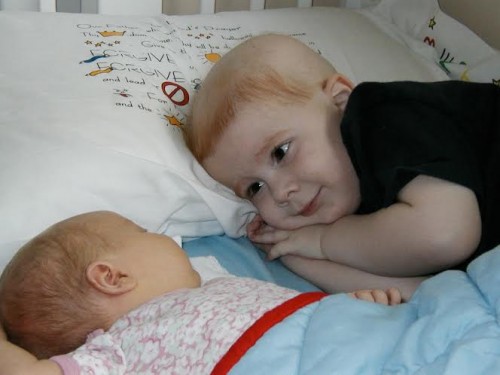
Ben and his sister.
Ben and his sister.

I was so worried about how I’d bring a baby into this hellish environment, but it worked out wonderfully. Madeline Grace was a breath of fresh air we all needed. She gave us a focus even when we were terribly overwhelmed – and you simply adored her.

2005-2009 was a time we were getting our groove back. We moved from Ohio to Colorado. Life continued and we only thought about cancer only when your scans came up. I never seemed to let go of the anxiety revolving around scan time – it was always excruciatingly nerve wracking.

But you endured. You started Kindergarten. You made friends. Things were normal. Unfortunately, right after your eighth birthday, we learned it was back. A routine scan showed a mass behind your heart, attached to your lung and one of your ribs. After I finished hyperventilating on the phone with your oncologist, I came downstairs to tell you. You looked into my eyes as I delivered the news. I had to force myself to tell you. And as the words came out of my mouth, you simply listened. No tears, no emotion. As it was sinking in, your one and only question was, “Does this mean I’m going to die?”

I searched for the sugar coating but (thankfully) couldn’t find it. I told you the truth. I said, “I have no idea, sweetheart, but I can guarantee that I will be by your side every step of the way.” And that seemed to be enough for you. Within a few minutes, you were back to playing/fighting with your sister.

September Ben1

For almost three years we traveled to NYC for a horrendously painful therapy. More radiation. More surgery. More yuck. You told me at one point that you were ready to die because it hurt so bad. You forgot your statement the very next day and I haven’t brought it up since. Once you graduated from the 3F8 therapy in NYC, we found another experimental study in Kansas City. Less invasive. More manageable. Didn’t work. Relapse #2.

The day we were told, I lost my mind. We were in a doctor’s office in Kansas City, you were listening to something on YouTube through your headphones. I collapsed against your doctor. She held me as I cried “Not again!” over and over. I’m sorry you had to see that. Your simple statement, “What’s wrong, mom?” sent me into another wave of tears. Your doctor explained that you had relapsed again and you said, “Well, I guess we’ll just have to fight again.”

We started more therapy back in Denver. You turned 12 in the hospital while battling pneumonia and kidney stones. Your beautiful hair fell out for the umpteenth time, but this time it bothered you because you’d be starting middle school in the fall. You fought another year only to relapse again July 4, 2014.

My darling, you’re back in treatment. Again. I know you’re getting tired, but my first promise to always be by your side still stands. I’m not going anywhere. We’ve lost many friends along the way. Mom and Dad got divorced. The financial struggles feel insurmountable. Some people don’t understand how much we need them and how it hurts when they retreat.

You’ve been fighting for TEN YEARS. And that’s not fair. But your tenacity is amazing. You’re here to fight another day. Even when it hurts beyond belief. Even when you’re sad about losing another friend. Even when you’re angry that you can’t be a normal kid. Even when you simply don’t want to. Now, that, I am afraid of.

I’m afraid you’ll get to the point where you simply don’t want to fight anymore. But I’m so proud of the young man you’re becoming. The sweet, sensitive, loving boy who gazed at me with those deep brown eyes 13 years ago changed me in such a profound way. And while I can’t be happy about all you’ve had to go through, I admire you in ways I simply can’t explain.

September Ben2

I am so very proud of you. And we’ll keep fighting, together, even when it gets too tough.

I’m here. I will always be here. It’s more than my job, it’s my mission. You’ve changed me for the better, my dear son.

I love you,

Mom.

Hannah’s Story: The Girl Runs in Her Dreams

September is Childhood Cancer Awareness Month. Each day a different guest blogger will be featured who will generously share their personal experience with childhood cancer.  Stories are always more potent than statistics.  

By Lynn Simons

“Hey Mom, it was  a good thing that tumor was in my ribs, rather than in my leg.  If it was in my leg, they would have cut my leg off and I would not be able to run.”

Hannah is a high school long distance runner, tall and exceptionally lean, who flies over trails and fields.  Cross county running requires runners to brave the heat of hot summer, breathing humid air, and propelling themselves through tall fields of weeds and mud.  In summer and early fall, runners hope the trail leads into the woods so that they can cool off in the shade of  trees.  By the end of the season, fall is nearly gone, and cold sleet rains down on runners, running down their necks, and getting sucked into their mouths as they gulp for air.

It’s a tough sport.

You compete as a team, but each girl  has a personal time record she wants to beat.  Each course is different, some with large hills and some with so many twists and turns, you fear you may get lost.  Each race has its own character, based on the runners, and how the runners pace themselves.  Follow the fast leader too long and your own energy is depleted.

As a freshman in high school, Hannah  made varsity by the end of the season, sailing past upper-classmates, and claiming her spot of honor on the varsity team.  After the official season was done, she ran on her own throughout the fall and winter, and began working out in February and March to take advantage of long distance races in the spring.  Running in Michigan in the winter is a cold and lonely experience.

The week Hannah’s lung collapsed and she was rushed to the emergency room with the tumor compressing  her heart, she had been running 5K’s earlier in the week.  Not that the signs weren’t there.  She had a lot of pain and was sneaking Tylenol so that she could keep running.  The fevers, fatigue and shortness of breath, she just chocked up to lack of training. Until the lung collapsed.  Then Hannah decided she really could not catch her breath.

The tumor was a rare bone tumor, growing in her ribs, nestled up to her lungs and heart.   It was a long spring and summer of chemotherapy, surgeries, and hospitalizations.  The picture of the cross country team went on each hospitalization, posted on the wall to motivate Hannah of where she wanted to be.     By late summer, practice started for the other girls, and Hannah was recovering from a lung resection, removal of four ribs, and a much compromised immune system from ongoing chemotherapy.  Her platelets were too low to run, so she decided to ride a bike for practice, along side the runners, who graciously stuck to the open roads for those practices.  It was probably a rare occurrence for the pediatric oncologists, who got the sports physical form from a determined fifteen year old who looked them in the eye, and told them, “Sign here and say it is OK.”

That fall, the team lined up on the starting line for the race.  All the girls anticipated the long course, and had been anticipating tough competition.  One girl in the lineup also worried if her wig would stay on if she ran fast, and would she be able to run the whole race.  One Mom stood in the crowd, knowing she was not allowed to cry, crying anyway, and watching her daughter fly by, near the end of the crowded runners.

Hannah had a slow but steady pace, and was winded before the first curve, and no where to be seen when the runners came out of a patch of woods.  This race ended too soon for Hannah, with breakfast spewed off to the side, and the effects of chemotherapy taking its toll on her body.  As the season progressed, Hannah ran less and less, losing too much body weight and not being able to gain enough weight back in between chemotherapy cycles.

Chemotherapy ended that winter, and the respite lasted only three months before the official verdict was relapse with metastases to the lungs.  Hannah heard the news, collapsing into tears.  “But I want to go to school and I want to run.”

None of the treatment options held much hope, so Hannah chose quality of life, and forged together a treatment plan that involved less long hospital stays far away from home.  The cross county season started that year while Hannah was recovering from another lung resection, more chemotherapy and full lung radiation.  Initially, she was too tired to run, but showed up at practices to ride her bike and she went to the meets to cheer her team on.  She built strength and decided to try another race, promising her coach to run a mile and discreetly drop out.

That same Mom watched the girls take off, and watched as one girl, clearly visible at the back of the pack, with a face as white as a ghost and nearly fluorescent pink shoes head for the mile marker.  And not drop out.  Hannah seemed oblivious to the crowds, and it was hard to discern if she was hurting too bad to respond, or was too determined to get sidetracked.  The two mile marker came, and the girls headed into the woods.  That Mom ran to where the girls were coming out of the woods to head to the finish line and waited for a skinny, skinny girl, to appear on the trail.

Several girls cut their races short, cut through a field, and headed for the finish line, choosing victory over integrity.  And still Hannah did not come.   Mom’s tears were running down her face and fear was beating her heart.  And then, there she was, rounding the trail and moving toward the finish line in those fluorescent pink running shoes.  The crowd lined the finish line on both sides and cheered that girl on, and she was flying again, running with the roar in her ears and the finish line in sight.    Later, Hannah noted, “It’s a whole lot harder to run 5K slowly than it is to run it quickly.”

The rest of that season passed, and Hannah had to settle for the goal of running one race.  The cumulative effects of the radiation, surgeries and ongoing chemotherapy had taken their toll and she was too thin, and too tired, to run with the team.  By May, Hannah finished chemotherapy, again, and waited for the June scans.  The physician just handed her the scan report, and then, because of its length, showed Hannah the conclusion, “No Evidence of Disease.”  That season she was the Captain of the cross country team, voted as a leader by her teammates.  That Mom still cried, she had not changed a bit.  And Hannah still ran.

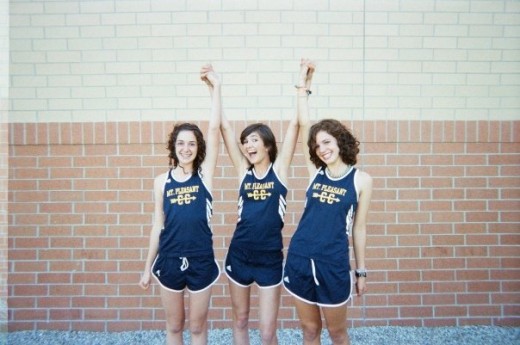
Cross Country Team Captain, Hannah, in the middle, surrounded by two teammates.

**********

Hannah said, “How much does a funeral cost?”  She was studying legacies at school.  “I’d rather spend funeral money on a piece of land where animals can roam and no one can build.  And, I’d put a running trail on it, winding through the woods, so people could go to a beautiful place and run.”

The cancer came and stayed.  The girl runs in her dreams.

**********

If you don’t want to miss an installment of the September Series, please subscribe. Here’s how:

Type your email address in the box and click the “create subscription” button. My list is completely spam free, and you can opt out at any time.

Isaac’s Story: A Nest Filled with Love

September is Childhood Cancer Awareness Month. Each day a different guest blogger will be featured who will generously share their personal experience with childhood cancer.  Stories are always more potent than statistics.  

By Sarah Steiner

I held his hand as he died.  Just as his time in the womb was just between me and him, so was his time of death.  After he took his last breath I told him over and over and over again that I was so sorry that all of the love the world sent his way wasn’t enough to save him.  And now, eighteen months later, I’m still so very sorry.

Isaac was the second of three boys.  The first five years of his life were filled with all of the normal things that make up early childhood. Learning to get along with siblings, playing with friends, developing his own special interests (Dinosaurs and Legos), the routines of preschool and church and extended family.   Isaac loved to help his Dad with yardwork and he loved to help me in the garden.  Isaac loved to travel to the ocean, the mountains and anywhere we took our pop-up camper.  He was a bright,  attentive, inquisitive and beautiful little boy with a world of possibilities in front of him.

And then a malignant brain tumor got in the way.  On June 6, 2011 Isaac was diagnosed with Medulloblastoma.  A “friendly” kind of pediatric brain cancer with a 90% five-year cure rate.  We held on to that statistic while our precious child endured brain surgery and proton radiation and a year of chemotherapy.  During this time Isaac turned to Legos as his form of therapy, went to kindergarten as much as he could and rarely complained.

I was exhausted as I shuffled him to doctors appointments and tried to maintain any kind of normalcy for my other children.  But in September, 2012, when his scans were all clean and his treatment was completed and he was declared cancer free, everything we had done to save his life was so very worth it.

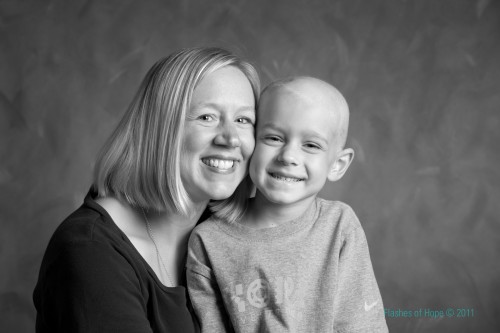
Isaac and Mom
Isaac and Mom

We celebrated.

We had saved the Make a Wish trip that Isaac had been given for after treatment.  In October, 2012 we went to Orlando.  We had never been there before and took it all in – Give Kids the World, Universal Studios and, of course, Disney World.  Isaac’s big brother fought Darth Vadar, our boys made lightsabers, they got Harry Potter wands and we crammed as many magical moments into that week as we could.

We returned home from our trip and got back to “normal” life.  This meant school for Isaac and his older brother and time at home with mom for his younger brother.  It meant that work resumed as usual for Dad and this included frequent travel.  We were busy and we were grateful.

Eight days after we arrived home from our Make a Wish trip Isaac began to complain of pain in his spine.  He had difficulty walking and frantic phone calls were made to his doctors.  The morning that he had a scan scheduled he woke up and couldn’t move his legs.  Before we even got in the car that day, I knew.  I knew the cancer was back.  I knew it was everywhere.  And I knew it was going to take him.

As the doctor showed me the images of the cancer throughout his body, I looked and her and said, “No.  More.  Pictures.”  I had seen enough. All I wanted to do was get my child home and love him.  He had endured enough.

So that’s what we did.  We made a nest filled with love for our six year old and tried our very best to allow him to die with dignity surrounded by all of the people and things he loved most during the last months of his life.  This meant there were lots and lots of movies (Star Wars, Lord of the Rings, Harry Potter), lots and lots of Legos, a brand new puppy and one last birthday party, when Isaac turned seven.

On March 6, 2013, Isaac squeezed my hand two times and was gone.  He told me once, “My love will never stop flowing.”  And my love for him will never stop flowing either.

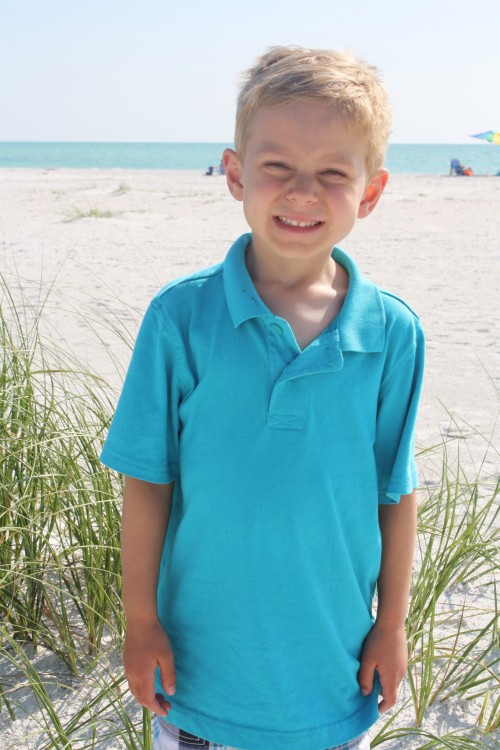
Isaac.
Isaac.

I still picture Isaac as the bright, attentive, inquisitive and beautiful boy that he was.  He was so much more than cancer and remains so much more than a statistic.