My 81 year old father, Da, died last spring. He was a lion, a character, a flawed King Lear, my anchor. He taught me much and I am grateful for his lessons. I miss him.
Because I spent twelve years working professionally with older adults in health care, aging was something he and I spoke of frequently. Sometimes he would allow me to accompany him to the doctor, though usually not. He used to say that his kids should send him out to sea on a raft if he ever got too old to function or exercise his independence.
My father died like many older Americans are dying these days — entwined in a medical system that is not equipped to cope with the needs or wishes of our older adults, many of whom are kept propped up through ill considered medical interventions.
His last five months were heartbreaking — nothing he would have ever wanted for himself and nothing I would have ever imagined for him. Two of those months he spent hospitalized (in three separate hospitals) and three were spent in a locked assisted living unit for people with dementia. He called it a “warehouse.” He was not wrong.
He did not have dementia and it was only confirmed shortly before his death that the acute and quickly evolving cognitive, behavioral, and neurological changes he experienced in those last months were caused by lung cancer. The same lung cancer that had been treated the previous fall, doctors felt successfully.
He knew he was dying long before I did. He told me one day and, in all sincerity, I tried to comfort him and explain that he was simply going through a difficult period. Sometimes I feel I failed him. I know that our medical system failed him.
I started photographing him in January 2015 when the sunlight on his leg dangling from his hospital bed struck me as poignant. I snapped a photo. I kept snapping photos as the months went on. He and I talked about the photos, he looked at them sometimes. While we never discussed what I would do with them, he knew why I took them. To remember.
I am fortunate that my father was a great supporter of my work, my writing — specifically how my husband and I documented our daughter’s cancer online. He read every word and saw its merit. I see these photos serving a similar purpose — to educate and encourage a dialogue. I really think my Dad would get a kick out of that — his stubborn version of having the last word.
I am the youngest of four siblings. The baby. Three girls and a boy. I have never written too much at all about family dynamics because it’s not solely my story to tell. As with any family, there are many stories to tell, but I don’t have exclusive ownership of them, so I simply don’t tell. Maybe someday when I am old and gray. Right now, I am just middle-aged and gray, so the telling still feels premature.
A few years ago I asked my Dad if I could write about what it was like to grow up with a father who experienced depression. Not the blues, mind you, but depression. Hard core intractable not getting out of bed for weeks (months?) depression. I am fairly settled that if I ever write a memoir, the title I keep coming back to is, “The Depressive’s Daughter.” It has a nice ring to it, don’t you think?
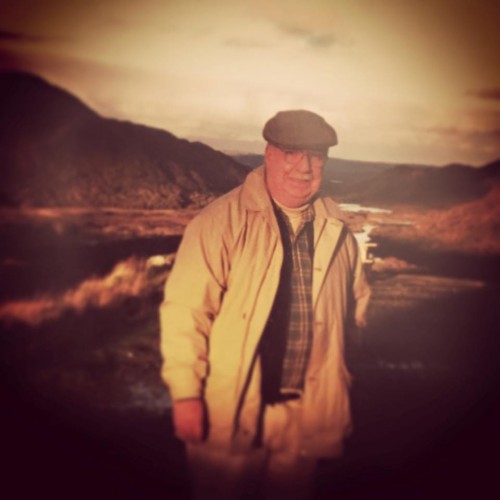
A candid I shot in Ireland on a trip my Dad and I took there together a few months before my wedding. He was so much in his element there.
Anyway. Clear as could be, my Dad said, “No. I wouldn’t want that. After I die you could.” Well, my Dad died almost three months ago. With his blessing, it is now my story to tell. I don’t think I’m up for that task yet, though. Not today. Not tomorrow. Maybe someday. Maybe never.
There are so many tasks when a parent dies. More so when your last parent dies. We are in the thick of that right now. Paying bills, closing up a condo, sorting through what our 81 year old father carried with him through his life.
Talk about depressing.
My two older sisters did the lion’s share of the work. I needed that. As POA for my Dad, I have been on high gear since his decline started in November. Now, as executor, I am overwhelmed with the legalities involved with closing someone’s estate. The task of sorting through a small condo full of stuff was too daunting to even imagine. I will forever be grateful to have been relieved of that task.
I am grateful this task is done, despite how final and brutal and crushingly sad it is to parse out your parents’ lifetimes and your own childhood all in one fell swoop. We done good, the four of us, and I think our Mom and Dad would be proud.
Nearing the end of the sorting (Did I mention my Dad was also a hoarder? True story. He blamed growing up in the depression for his tendency to not release a single sheet of paper that ever crossed his path.), it was time for all four of us siblings to do something I have dreaded — dividing up Dad.
When my Mom died ten years ago my Dad pushed hard to sell their rural retirement home and downsize into a city apartment within ten months of her death. Very methodically he supervised the dismantling of his home, with anything of value — either sentimental or economic — to be placed in the living room.
When we began the process of dividing things back then, it had the air of Christmas to it. We were that maudlin family who for years would talk and joke about what we wanted when our folks kicked the bucket. It was a rare thing for all of us to be together not on a holiday. But there we sat, cross legged on the living room carpet, waiting our turn to pick what we wanted to be ours.
My Dad devised a system of 1-2-3-4-4-3-2-1. The oldest picked first, leading to the youngest, then we went in reverse, with the youngest making an immediate second pick, leading back to the oldest. Being the youngest, I got to pick two things at a time.
The process was as joyful as it was excrutiating. I remember it got heated a time or two. Dammit!, you would think, as someone else picked something that was next on your wish list. And because we’re all Irish sentimentalists, the old copper kitchen canisters from 1958 had more value than a set of Waterford candlesticks. My Dad kept all of my Mom’s jewelry, except for a few pieces (I got the choker of pearls!). I think he was not yet ready to part with it.
My Mom’s jewelry lived in an empty can of cocktail peanuts for years before my Dad requested we all sit down and divvy up those treasures.
With our Dad gone, we only had ourselves to rely on during this last process of division. I was grateful to see my nephew was there, thinking his presence would keep us all honest. Surely we would all avoid the drama and act like adults if someone was there who only knew us as adults, and not as the children we felt like.
My Dad had held on to most of our big family treasures after my Mom’s death. Her oil paintings (she painted before and after her first couple of kids were born), a very finely calligraphed papal blessing of their wedding, Irish landscapes my Dad used to import during his years traveling back and forth to his parent’s homeland, a snub nosed Smith & Wesson, ephemera of a lifetime working in transportation and their mid-century marriage.
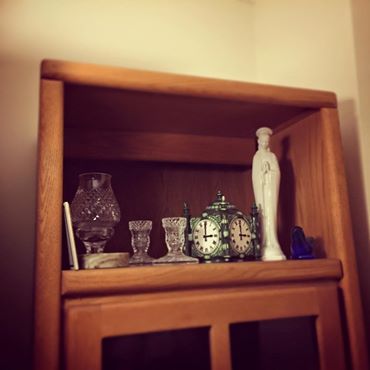
Some of my loot — Waterford crystal my folks loved, a Marshall Field’s candy dish, the Virgin Mary that lived on my Dad’s dresser from 1958 until he died, a Connamara marble ashtray, a cheap blue bird my Mom loved. All just things, but things that call up my folks and my childhood simultaneously.
So now it’s done. Dad is divided, equally, we all hope. My oldest sister, doing as oldest siblings do, brokered a stalemate and helped us all avoid ugly conflict around all four of us wanting the two to three most prized possessions. Thank you, brother and sisters, for all of us keeping it civil and drama free!
I am grateful this task is done, despite how final and brutal and crushingly sad it is to parse out your parents lifetimes and your own childhood all in one fell swoop. We done good, the four of us, and I think our Mom and Dad would be proud.
But so much of my energy was just spent getting through the division of Dad that I didn’t really allow myself to feel too much of it in the moment. Now is the time for feeling. As a light a candle in their treasured crystal hurricane lamp engraved for their 25th anniversary in 1983 that will now sit on a credenza that used to rest in their bedroom, I will think of my Mom and Dad often, with love and fondness and a little hole, which will never be filled in.
It will be okay. I know this because if you wait long enough, the sting of initial grief passes, eases, ebbs. I’ve buried my Mom and daughter, so burying my Dad is not the shock it could have been had this been my first time at the sadness rodeo. But it still sucks.
Today really sucked.
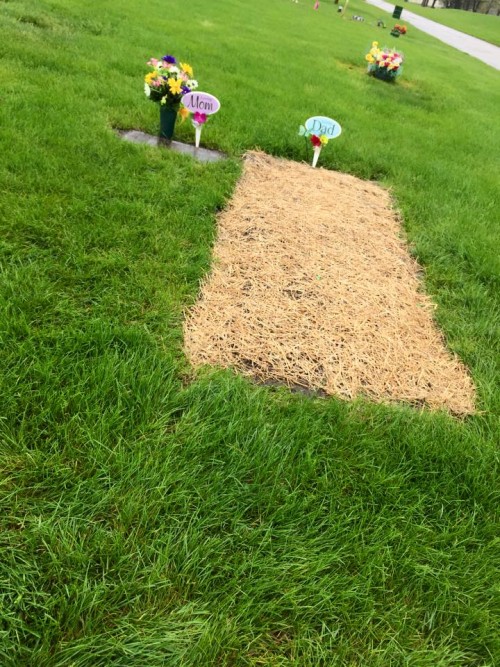
In a veil of light rain, I drove to my childhood hometown to finish some of the busywork of death — pick up my Dad’s death certificates at the funeral home and arrange for his headstone at the cemetery.
I haven’t lived in the south suburbs since 1992, moving from my parent’s home, my childhood home, to Chicago’s north side as a young woman of 22. That was over half my life ago. The area is simultaneously foreign and familiar. It feels odd to be back there, odd to bury my Dad there, like I’m leaving him without a ride home.
He moved to the South Loop neighborhood after my Mom died ten years ago. Like me, he, too, grew away from his south side roots, transplants both of us. Out of the blue he bought a condo last spring a bit further north. In typical Dad fashion, his decision was not up for discussion. It was his decision to make and he was not one to listen to the concerns of his children.
The view was spectacular — skyscrapers and CTA tracks. I got why he liked it so much. I wish he had had more time there. He did, too. When I looked for a new home for him in February, I thought he might like that the two windows in his assisted living unit overlooked a grassy area with a lot of trees. He hated it, preferring his urban landscape to anything nature offered.
You do the best you can when your choices are limited. I tried and my Dad tried. We both did the best we could in the face of his changing health. “Don’t worry about a thing, nothing will turn out all right,” was one of my Dad’s longstanding mantras. Wiser and more cynical words have never been spoken.
His point was that spending any amount of time or energy worrying was a waste of both of those precious resources. He always said that his mother taught him not to worry, that worrying never changed anything, so why engage in it? It seemed so simple when he said it.
When he was diagnosed with lung cancer last year, I knew he was worried. He didn’t talk about it too much and he preferred to keep the diagnosis private. Need to know basis, you know? I felt his relief after going through the radiation treatment. His radiation oncologist was the same doctor who treated my Mom and daughter. Talk about freakishly small worlds — oncology, even in a big city like Chicago, can be fairly incestuous.
He let me go to one of his appointments with her last year. Just one. My Dad was very independent in most every way. After his treatment ended, Dr. Marymount said to my Dad, “I think we got it. Lung cancer is the least of your worries.” She sent him on his way with an order for follow-up scans in three months. His cancer was caught early, stage 1. None of us were really worried. Turns out, we should have been.
Lung cancer is what is listed on his death certificate under “cause of death.” Lung cancer. Of course. Freaking cancer. Of course.
My Dad never made it to a follow-up appointment or scans. He was too busy with other medical crises that on the surface had absolutely no connection to lungs or cancer. I remember in January pushing, gently, for repeat scans. My Dad was already hospitalized. It seemed like a task that should be easy to accomplish. Ha — in Hospitalville, “common sense is non-sense,” another one of my Dad’s favorite mantras. Perhaps I should have pushed more assertively. Perhaps it wouldn’t have made a bit of difference.
We’re all gonna die someday. April 29, 2015 was my Dad’s day to die. Lung cancer is what got him in the end. My personal belief is that he died before May 1 to spare his estate the cost of another six grand of assisted living expenses and another six hundred dollar insurance premium. He knew. I am convinced of that. He knew.
I miss him. His death has brought me back to my Mom’s death ten years ago. They are together again now, side by side, just like in the full sized bed they shared since their 1958 marriage.
I miss them both. It feels a bit like a Mack truck ran over me today, so I don’t even know why I’m sitting up at 8:45 at night typing these words, other than I need to. Writing is part of the way I move through grief. Which takes me back to the first sentence of this post, “It will be okay.” It will. It’s not okay right now. Right now not much of anything feels okay. But it will be okay again. I hope.





 Mary Tyler Mom