Aging Parents: A Promise Kept

My Mom lived the last eleven months of her life with right sided paralysis caused by a bleed out in a brain tumor she didn’t know she had.  She could no longer walk, get out of a bed or car independently, bathe herself, or even wipe. There were cognitive changes and her communication was severely limited during that time.  It was heartbreaking.  My Dad was by her side for all of it.

I didn’t understand their relationship.  I chose a different dynamic for my own marriage. But my ignorance of how or why my folks stayed together is immaterial. There was love there.  I saw it and felt it, even if I didn’t understand it.

I promised my Dad, after my Mom died, that I would be there for him as a caregiver and advocate if he ever needed that.  The same way he was there for my Mom through those eleven months of what a brain tumor does to a person.
Promise meme

He brought in extra care when he could no longer manage himself. He negotiated hospital systems that are not easy to negotiate even for those of us who work(ed) in them.  He argued with surgeons and demanded basic care for my Mom when basic care seemed like a lot to ask for.

Caregiving is exhausting.  Advocacy is tiresome. Both are absolutely necessary in serious illness.

To be a surviving spouse is a tough, tough road.  It is lonely and quiet and empty and confusing.  The surviving spouses I worked with as a social worker taught me that.  To see what happened when they themselves came to the tipping point of aging, when their needs changed, sometimes slowly, sometimes rapidly, without a caregiver or advocate by their side moved me.  I never wanted that for my Dad.

My Dad was a guy who needed to be in control.  And he hated authority.  The irony of his own authoritarianism was not lost on any of us who knew him.  Whereas my Mom received care in a gracious manner, was pleasant, helpful, and patient, I worried that dependence and my Dad were not a good fit.  Certainly, the structure that most of our systems that accommodate older adults require — hospitals, nursing homes, assisted living communities — was not something that my Dad would ever adjust to easily.

We talked about this often, my Dad and I.  Joked about it, too.  HA HA HA!  Dad in a nursing home?  No freaking way!  “You should live with us,” I told him.  He agreed. Gratefully, so did my husband.  We all agreed to something we had absolutely no control over.  How naive we all were.  How wishful.

I imagined the perfect death, somehow, full of meaningful conversations and a hospital bed somewhere (I never quite got far enough in my dying Dad fantasy to pinpoint where that hospital bed would be in our home — living room?  guest room?  our room?) and grandchildren close by, fully aware of the sacred transition that was happening in their midst.

Sigh.

What really happened did not look at all like that fantasy I had conjured.  What really happened was sudden acute changes in my Dad that both shocked and terrified those who loved him.  What really happened was eight weeks in a hospital fighting for basic care most of the time.  What really happened was a trial discharge to my home and a re-hospitalization just 40 hours later, but not before tears fell and I heard the begging pleas of my 81 year old Dad to be allowed to stay, something that was simply not possible given the severe change in his needs.  What really happened was an unexpected move to an assisted living community that my Dad hated.  What really happened was not at all what I imagined would happen.

Most of it sucked spit.

In the end, after advocating for a palliative care consult with siblings and doctors, I got the call on a Monday afternoon that my Dad was more appropriate for hospice, not palliative care.  Cue the tears.  Again.

Things changed quickly when the decision was made to stop the cycle of health care hell.  There is a liberation, a familiar liberation I felt with the end of my daughter’s cancer treatment, of saying enough.  I knew from the many conversations my Dad and I had had about his health care in the past decade to know that he was not living the life he wanted to live.  He hated all of it — the lack of control, the confusion, the food, the new home he called a “warehouse.”  It was not the life he wanted for himself.

But he still needed an advocate and he needed more care than he ever had, now no longer walking and bed bound.  Hospice should be easy, but it isn’t always.  There are many instances of having to advocate and fight, literally argue, for more medication, stronger medication, different medication.  You think you will lose your damn mind in the process of having to justify the need for something that seems like basic human compassion.

But you don’t, you can’t, because you made a promise and your Dad needs you.  He needs you more than he ever has.  So I did what my Dad did ten years earlier for my Mom — I argued and pushed and advocated and did not give up.  “It feels like I am shouting into the wind these past three days, but I am going to keep shouting until someone hears me,” I told the hospice nurse.  Fifteen minutes later she was at my Dad’s bedside and finally, finally, someone understood my concerns.  She acted, she cajoled the doctors, the proper medications were ordered, albeit on a prn basis, which required one last advocacy push a couple of days later to straighten out.

I am tired.  I am worn.  My Dad is dead.  He no longer needs a caregiver or advocate.  I kept that promise to him, just as I told him I would.

These words are written not to solicit kudos for what a fine and loving daughter I am, but as a cautionary tale.  Every person you know and love who experiences serious illness requires an advocate and a caregiver.  You might know this, you might not.  You might have experience in health care, you might not.  Be prepared.  Trust your gut. Have a plan.  Know that your loved one needs you like never before.

When all is said and done, none of us want to live with regrets, either the person who is dying or those of us who will survive them.  I am so grateful I was able to help my Dad in his final months.  I am very sad it was as hard to do as it was.

The Call

A few hours ago the phone rang.  Typically, this is not a big deal.  Six o’clock, cooking dinner, the telemarketers know and use this time to reach you at home.  Except this wasn’t a telemarketer, it was my Dad.  And my Dad, as of one week ago, is on hospice care.  I literally cannot remember the last time my Dad called me.

Six months ago, a call from my Dad would have been a regular thing.  He, my aging aunt, my stubborn sister who spurns technology, and telemarketers are about the only folks who reach me on the landline.  And, full confession, had my Dad called me six months ago at six o’clock on a week night, I guarantee you I would have shut that call down and fast, probably with a sigh of exasperation for good measure, just so my Dad knew it was an inconvenient time for me.

6 PM is the height of the bewitching hour where the kids are losing steam before bedtime, I am juggling dinner and homework and a melting down toddler, and counting down the minutes before my husband walks through the door after long days for both of us.

But when your dear Dad who is on hospice calls you at 6 PM, you take the call and you’re grateful for it.  You realize, even while you’re talking to him, what a gift that call is and that you may never get another one like it.

Phone home

I spent a couple of hours at my Dad’s bedside today.  He didn’t really talk to me.  He slept, ate about eight sips of soup for me, grimaced every time he tried to turn over in bed, and didn’t respond when I said goodbye.

Hospice is the real deal, folks.  My Dad knows his time is coming to an end and we talk about it regularly now.  I don’t know if it is the quality of relationship we have, or that I worked with older adults and hospice as a social worker, but we speak about his death with ease.  We have both made our peace with it, it seems.

All of this makes me sad, so very sad.  I will miss my Dad terribly, something I was sure to tell him last week just after I informed him the docs thought he was hospice appropriate.  I also told him he was one of my very few anchors — one of the people I rely on most for advice, guidance, support.

Did I mention how much I will miss my Dad?  How much I have missed my Dad these past five months of medical turmoil?

I used to help people — older adults and their families — cope with this stage of life.  I have sat at the bedside of countless dying people.  Seriously, I don’t even know how many.  It was my job and my passion and I was good at it.

So much of being helpful is just about showing up.  Being there, being present, and bearing witness is the only thing a dying person needs at this stage of the game.  I did this for many clients over the years and now I am doing it for my Dad.

It’s a different experience with my Dad.  I go home heavy, feeling the weight of his soon to be absence. I want to cocoon up in my bed, alone and silent, thinking, until the next time I can be at his bedside.  I don’t truly want to be anywhere else right now.

But that’s not realistic for me.  I have kids and a husband and a badly neglected blog. The dinner must still be made, the laundry must still be washed, the kids must still be bathed and shuttled back and forth and cared for.  So tonight, at 6 PM, I was doing just that — tidying the house, supervising homework, wondering what I could pull out of the fridge and call dinner when the phone rang.

And there was my Dad.  “What’s happening?” he asked.  Just like that.  Just like it was six months ago and he was perfectly independent and perfectly healthy — well, as healthy as an 81 year old man with a history of lung cancer, heart attacks, COPD, and emphysema can be.

He asked what I had done all day, not remembering that it was me who had fed him his soup at lunch, me who had stuffed the pillows behind his back to help achieve some level of comfort.  He wanted to know when I would return.  He wanted to talk about money, “Who’s paying for all this?” he wanted to know.  I am hoping that by tomorrow he forgets he was curious about money.  My Dad might shoot me if he knew how expensive it is to die these days.

For those few moments, on a call at six o’clock, it was just me and my Dad talking about our days.  What a gift.

Aging Parents: Growing Older, Growing Invisible

Today I reached max capacity.  After over three months of my Dad being in some or other sort of medical crisis, I wept on the kitchen floor, no longer able to hold it in, as my two sons played and laughed right beside me, looking at me like I was some sort of zoo exhibit, uncertain what to do with Mom losing her cool.  Poor kiddos.

The doing and the busywork of caregiving was no longer enough to keep the feelings at bay.  I knew they would come out eventually and today was that day.  What finally got to me was seeing my Dad work so hard to get out of bed — really focusing and using every bit of muscle and reserve in him just to stand up and get out of bed, and in the midst of that, having a CNA, just going about her business, trying to remove his IV while he was in the middle of this struggle.

I wanted to jump across the bed and throttle that girl.  I didn’t, but I wanted to. Instead, I took a deep breath and calmly asked the CNA if she could wait a few minutes so my Dad could focus on his much needed therapy.  If I could see that he needed to focus and that too much stimulation from too many directions might be just enough to send him back to bed, why couldn’t she?

On the drive home, I was a mess.  My nine years as a social worker in a retirement community came splashing back to me.  Specifically, the monthly caregiver support groups I facilitated.  God.  How very little I knew then.  I would sit at a table with eight to twelve caregivers, typically spouses or adult children, of someone living in our nursing home section.

They had so many complaints, these caregivers.

I remember the push-pull of wanting to address their service complaints, but also encouraging them to cope with the emotional impact of caring for someone they love, seeing someone they love weaken and diminish despite their best efforts.  Pffft.  My guess is they might have wanted to jump across the table and throttle me.  If I could reach back in time, I would throttle myself.

The truth is, sometimes care sucks.

Sometimes a hospital is going to sit on test results for twelve days, while your Dad worsens each of those days, losing the ability to walk and talk before they act. Sometimes (this has happened twice in two months now), a med tech will shave off your father’s moustache and goatee without his permission, so that he doesn’t recognize himself the next time he looks in the mirror.  Sometimes a nurse will ask why your father doesn’t go to karaoke just days after losing his home, identity, and independence.

It’s enough to make you want to scream.  And if it’s hard for me, I truly cannot begin to imagine how much this hurts my father.  My lion of a father, my force of nature dad, is becoming invisible.  It’s as if the great eraser in the sky has started the work of removing him, bit by bit.

The hardest part — the thing that had me reeling on the kitchen floor this afternoon — was knowing how aware my Dad is of his decline.  He feels his growing invisibility, he knows it is happening, and he believes there is nothing he can do to stop it.

My Dad is not invisible.  I see him so clearly.  I wish everyone did.

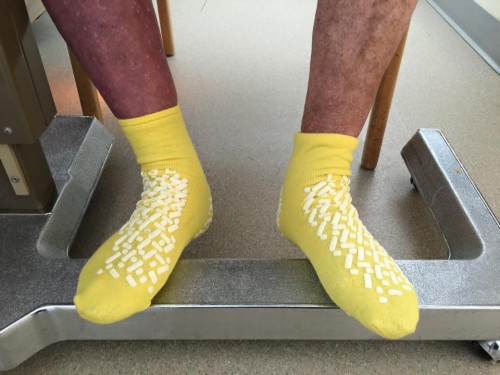
Dad's feet