Loving Chicago Is Complicated, But It’s Home

As a white, middle class woman who lives on Chicago’s far north side, it’s easy for me to talk about loving Chicago.  It’s easy for me to feel defensive when I hear politicians and muckrackers and outsiders like Trump and Giuliani and FOX News anchors talk smack about my city.  It’s easy for me to stay in my lane, feel the security (false as it may actually be) of living in my white, middle class bubble.  It’s easy for me to feel angry towards folks I knew long ago who wonder why I stay and feel the need to tell me to leave, now, before it is too late.

The truth is that I love Chicago, despite its many flaws.  It is my home, gifted to me by my four immigrant grandparents who crossed the Atlantic to settle here.  Chicago would be their new home, their chosen home.  They worked in steel mills and scrubbed the floors of tony addresses on Division and rented apartments in Englewood and owned a sided bungalow in Vrydolyak’s 10th Ward on the southeast side.

My beautiful skyline, dressed up for Spring.

In the 1990s, when all of my family opted out of Chicago, I stayed.  When people came home, where would they go if none of us were here?  I stayed and made it my home.  I’ve had addresses in neighborhoods like Lakeview and Ukrainian Village and West Ridge and Roscoe Village.  I’ve lived in Chicago proper longer than any other place and my roots here are deep.

But my eyes are open.  Wide open.  The Chicago I know and love does not exist for everyone.  Chicago is brutal.  Is it cruel.  Its politicians are misguided at best, corrupt at worst.  Its police force is in bad need of reform.  Its public schools are segregated and inequitable, just like its neighborhoods.  Its violence is relentless.  Its infrastructure is aging.  Its pension obligations are staggering.  It needs help.

And yet, despite all these problems, I don’t think I will ever leave.  Hell, our older boy’s middle name is Daley.  That was intentional and less about an idealization of the Irish Catholic Mayors Daley and more about a mother’s hope that if he ever leaves this place, he will always know it was home.

My city, like America, is long due for a reckoning.

Milwaukee Avenue mural, Wicker Park.

Chicago’s history is storied and deeply entwined with institutional racism.  Factors that were put into play decades ago are still wreaking havoc on black and Latino folks.  Neighborhoods that were once jewels are struggling with gun violence and gangs.  Other neighborhoods that were ethnic centers with affordable housing stock are gentrifying, losing their literal and figurative flavor, now catering to those who can afford million dollar homes.

As an adult raising children here, we’ve made choices to try and balance providing our kids a safe and comfortable environment while still having them be in what is very much a thriving, diverse neighborhood, full of apartments, condos, and single family homes.  Our neighbors are black, white, Latino, Middle Eastern.  When I look out my front window, it’s an even toss to see someone wearing shawls and yarmulke, a burqa, or the latest pair of Jordans.  Someone once told me I live in a fairy tale and my neighborhood isn’t real.  Nope. I can’t abide folks I knew long ago suggesting that our valid life choice to live in an integrated neighborhood is somehow pie-in-the-sky romanticism.

Our older boy is enrolled in one of CPS’ controversial selective enrollment schools that many consider elitist, but he was also reading at three and has some pretty unique educational needs that are very well met there .  Our younger guy will, most likely, attend our neighborhood school up the street when he starts kindergarten next year.

Again, though, is that issue of choices, and the privilege inherent in having them.  My family has choices.  We can move schools or addresses.  We can leave any time we want.  What we want is to stay.  For us, staying means acknowledging that there is a deep and profound inequity in Chicago, just like many other American cities.

We want to teach our sons about the whole of Chicago, not just its bright and shiny parts.  And, like my father did with me and my siblings, we want our boys to feel an ownership with every part of this city — its steel skyscrapers, its cultural offerings, its gorgeous lake shore, its public transportation, its segregated neighborhoods, its alleys, its projects, its racism and ugliness, its storied colleges and universities, its muck, its majesty.  If my boys grow up to be like my Dad, who appreciated most everything about this city, we would have succeeded.

Last weekend was horrific, with over seventy shootings, more than a few of them children.  This weekend was calmer, only thirty-three folks were shot.  Hard to believe that almost three dozen shootings feels calm, but there it is.  My older boy and I spent Saturday afternoon walking up and down local alleys, looking for garage sales.  That kid never met a garage sale he didn’t love.  We scored a new scooter and book for him and a bag of magnetized cars for his younger brother.

Somewhere else, not too far away, some other kid was resting in a hospital bed, recovering from a bullet wound.  It ain’t right and we have to stop ignoring it.

_________________________________

Do you want to read more about Chicago from folks who actually live here?  Read THIS, something I wrote a few years ago — it even won a fancy award.  WBEZ reporter, Natalie Moore, wrote a book I highly recommend, The South Side:  A Portrait of Chicago and American Segregation, that taught me a tremendous amount about real estate patterns in Chicago that enforce racism.  Oh!  And you can pre-order the magnificent Eve Ewing’s, “Ghosts in the School Yard:  Racism and School Closings on Chicago’s South Side,” which breaks down the recent closure of 50 Chicago public schools.

Fireworks and Guns and Empathy in Chicago

My Facebook feed has been chock full these past few days with angry friends and family who live in Chicago and the surrounding suburbs.  Are they angry about the 101 shootings that occurred in Chicago over the long 4th of July weekend?  Probably, but that’s not what they’re talking about on Facebook.  They are annoyed at the loud and booming fireworks that have disturbed their peace over the past few days.

Officially, fireworks are illegal in Illinois.  Just like guns.  Officially, lots and lots of people don’t care.  As easy as it is to cross the border into Hammond or East Chicago or Munster and load up your trunk with fireworks before crossing back into Illinois is about as easy as it is to purchase guns and cross that same border.

Let that sink in for a moment.

fireworks1

There is no question that the noise from fireworks is out of control in the days leading up to America’s birthday.  And there is no question that the loud booms from firecrackers and Roman candles and other fireworks can be harmful to pets, young children, veterans, and others who may experience the loudness as a trigger.  I am sensitive to that and appreciate it is a real problem for a great many people.

But those loud noises are a passing nuisance that can be expected.  Every year around the end of June, we know that we will be startled by the explosive noises.  As I’m typing this, one just went off, and it’s 10:24 a.m. on July 5.  It sucks.  Last night felt especially out of control, as a few friends posted live video of how bad it was in their neck of the woods, and there is no question, it was pretty dang bad. The sounds mimic a war zone, without exaggeration, and go on for long hours late into the night.

fireworks2

These fireworks were shot off by my neighbors across the alley last night. They were “BALLS TO THE WALLS” loud.  The logo tells me they came from Krazy Kaplan’s in LaPorte, Indiana.  It is illegal to use or be in possession of these in Illinois.  It is illegal to purchase them and cross state lines, but, sure enough, thousands of nice and respectable folks, just like my neighbors, were shooting off these illegally obtained and transported fireworks across the city and suburbs.

This morning, I connected the dots between the local news about gun violence and my annoyed friends and family upset over fireworks.  This is an opportunity to practice empathy.  Those same folks whose lives have been disrupted in tangible ways these past few days can use that disruption as a way to better understand what it feels like for those other folks who live in Chicago neighborhoods where gun violence is rampant and disruptive, the difference being that the loud noises are more than a nuisance for some.  Those loud noises are attached to bullets instead of firecrackers.

Actual people in actual neighborhoods not five or ten or twenty-five miles away know to duck for cover while sitting outside or in their living rooms when they hear the loud bang of a gun being shot.  Those loud noises are business as usual in Chicago neighborhoods that are being decimated by gun violence that now garners international news reports and more than occasional tweets from our POTUS.

But that’s the small picture (micro system is what we used to call it in grad school).  The big picture (macro system, for those who like jargon) involves how easy it is to get guns into a city and state that until recently had very strict laws against gun ownership and use.  Because I write about gun violence on the ChicagoNow platform, an almost immediate response to anything I post about guns is, “Yeah, and you live in Chicago that had the strongest gun legislation in America, which just proves that laws don’t work!”

My response has always been the same — the guns are coming from outside Chicago and outside Illinois.  Chicago could have a wall around it and guns would still permeate it easily, given Indiana’s lax gun laws.

It was a gut check this morning to realize that as easy as it was for me to go into a gas station last weekend and purchase a few dollars worth of sparklers, that same ease applies to gun purchases.  And I can pretty much guarantee that those same suburban men who yell the loudest about Chicago gun violence drove their mini-vans across the border to stock up on illegal fireworks to impress the other dads in the sub-division.

We all have to start connecting the dots.  We all have to start taking ownership of the problem of gun violence.  We all have to understand how this isn’t strictly a Chicago problem or, as POTUS’ spokesperson suggested last week, a morality problem.  We all have to better empathize with the folks who live in these Chicago neighborhoods that are plagued with gun and gang violence.

The problems are clear.  Fixing them will be a lot harder than crossing that Indiana border.

The Women’s March: Stop Raining On My Parade

I count myself among millions of women (and men) who marched in protest last Saturday, the day after our 45th president was inaugurated.  What a fantastic, tremendous, momentous experience.  Chicago was enjoying an almost 60 degree day, with the bright sun both warming us and lightening the mood and spirits of us marchers.

It seems cliche to say there was an electricity in the air, but damn, there was an electricity in the air.  Happy anticipation was palpable as the crowd gathered and grew and grew and grew and grew.  I stepped on the train believing I was going to enter a crowd of 50K.  I stepped off the train, where we were packed like joyful sardines, and overheard the crowd estimate had been raised to 70K.  Soon, I heard were voices around me saying, “There’s 100K of us!”  Helicopters circled overhead as we came to Michigan Avenue.  Only later would it be confirmed that the crowds surpassed 250K.

march6

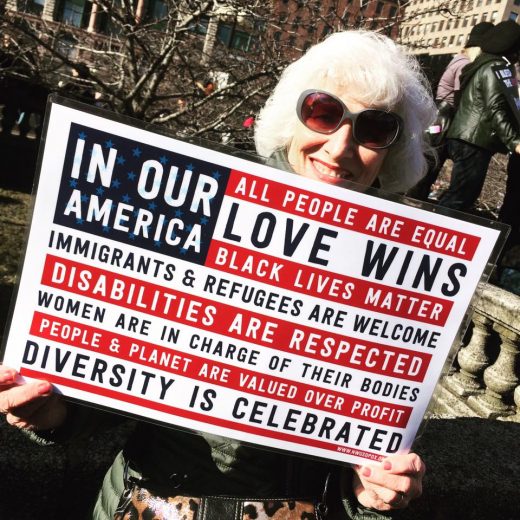
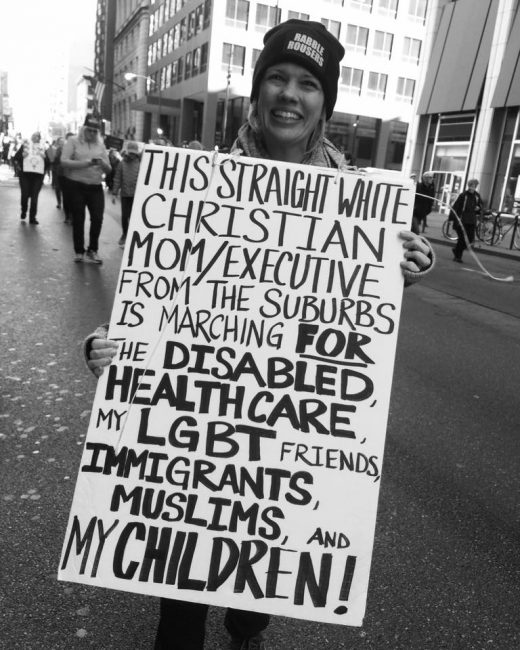
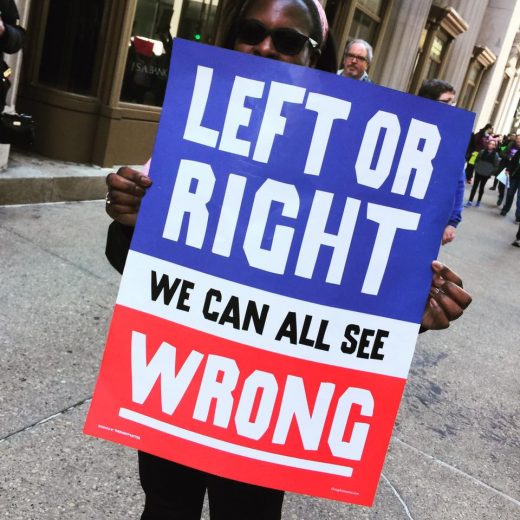
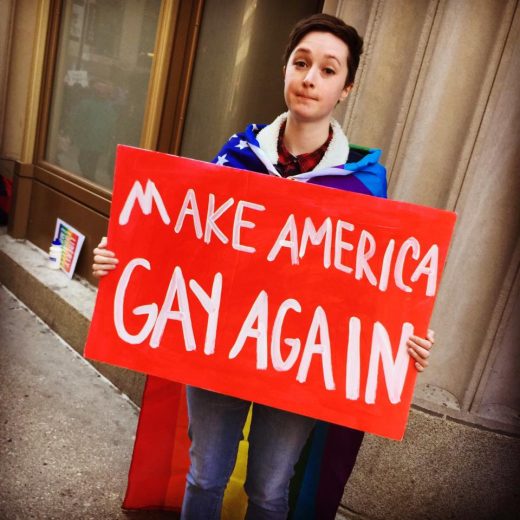
It was a sea of people.  Motivated, hopped up, angry, passionate, energized people.  My beloved Michigan Avenue was closed, full of humans as far as my aging eyes could see.  They held signs about public education and women’s reproductive rights, and black lives mattering, and LGBTQ rights, and climate change, and immigration, and religious freedom, and access to health care, and kindness, and love, and hope.  So many signs about hope.

I was with my tribe.  It felt good.

march2

Twice during the event, my sister and I positioned ourselves in places where we could watch the marchers around us.  I wanted to take some photos, but I also wanted to have some time to experience the scope of what was happening.  When you march, you sort of move in a pack.  It is a powerful statement and experience, but it limits your ability to see the bigger picture.  Stepping back and observing what was going on around us is a choice that I am grateful we made.  This is what I saw:

  • The crowd was primarily white women with healthy doses of white men, African American women (just a few African American men), Latinas and Latinos, Muslims, Arabs, and Asians.
  • There were families there aplenty.  Many with infants and young children, some with aging parents, some with three generations represented.  So many strollers, so many walkers, so many wheelchairs.  Hats off to all who required wheels on their march.  I also saw a few sibling groups — older brothers and sisters (folks in their 50s and 60s) marching together.
  • Lots of ages were represented.  I saw babies, young children. tweens, teens, Millennials, Generation X, Baby Boomers galore, and a smattering of the Silent Generation, who it turns out, are not always so silent.  Age diversity was a true strength of the march.
  • People marched for wildly different reasons, identified by the signs that they carried.
  • A few folks walked carrying flags.  There were American flags, rainbow flags, UN flags, transgender flags, pan-African flags, and Palestinian flags were among those I saw.  At one point, I was moved to say thank you to an older man carrying an American flag, as there is nothing more American than gathering to register protest.  He stopped, asked me to hold his bag, and fished out two American flag bows for me and my sister.  A kind gesture.
  • Joy was palpable.  Early on, three generations of Muslim women (granddaughter in her early 20s, her mom, her grandmother) walked past me as I was snapping some photos.  The mom smiled and waved at me, then she and her daughter briefly stopped and smiled for my camera.  That moment was full of peace and happiness, acceptance and awareness.
  • Hope was potent.  At one point during the march, chants of “This is what democracy looks like!” all around us, a young Arab man, probably early 20s, turned to me and said, “I have not felt this kind of hope in months.”  We smiled, I agreed with him, it was everywhere.  In that small moment, anything seemed possible.
  • People talked to one another.  We came with our own folks, but there was a great feeling of community and reaching out.  Post-march, after things were officially over, but before the police cleared the streets, a rousing concert took place smack dab in the middle of Dearborn Street.  Spontatenous dancing and singing occurred.  Art unites because of its humanity.

Saturday’s march was a beautiful, singular experience I will never forget.  I am so proud to have been a part of it.  I am honored to live in a country that (at least for now) allows me to exercise my right to gather and protest.  I stand by my belief that it was a worthwhile way of demonstrating my concerns about what direction the US, and the larger world, seems to be moving — one of increasing fear, intolerance, nationalism, and isolation.

march5

And then Sunday happened.

Initially, the criticisms came from the outside.  “Vagina screechers,” was the term a local school board member used to describe marchers.  There were lots and lots and lots of disparaging comments made about the weight or level of attraction of marchers.  As women under this administration, this is something we all need to get used to.  No matter the quality of intellect we have or the depth of our compassion, a woman will always be judged on her looks.  We are acceptable if we act in the manner we are told to act.  We are acceptable if we stay in our lane.  We are acceptable if we submit.  And it does not require a man to exert these limitations.  Fellow women are very happy to suggest other women are unacceptable.

march4

Soon enough, though, the criticisms came from within.  Those who were present, those who marched side by side, started jabbing at one another.  Handcrafted pink hats are elitist symbols of a hyper-sexualized binary gender interpretation of what womanhood means. White women who thanked the police accused of being racist.  Those same white women crying foul without pausing to listen and engage and absorb.  Women of color were not visible enough.  Using vulgar language or symbols denigrates our collective message.  If we don’t have a single unified message, the march was futile.  What was the point anyway?!

I’m not gonna lie, the day after the Women’s March sucked on the social media landscape.

But here’s the thing, as my sister (whose old lefty street cred is impeccable) reminded me, democracy is messy.  Creating a movement is messy.  Nothing is linear.  Total agreement will never be achieved.

march3

This is what I believe:  Participating in a protest that demonstrated such vast numbers and scope was an empowering experience.  For a few brief, shining moments, I was surrounded by people who both looked and did not look like me and we shared a bond of hope. We are at the beginning of a marathon, not a 50 yard dash.  White feminism is flawed and needs to be more inclusive.  Black lives matter. It is far easier for police to contain and manage a crowd of 250K  folks that look like their mom and sisters and grandmothers and daughters than a crowd of 1K that do not.

march8

I am okay with some messiness.  Those who are not may not be up for what is needed to sustain their involvement.  And all of that is okay.  As I try to do with most things in my day-to-day life, I will consciously work to act with compassion, empathy, respect, and an open mind.  I have my limits, to be sure, and I fail all the time, but I am reporting for duty, fired up and ready to go.

march7

march1