Cubs Star Anthony Rizzo Is Already a Champion to Chicago’s Childhood Cancer Community

Tonight, the Chicago Cubs are on the cusp of history — game seven of the World Series.  The pressure could not be more intense, yet there is a joy in the air, a sense of hope, and happy anticipation for some of their most vulnerable fans living with childhood cancer.

Ball player Anthony Rizzo is no stranger to hope.  Diagnosed with Hodgkin’s lymphoma at age 18, the young ballplayer was successfully treated and eventually found his way to Chicago.  Teammate Jon Lester is also a cancer survivor.  Their bond is strong (you can read about it HERE or watch a story about it HERE) and captures a side of these Chicago Cubs that many fans don’t see, but that those in the childhood cancer community are well acquainted with.

A frequent visitor at Lurie Children’s Hospital of Chicago, Anthony Rizzo is a symbol of hope and possibility for children and families coping with a childhood cancer diagnosis.  He visits frequently, spending time with patients, posing for photos, gifting baseball caps and tickets along the way.

For the families and patients who have come to think of Rizzo as one of their own, his support and recognition means the world to them, as they draw on his example of perseverance, coming out the other side, and defying expectations no matter what comes your way.  All important lessons for a child or teen coping with cancer.

A few patients and families treated at Lurie’s for cancer shared their photos and experiences with me.  File these under “inspiration” and enjoy.  And let’s all hope that tomorrow we’ll be flying that W.

rizzo5

Joe meets Anthony Rizzo

Joe absolutely loves Rizzo. Joe was going through a really tough chemo where he would go weekends at a time with no food … his mouth full of sores and his taste buds shot.  When the cereal RizzOs came out we were in the hospital on one of those endless weekends.  My mother-in-law got Joe a couple boxes of the cereal and brought it to the hospital, and guess what??? He ate a couple bowls of it!!!

He got to meet Rizzo and Joe asked him, “How did you go through chemo while already in the MLB?”  Rizzo told him, “You are great and will overcome.  When you feel okay, get out and play ball, when you don’t, rest.”  Joe took that to heart and always had that in mind.

What Rizzo did for Joe — giving him words of encouragement — had more of an impact that anything we could have imagined. Joe has stayed positive and always looks up to Rizzo.  Flavia, Joe’s mother


rizzo1

Maya and her mom, Rachel, on Anthony Rizzo

I will say it over and over again…Anthony Rizzo is not only a phenomenal ball player, he is an exceptional person. The amount of time, care and financial support he dedicates to children and families with cancer is truly inspiring. Not only have we come into contact with him at Lurie, but he sponsored Maya’s Water Sports camp experience through Children’s Oncology Services this past summer and he has supported events she has been a part of through the Leukemia & Lymphoma Society and Gilda’s Club, he is serious about the work he does in the cancer community and it shows.

Seeing him walk into Maya’s hospital room larger than life with that charming smile was not only a diversion from a rough treatment day or two, but he reminded us to stay hopeful. His visits gave us permission in those moments to believe in a future for Maya. There is no greater currency than hope when going through cancer treatment with your child. Anthony Rizzo is living proof that Maya’s dreams are not over just because she had cancer and that those dreams don’t have to be compromised despite the challenges she has faced as a result of treatment. Watching him play ball during the World Series only reaffirms this for us and I can’t help but think that the pure joy and enthusiasm he exudes is even greater because of his perspective on life. He is so fun to watch and we are all huge fans!

He also gave Maya the opportunity to make a great memory with her grandpa when he gave her tickets to a Cubs game during one of those hospital visits. My dad is a lifelong, diehard Cubs fan and he was able to accompany his granddaughters to their very first Cubs game because of that generous gift. That was an experience that will be treasured forever and it came at a time when making memories was at the forefront of all of our minds. I will always be incredibly grateful for that.  Rachel, Maya’s mom

rizzo3

Mia and Anthony Rizzo

Anthony Rizzo is not only an incredible sports hero to our family, he is a role model. Great at his craft, yet, even greater as a human being. An inspiration on multiple levels. You can tell where he gets it from when you meet his family. They are kind to no end. Having a child like Mia – fighting cancer – it helps to have motivation, inspiration, and friendship from people like Anthony. You root hard for him on the field and even harder off the field because you know he has been there. Struggled, suffered, and overcame. We love the RIZ. #44  Lisa, Mia’s mother

rizzo2

Jack with his hero, Anthony Rizzo

There is no more awkward time in this world than middle school. To be diagnosed with cancer and in treatment in middle school? Doubly bad. When every other boy is moving on, growing-up and getting stronger, you are stuck in a miasma of ick. 2 years out of treatment, our now 14 year old knows that he is mentally tougher than other kids his age and that grit sets him apart.  But he struggles to make up for the time lost to sickness, a time where his peers passed him up and passed him by. He focuses on being stronger and rebuilding his health and his mental game. But for the most part the positives are just theory and he wonders if he will ever get all the way back.

And then you walk through the doors on the oncology floor at Lurie Childrens and Anthony Rizzo is there. The living embodiment of all the good that can come from all the bad. The bigger, the stronger, the faster, the better. For a young teenage boy not sure if he will ever catch up with his peers because he “lost” years to sickness and chemo and hospitals and doctors, Anthony Rizzo is the proof. Proof that maybe it is not all just talk trying to make you feel better. It is proof that you can get there. You can catch-up, you can move ahead, you can be better. You are better.

Anthony Rizzo is a reminder that even with the worst possible odds, you can be the best possible version of you. Your had cancer, it is part of you but it does not define you. It might even help make you better than you ever thought you could be. Ann, mother to two sons with childhood cancer
rizzo4

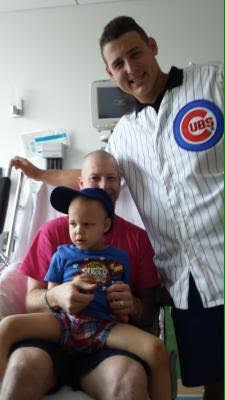
Kyler and Anthony Rizzo

I recently thought that if Kyler had survived cancer he would grow up to be someone like Anthony Rizzo. Kind, compassionate, caring, and for the cause of helping other kids with cancer, on top of being a great athlete. It made me smile. Thanks be to Rizzo.  Rebecca, Kyler’s mother

____________

If you would like to support the good work of the Anthony Rizzo Family Foundation, click HERE.  

Chicago’s Dirty Laundry Played Out in Baseball: North v. South, Cubs v. Sox

In America, it is a story as old as dirt.  The North v. the South, the Union versus the Confederacy, abolitionists versus slave holders, industrialism versus agrarianism.  In Chicago, it’s the northside Cubs and the southside White Sox acting as totems of geographical allegiance.

With the Chicago Cubs advancing to the World Series for the first time since 1945, this crosstown rivalry has reached a crescendo in recent days. Cubs fans are a bit stunned and feeling very, very celebratory, gearing up for their games of a lifetime, or as history proves, several lifetimes.  Sox fans are either quietly supportive, trash talking, or increasingly angry as their own World Series victory (Hello, 2005!) seems to be entering the footnotes of Chicago history.

Full disclosure, I am not a baseball fan, or any kind of sports fan, actually.  I do have some skin in this game, though, as I am a lifelong Chicagoan.  I spent my first 22 years living in the south suburbs, moving to Chicago’s northside the first chance I got after college and have called a series of northside neighborhoods home for the past 25 years.  I am fond of saying that you can take the girl out of the southside, but you can never take the southside out of the girl.

I credit my southside roots for my scrappy nature, never backing down from a debate, work ethic, and love of social justice and bargains (not necessarily in that order).  My grandparents were all immigrants, like so many other southsiders, and worked as steel workers and domestics.  I grew up in the land of landfills, where, when the wind was blowing just so, you could smell the stench of north side garbage being incinerated a few miles from our front door.  More than a few southsiders have some pretty sizeable chips on their shoulder, and for good reason.

A lot of this is being played out in the news and social media right now. These are legitimate concerns, given that so many national media outlets seem intent on putting forth the impression that Chicago only has one beloved ball club and they are called the Cubs.  Yesterday, on freaking ESPN no less, a graphic was used detailing Chicago’s ten national sports championships since 1965.  There were six for the Bulls, three for the Blackhawks, and one for the Bears.  Ummmm . . . yeah, no mention of the 2005 White Sox World Series winners.  Come on, guys.  That’s either nasty or lazy, but either way, it ain’t right.

You see, that kind of bias makes southsiders feel invisible, less than, unworthy.  Kind of like a local basket of deplorables, which is how they are perceived by more than a few northsiders.   That chip on the shoulder of many southsiders, while unfortunate and unattractive, was earned honestly.

It’s interesting to me that a national championship is leading to Chicago airing out its dirty laundry for all of Facebook to see.  There is a great divide in Chicago that runs far deeper than what baseball team you root for.  This northside/southside paradigm is real and deeply rooted.  And, like our current presidential election, it is bringing out the ugly in a lot of folks.

cubs-sox-logo-mashup

One childhood friend described getting a series of texts from Cubs fans rubbing in their pennant win, knowing she is a Sox fan. Another childhood neighbor described flying the W flag at half staff, a mandate from his southside wife.  More than a few Cubs fans have speculated to me that the reason Sox fans seem so obsessed with the Cubs is because the southside and Sox fans don’t even register or exist on the radar of your average northsider.

To me, it keeps coming back to that idea of being invisible and unrecognized.  It never feels good, so why would baseball be any different? Even if every media outlet across this great land of ours neglects to mention that Chicago enjoyed a World Series title eleven years ago in the form of a Sox win, that can’t erase the reality of their championship win.  The Chicago White Sox and their fans brought a title home.  Cubs fans then, like Sox fans now, might not have celebrated along, though surely some did cross fan lines to celebrate their city.

I’m told that sports rivalries are fun and longstanding and not going anywhere.  That’s cool.  There’s no need for a kumbaya moment here, but a little empathy goes a long way.  Wouldn’t it be grand if all you northside Cubs fans honored the team a few miles to your south, at least by recognizing their existence?  And wouldn’t it be swell if southside Sox fans didn’t feel the need to taunt and denigrate a team that is on the cusp of making history?

Find the common denominator.  It’s baseball, folks.  And Chicago.  It’s more, of course.  It’s an entrenched history of the haves and the have nots.  It’s a pattern of systemic devaluing of all things that happen to exist below Roosevelt Road.  It’s industry and manufacturing, the ruins of abandoned steel mills and undeveloped land, housing projects and white flight juxtaposed against lakefront mansions and million dollar condos, widespread segregation, disparity in public education, and any lack of outrage when people of color are shot and shot and shot and shot.

Wouldn’t it be amazing if baseball could cross that divide rather than add to it?  It’s possible, I think, but then again, I am fond of choosing hope.  As the Cubs go into game one tonight, whether or not you’re a fan, think about what a W could mean for Chicago, not just for northsiders or Cubs fans.  A win is a win for our city.  Or, so says this naive non-baseball fan with southside roots and northside address.

A Tale of Two Chicagos

NOTE:  This blog post was honored with the Peter Lisagor Award for Best Individual Blog Post, Independent 2015 by the Chicago Headline Club and the Society of Professional Journalists.  

One of my potent memories of childhood is packing into whatever used Cadillac my Dad was driving at the time for a weekend day trip, Montovani or Percy Faith playing on the 8 track. We lived in the southern suburbs and would snake up the Dan Ryan, the most infamous of Chicago’s expressways, and head north.  My Dad was always behind the wheel and the windows were usually down, as both my parents smoked.

It was not uncommon for my Dad to exit at the Robert Taylor Homes, in the Bronzeville neighborhood.  These were a collection of high rise housing projects made warm and fuzzy by the 1970s sitcom, Good Times, but in actuality were a vertical concentration of poverty, unemployment, crime, and violence.  And, yes, the windows went up, and the doors were locked.  My young heart beat faster in the few minutes we drove down State Street before re-entering the expressway north.  The buildings were enormous and barren and monolithic and terrifying.  Even as a child, I recognized the disparity between “us” and “them.”  Even as a child, I thought in those terms, “us” and “them.”

Was that racist?  Yes, I think so.  How could it not be?  Every face staring back at me from the other side of the window was black.  I never recall my parents or any of us saying much of anything as we drove down those intimidating streets.  There were no racial slurs on those drives.  Just quiet and heaviness.  I have no doubt that we all breathed a sigh of relief as we got back on the expressway.  Was that racist, too?  Yes, it was.

Those drives would continue all the way north, eventually winding through the posh, leafy suburbs of Chicago’s North Shore.  Places with names like Lake Forest, Kenilworth, Glencoe, Winnetka.  The juxtaposition between the extremes of Chicago’s poverty stricken south side and its tony North Shore estates were jarring then, just as they are jarring now.  Chicago’s disparity of wealth has not changed, other than becoming more intractable.

An important point to make, too, is that my heart raced as fast in those leafy wide lanes along Lake Michigan’s shore, just as they did in the Robert Taylor Homes. The sense of “us” and “them” was absolutely no different as I watched the people in tennis skirts, Lily Pulitzer prints, and pink oxford cloth on the other side of the window.

Was that classist?  Yes, I think so.  How could it not be?  Every face staring back at me from the other side of the window was rich.  I never recall my parents or any of us saying much of anything as we drove down those intimidating streets.  There were no class slurs on those drives.  Just quiet and heaviness.  I have no doubt that we all breathed a sigh of relief as we got back on the expressway.  Was that classist, too?  Yes, it was.

When my Dad died last spring, I prepared a eulogy for his service.  Those long drives on rainy or sunny weekend afternoons would factor prominently in how I remembered my Dad.  I thought of those drives as a lesson my Dad was giving, not in words, but in drives, about some people having more than us and some people having less than us and that we should be grateful for what we had, modest as it might have been in a working class suburb filled with ethnic whites with Polish and Irish and German surnames.

My sister had a completely different take on those drives.  For her, they were about my Dad laying Chicago at our feet — all of it — the good and bad, posh and poor, ugly and beautiful, dangerous and refined, black and white, that Chicago had to offer.  All of it was ours.  We had as much stake in what happened at the Robert Taylor Homes as we did with what was going on in Wilmette.  All of it was Chicago and all of it was our home. Ours.

Thinking about our conversation, I believe that my sister’s sense of why those drives happened was more likely.  My Dad owned every room he ever walked in.  Every single room was his.  Wealth did not intimidate him.  Poverty did not intimidate him.  Color did not intimidate him.  A person’s circumstances, blessed or damned, did not intimidate him.  He was just as likely to strike up conversation with the black man on the street corner as he was the white man dining al fresco and find value in both.

I thought of my Dad last week as I made a drive down that same Dan Ryan expressway, this time headed south, not north, with the Englewood neighborhood as my destination.  I was hoping to talk with Tamar Manasseh, founder of Mothers Against Senseless Killings (MASK).  I had read a news report about Tamar and her efforts to create a grassroots network of moms patrolling violence plagued intersections on the south side in an effort to discourage gun and gang violence.  The mere idea astounded me and galvanized me simultaneously.  Motherhood is a powerful thing and Tamar was proving that.  (You can read my companion interview with Tamar HERE.)

Tamar Manasseh, founder of Mothers Against Senseless Killings (MASK) and the activist behind Moms on Patrol.

I’m not going to lie, as I exited the expressway, that rapid heartbeat I had felt as a girl on those drives returned.  I don’t recall ever feeling quite that well intentioned or quite that white — the embarrassing stereotype of the Lake Shore Liberal come to life.  Yep, that’s me.

It was easy to spot the volunteers dressed in their hot pink t-shirts.  I turned onto Stewart and parked my ridiculous mom car.  True to form, I had brought along water and cupcakes to share.  WHO DOESN’T LIKE CUPCAKES?  Again, the stereotype I am makes me cringe at times.  I was grateful when a young man approached me.  It was clear that he was familiar with the somewhat pensive looking white lady type that I was.  With increasing coverage, more and more volunteers and donations are coming in to support the efforts of MASK.

Armed with a notepad and my iPhone, I set about the business of finding people who would talk to me.  It was easier than I thought.  The legit reporters with trucks and microphones and fancy cameras were across the street, panning the scene.  I was crouched on my knees, something no 45 year old woman can do for too long. People were happy to talk with me.

Tracy, PR Coordinator for MASK, and volunteer Mary.

There was Mary, a volunteer since the effort started on June 29th after the shooting death of a young woman.  Mary’s son was murdered in 2001.  She runs a weekly grief support group at Mercy Hospital.  There was Tracy, a PR executive who volunteers for the campaign every night and manages their social media.  She wanted me to know about the transformation of the young men with gang affiliations who were now regularly coming by to be a part of the nightly watch.  As a sign of respect and cooperation, they were pulling up their pants and wearing shirts.  These things made them less threatening to their neighbors.

Tamar and her cousin Eddie.

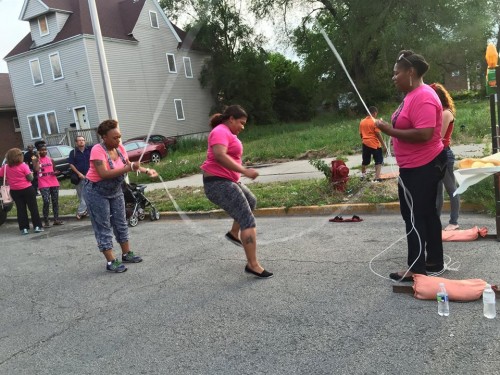
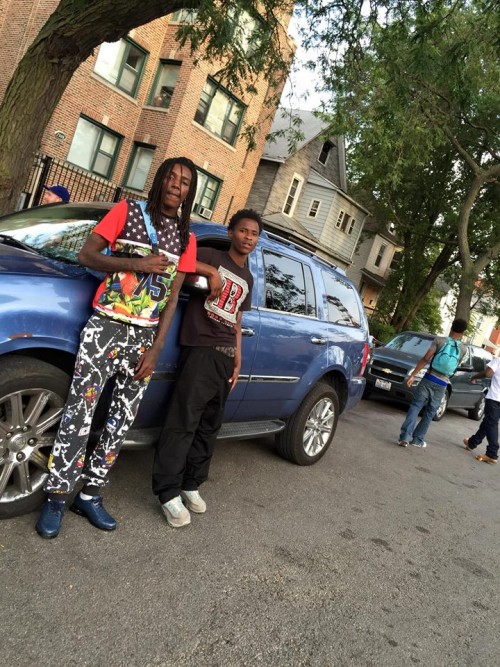
There was Eddie, Tamar’s cousin, who joined the Nation of Islam at 15 years old, three years after his own father was murdered.  There were two young men with dread locks who would not give me their names, but who believed that it would be “business as usual” once the moms packed up and went home.  There was the family down the street who did not want me to photograph them as there were drugs on the porch, but they talked to me about being able to let their little ones up and down the street this summer — something that had not been possible before.  There were the double dutch jumpers, middle aged women just like me, enjoying the pastime of their childhood, if a little more rusty at it.

Double Dutch on the corner of 75th and Stewart.
Dreads and cool threads.

There is no question to me that Chicago is deeply divided.  Talking with the good folks gathered at 75th and Stewart last week was like breathing air into a news report.  The “us” and “them” of my youth absolutely exists, but in those 90 minutes I was there, it was suspended.  What separates us is color and opportunity and school quality and access to resources and lack of hope and fear and racist institutions and drugs and crime and so many other factors that are too many to name.

Just as my Dad taught me on those drives so many years ago, this is “our” Chicago, not “theirs.”  When we acknowledge that what happens in Woodlawn and Englewood is just as relevant as what happens in Lincoln Park or North Center, and that the tragedy of one neighborhood is the tragedy of our entire city, only then can we truly call ourselves a Chicagoan.

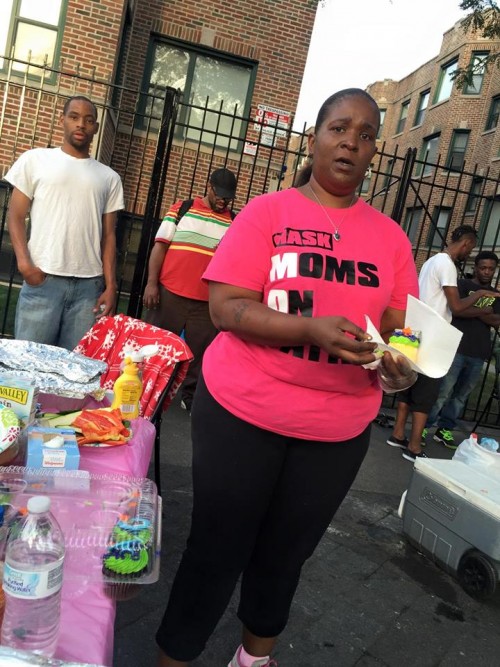
Kim D, manning the food tables that provide a nightly dinner for volunteers and local neighbors.

If you would like to help the efforts of MASK, click here.

**********

You know who can subscribe to my blog?  ANYONE!  You don’t even have to be from Chicago.  Here is how:

Type your email address in the box and click the “create subscription” button. My list is completely spam free, and you can opt out at any time.