Isabelle’s Story: Wintering at Shands

http://embed.newsinc.com/Single/iframe.html?WID=2&VID=25195296&freewheel=90921&sitesection=chicagotribune&height=281&width=500

September is Childhood Cancer Awareness Month. Each day I will feature a different guest blogger who will generously share their personal experience with childhood cancer.  Stories are always more potent than statistics.  The hope is that by learning about children with cancer, readers will be more invested in turning their awareness into action.  Read more about this series and childhood cancer HERE.

By Annie Bares Thomas

We wintered at the children’s hospital that year.  It was a colder winter than most, filled with stinging rain and painful memories.  I recall bringing Isabelle back to the hospital one night, after she spiked a fever and required urgent medical care due to neutropenia.  The sky seemed blacker than usual.  The air crisp and biting.

As much as I dreaded arriving at the parking garage, it was also my favorite place in the hospital.  It was our limbo.  If I was holding Isabelle in my arms in the garage it meant one of two things; either we were at the threshold of the cage-like constraints of being inpatient, about to fly free, or we were heading back in, still with the taste of freedom and home in our very recent memories.  I would never mind having to circle the many levels of the garage to find a spot, for it meant we were free for a few more precious moments.  My husband Alexis offered to drop us off at the front door.  Unless Isabelle was very sick, I always declined.  This was such valuable time for me.  I savored the last breaths of fresh air, in spite of the added smell of car fumes. Every time I pulled Isabelle out of our rusty, early model Volvo, car seat and all, I’d silently remind myself, “You can do this.”

Isabelle and her Mom, Annie, at the entrance to Shands

My usual brisk pace slowed as we neared the east wing.  The mechanical swoosh of the automatic doors foreshadowed the flooded heat of the hospital, immediately bombarding us with artificial warmth.  The smell of the air on the main floor was deceiving.  Fresh brewed coffee from the Java Hut intertwined with chicken from the cafeteria and perfume samples sprayed in the gift shop.  Here in the lobby we would see excited people rushing with balloons and flowers to meet a brand new family member, or swollen-eyed groups, leaving the hospital with weeks worth of belongings and one less in their clan.  As I held my neutropenic baby, I made sure to push the elevator button with my elbow and not my clean fingers.

We called it wintering because we were in a new and exotic place.  Isabelle had never been in a hospital before her cancer diagnosis, for she was born in an old Victorian house under the gentle care of midwives.  I too had escaped hospital life until now, as the only time I spent inpatient was as a healthy newborn, back in the 60s, when all babies were kept for a week.

We were treading on new territory.

I grew up in a large middle class family in a west Chicago suburb.  No one I knew ever “wintered” anywhere but home.  The first reference I heard to wintering was while watching a M.A.S.H. rerun on the black and white TV my sister Maria and I bought with collective babysitting money.   During one episode, Winchester met his match with another snooty officer who was visiting the M.A.S.H. unit.  As it turned out, the visiting officer was the son of a servant, so his experiences of “wintering” were those of the hired hand.  Yet, since he had been to all the right places, he was able to fool Winchester into thinking that he was more refined.  Kind of like us.  Wintering at the hospital, yes, but so very sure we were not like these other people.  We would spend some time here, okay, but we would not stay.  Isabelle would move on.  She would live and survive.  That was the thought that kept our blood flowing and our hearts beating.
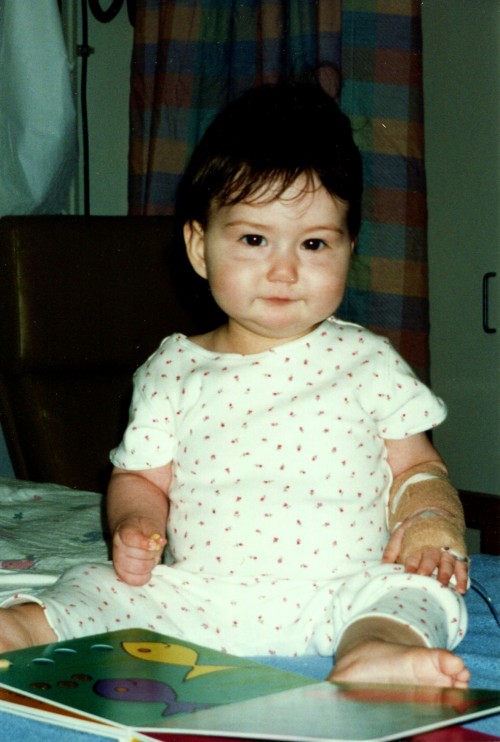
Baby Isabelle in treatment.

***

I remember the day my sister Maria and I planned to purchase that television so well.  I was babysitting Leah Simonek.  The money I would make from that visit would bring our savings to what we needed to buy our own television set… a true luxury of the time.  My dad was to pick me up, with Maria in tow, and we would head off to the Service Merchandise to complete our first major purchase.  We had picked out the TV weeks before.  It had a goldenrod frame with two big black dials on the front right hand side, one on top of the other.  The antenna was long, so we were excited about the possibility of being able to harness nine stations.  We longed to have our own television, as it meant we could fall asleep to reruns of M.A.S.H. and the Honeymooners, our two favorite shows at the time.

When my dad came to retrieve me, my sister Maria was nowhere to be seen.

When I hopped into my dad’s car he said nothing at first, other than, “We need to go home.”  I was angry and pouting as I knew we weren’t going to the Service Merchandise as planned, but I didn’t say anything aloud, as my dad was strict and not always approachable.  Mrs. Simonek, the woman I had been babysitting for, came running out to the car.

“Roger!” she yelled to my dad.  “Roger, I had a dream about Liz last night.”  My dad stopped her before she could say anything else.

He simply said, “Lizzie passed away today.”  Mrs. Simonek burst into tears, gurgled something to my father, and then ran for the safety of her home.

Passed away?  What did that mean?  I had only known of old people “passing away.”  Young girls, like my sister Liz, didn’t “pass away.”  As he pulled out of the long drive, my dad turned to me and said, “Lizzie died today.”

I was angry and confused.  I knew my sister had bone cancer, but no one ever told me she could die from it.  I went to the hospital with my mom the night before, at my pleading, and saw Liz.  She was alive and happy.  I remember my mom scolding me for eating food off the hospital dinner tray that my sister wouldn’t touch.  Liz laughed at me for getting in trouble, as she so often did.

“What do you mean, she died?”  I said, although I knew immediately after the words leapt from my mouth how ridiculous they must sound.  My dad’s uneasiness was palpable.  In my childhood experience, my mom would normally be in charge of braking difficult news.   A sigh escaped his lips, not one of aggravation, but of quiet desperation.

“Lizzie died today, Annie.”  The fact that he was calling her “Lizzie” instead of “Liz” clued me in to how serious a circumstance we were facing.  Liz was too cool and mature, in her eyes, to be referred to as “Lizzie” anymore.  Yet, as a child, we called her “Yibbie” first before we could pronounce the “L” that evolved her name to “Lizzie.”  Liz was her “high school” name.  She would be mortified at the thought that anyone would refer to her as “Lizzie” now.

But, according to my dad, Liz, Lizzie, Yibbie, Elizabeth, she was now gone from this world.  The idea of purchasing my own black and white television set no longer seemed like such an important task.  That day would forever be associated with grief; a giant red “X” struck across the little calendar box in my mind.

Liz, the author's sister
Liz, the author’s sister

*****

Because of Liz, my impressions of long term hospital stays did not have happy endings.  They were a slow and emotionally painful journey.  As we wintered with Isabelle, we too followed a slow and painful path.  Our greatest hope and deepest fear, both revolved around the ending, tethered by heartstrings, pulling us in both directions.

And so with that childhood reference to M.A.S.H., I came to the notion that we were wintering with Isabelle.  Maybe because M.A.S.H. took place in a hospital of sorts as well, the idea of wintering simply stuck.  As I would lie in the metal hospital crib at night, curled around my baby and mindful not to put weight on any of the tubes that connected Isabelle to the machines, and to life, I would often think of my sister Maria and me, falling asleep to the dim black and white glow of our television set, wondering silently to ourselves what tomorrow might bring.

Isabelle is doing very well these days, cancer free, thriving.  Grateful thanks to her mother, Annie, for sharing her story of how childhood cancer has impacted so much of her life.  

If you’re looking for all of the posts in the  Childhood Cancer Stories: The September Series, you can find them catalogued HERE.  

If you don’t want to miss a single child’s story, you can subscribe to my blog.  Please and thank you!

Type your email address in the box and click the “create subscription” button. My list is completely spam free, and you can opt out at any time.

Gabe’s Story: Fact, Legend, and Lore

http://embed.newsinc.com/Single/iframe.html?WID=2&VID=25195296&freewheel=90921&sitesection=chicagotribune&height=281&width=500

September is Childhood Cancer Awareness Month. Each day I will feature a different guest blogger who will generously share their personal experience with childhood cancer.  Stories are always more potent than statistics.  The hope is that by learning about children with cancer, readers will be more invested in turning their awareness into action.  Read more about this series and childhood cancer HERE.

By Randee Donovan

When I was growing up, my mom kept all of our family photos in albums.  They sat on a shelf in our living room.  Each album was burgundy, and it was numbered on the spine.  The photos were labeled with our names, dates, and little captions that she carefully hand-wrote on paper that stuck to the magnetic pages.  The first albums began with my parents, then me as a baby, and they went on and on, following all six children in my family through the years.

When my brother and sisters and I were kids, we would sit in the living room, and flip through the albums, admiring ourselves and memorizing our family history:  birthdays, dance recitals, Thanksgivings, and vacations.  Now, some thirty-eight years later, when my family tells the stories of our childhood, we often don’t know what is real or what is built around one of the photos in the album.  Over time, my family’s stories have become part fact, part legend, part lore.  The photos have shaped our memories or become our memories, and no one can say for certain which.

Batman & Robin, Halloween 2007.  Less than one month before diagnosis, I felt like we had everything we could want.
Batman & Robin, Halloween 2007. Less than one month before diagnosis, I felt like we had everything we could want.

Losing a child to cancer has had a similar effect on my surviving children’s lives.  My son Gabriel was born in May of 2006.  He was diagnosed with Acute Myelogenous Leukemia, the childhood leukemia that does not have a 90 percent cure rate, in November of 2007, five days after Thanksgiving.  He was treated at Ann and Robert H. Lurie’s Children Hospital of Chicago, which will always be Children’s Memorial to me.

Gabe’s doctor called us around 6:00 p.m. to tell us that he had leukemia.  We were told to be in Chicago less than 12 hours later so that he could begin his treatment.  His first stay in the hospital lasted a month.  For the less than six months that Gabe survived, he spent one night in the hospital for every night he spent at home.  He died very unexpectedly four days before his second birthday in May of 2008.  His wake was held on Mother’s Day.  He was buried the next day.

My son Jack was four when Gabe was diagnosed.  He was five when Gabe died.  Every weekend that Gabe was in the hospital, Jack was there by his side.  Even as the chemo ravaged Gabe, he would perk up for his big brother, have a bite to eat for his big brother, sit up and play with his big brother.  Today, Jack is 10-years-old.  He is smart, funny, and outgoing.  He is also a little bit nervous, a little bit outspoken, and a little bit angry.

Jack visiting Gabe at Children’s Memorial, December 30, 2007.  Gabe would light up when Jack entered the room.  They spent hours and hours in that bed, playing, eating, and watching TV.  Jack was by Gabe’s side through it all.
Jack visiting Gabe at Children’s Memorial, December 30, 2007. Gabe would light up when Jack entered the room. They spent hours and hours in that bed, playing, eating, and watching TV. Jack was by Gabe’s side through it all.

When he talks about Gabe, Jack remembers how “FUN!” the hospital was, that he got to eat breakfasts, lunches, and dinners from McDonald’s, and that he was a hero for his brother.  When he talks about Gabe, he also remembers helping us pin his screaming and flailing little brother to the floor so that we could give him the oral meds that he hated with a passion, he remembers putting on gloves and a face mask to “help” clean the rubber tubing that was inserted directly into Gabe’s chest to administer IV drugs, he remembers me pounding on the side of Children’s Memorial ambulance that was sitting at a red light in Chicago traffic on a rainy morning and begging the driver to take us to the hospital the day that Gabe died.

My daughter Grace was born 14 months after Gabe died.  Today, Grace is four-years-old.  She is bright, independent, and strong willed.  She is also a little spoiled, a little wild, and a little bit of a handful.  Grace never met Gabe in person.  Yet she also “remembers” Gabe and talks about him too.  Many nights, as we cuddle in her bed before she falls asleep, she says, “Tell me about your baby Gabe.”  And I do.  I tell her about the doctor taking him out of my belly, about bringing home a perfect, beautiful boy and watching him grow to love binkies, bubbles, his brother, his dog, toy tools, and cars.  I tell her about bringing him to the pediatrician and being told that he was very sick.  I tell her about taking him to the hospital where he had to sleep for a long time and get strong medicine that made him bald, weak, and sicker.  I tell her that one day, he died and went to Heaven.  I tell her that we all cried every day and every night for a long, long time.  And I tell her that one day, I asked God for another baby, and God said yes, and that baby was her.

Grace retells me this same story.  She looks at Gabe’s baby photos and the photos that I took nearly every day of Gabe’s treatment.  She inserts herself into Gabe’s story and into our memories.  She calls Gabe her “little brother.”  One day I corrected her and said, “No, Gabe is your big brother.”  She was so angry, and she said, “NO!  I am bigger!”, and I thought, “She is right.”  So now, she calls him her little brother, as in size, not age, and I let her, because technically she is right, and with age and experience, she will make that correction on her own.

So what is the reality of losing a child to cancer?  It is sad and dark and full of pain, anger, and destruction.  But over time, there comes light from memories that are shared and cherished and passed on by the people that were there and by the people that weren’t.  Which parts of Gabe’s story are fact, legend, or lore?  Many days, I’m not really sure.  Some days, I hold a toy that he held or a pair of his pajamas, and I wonder if any of it really happened.  Was he even really here?  But then the memory of that little boy, with the darkest, most beautiful brown eyes that I have ever seen, grounds me.  That boy shaped my family’s past, and he continues to touch every day, every experience, and every future memory that we create.

Jack and Grace, a back to school picnic at Gabe’s grave, August 20, 2012.  Seeing my kids so happy and comfortable eating McDonald’s by their brother’s grave breaks my heart.  It also fills my heart with happiness, because Gabe is a constant part of their life.
Jack and Grace, a back to school picnic at Gabe’s grave, August 20, 2012. Seeing my kids so happy and comfortable eating McDonald’s by their brother’s grave breaks my heart. It also fills my heart with happiness, because Gabe is a constant part of their life.

I got to meet Gabe in the hallways of Children’s Memorial.  Both Gabe and Donna had the same idea of fun — pacing laps around the floor, IVs trailing behind.  I first spotted Randee across a crowded playroom.  No joke, but I instantly loved her and instinctively knew we would be friends. She was my first teacher of what it was to be a grieving mom, and for that I am extremely blessed.  And somehow, whenever we are together, we laugh and we laugh and we laugh.  I love you, Mama.  

If you’re looking for all of the posts in the  Childhood Cancer Stories: The September Series, you can find them catalogued HERE.  

If you don’t want to miss a single child’s story, you can subscribe to my blog.  Please and thank you!

Type your email address in the box and click the “create subscription” button. My list is completely spam free, and you can opt out at any time.

Mia’s Story: Small but Mighty

http://embed.newsinc.com/Single/iframe.html?WID=2&VID=25195296&freewheel=90921&sitesection=chicagotribune&height=281&width=500

September is Childhood Cancer Awareness Month. Each day I will feature a different guest blogger who will generously share their personal experience with childhood cancer.  Stories are always more potent than statistics.  The hope is that by learning about children with cancer, readers will be more invested in turning their awareness into action.  Read more about this series and childhood cancer HERE.

By Lisa Jacobs Gurevitz

When my younger daughter, Mia, was nearing her second birthday in November of 2011, we received news that no parent should ever have to hear. Our lives changed forever in the span of a 5 minute phone call as we were informed, “Your daughter has a mass in her brain.”

We had taken Mia for an MRI of her brain after she fell off the weight and growth charts.   After the call, we were in a state of shock and fear.  Our lives had just been turned upside down. Outwardly we tried to keep things normal, especially for our older daughter, Rachel, who was just five years old at the time.  Inside, my head spun with thoughts no parent ever wants to think about, what no parent should ever have to think about.  After meeting with a neurosurgeon and coming to the realization that we were dealing with a brain tumor and furthermore, due to location, it is classified as inoperable, we were pushed even further into the darkest place imaginable.

A biopsy was done to determine tumor type (benign and generally slow growing, but a brain tumor nonetheless).  A couple of weeks later she received a port to administer meds and draw routine labs to monitor her blood counts. We met her neuro-oncology team and chemotherapy started. The tumor presses on Mia’s pituitary gland, which put her into an anorexic state.  She looked horrible yet remained sweet, silly and playful.

Along with chemotherapy came the vomiting, fatigue and hair loss. We saw what fortitude a child really has, what they can endure.  To boost her weight, Mia was put on 12 hour nightly IV nutrition. We thank our lucky stars for being matched up to the world’s best home health nurse. She taught us what we needed to know to manage the IV nutrition on our own.  She made Mia feel at ease during her weekly visits.  In addition, we spent every Thursday at the hospital for the chemotherapy protocol.

Mia and her family.
Mia and her family.

The hospital became quite important to us, like a second home.  In a strange way, it gave comfort to be there because something was being done to help her.  We were emotionally drained.  Our friends and family took charge.  We had rebuffed any offers of help, wanting to handle it all, feeling uncomfortable accepting help. It’s so much easier to give than to take. Friends and family persisted and schedules were created for meals, Rachel’s care, and ensured I had someone with me each week at the hospital. I was amazed and touched by the outpouring of concern and love that we received.  It helped us function.

Dan worked harder than ever because we now had huge hospital bills that quickly piled up. He jumped in to help whenever he could during the day and would split duties with me at night. Our parents stepped in for long stretches of overnight stays. This was our routine for the better part of nine months until Mia was switched to another type of supplemental nutrition and chemotherapy.  As is typical, Mia also had many inpatient admissions and ER visits.

It took months to accept Mia’s cancer diagnosis.  For a long time I would refer to it only as a benign brain tumor.  Denial helped for a while, but eventually I learned that cancer is just a word. It’s a really crappy word, but it certainly doesn’t define Mia.  We force ourselves to keep our lives structured for both of our girls.   While we live our forever “new” normal, cancer has affected every facet of our lives.  We want to hide from it, outsmart it, and run as far, far away from it as possible.  Yet it’s always there, infiltrating our family and our lives.

I mourn that old life; we will never get it back.  We will never be able to wake up from the nightmare that comes with a cancer diagnosis.  But day by day we accept what we can and try to function the best way we know how.  While much of the time it feels as if we are waiting for the other shoe to drop, it has also taught us to realize what truly matters in life.

With the countless horrors that come with a childhood cancer diagnosis, there are some silver linings too.  We have met other families living with cancer that we have come to care deeply about.  The Cancer World bonds us.  If we could only say we met at school, the park, Starbucks.  We revel in the good news about our kids and our hearts are heavy when the news isn’t so great.  We support one another in a way that only other parents going through this awful situation understand.  We are in the cancer trenches together.

Seeing how Rachel, entering second grade this fall, handles it all is bittersweet. I am proud of her and heartbroken for her at the same time.  It’s as hard for her emotionally, as it is for Mia physically.  My sweet first baby, this has shaped her life forever.

It takes a Village to deal with serious illness.  Our parents walk thru this with us too.  Their lives are shaken having a grandchild with cancer.  Family members near and far are affected. Our friends have been incredibly wonderful, loyal and steadfast. Thank you for being here for us since day one. Getting through this wouldn’t be possible without the help, love and never-ending support from our friends and family — Mia’s Peeps.

This story would be lacking without a huge shout out to Mia’s medical team, our Dream Team.  Your care, knowledge and never ending compassion as you guide us thru this journey means the world.  Thank you for always treating Mia as a person first and a patient second.

So how is Mia after 18+ months of treatment?  She’s a freaking warrior. She’s gained weight, she’s grown, but she’s still at least a head smaller than other kids her age and likely always will be the smallest of her peers.  She’s outgoing, outspoken, loving; full of sunshine and sass and throws tantrums like any 3 1/2 year old.    She’s in preschool, attended camp and loves her weekly dance class and horseriding lessons.

Mia’s scan this past June was her third  stable scan in a row and she’s currently off treatment. Her body will get a break, and while we don’t know how long that break will be we HOPE it’s for a REALLY long time.  While this is something to be happy about, it brings an entirely different set of emotions and anxieties.  She will continue to get quarterly MRIs, but now there’s not even the chemotherapy we love to hate protecting her.

Cheese!
Cheese!  A recent photo of Mia.

So what do we do?  We move forward while collectively holding our breath until her next set of scans.  We try to embrace this life and everything that comes with it — the good, the bad, the barf, the bald.

If you want to keep up with Mia and become one of her peeps, you can find updates at Mia the Warrior and Her Peeps on the Facebook by “liking” her page.

If you’re looking for all of the posts in the  Childhood Cancer Stories: The September Series, you can find them catalogued HERE.  

If you don’t want to miss a single child’s story, you can subscribe to my blog.  Please and thank you!

Type your email address in the box and click the “create subscription” button. My list is completely spam free, and you can opt out at any time.