65 Years Later: The Fire at Our Lady of the Angels School

Memories From a 5th Grader

“I did it,” whispered the boy sitting behind Ricky, as he poked him in the shoulder, “I did it.” Ricky did not dare turn around, as he knew it would result in certain punishment from the nun at the front of the classroom and he did not want to suffer the consequences of taking the bait from a kid who had a history of getting himself and others in trouble. Ricky ignored the whispers and pokes from the boy everyone called a “fire bug” as best he could.

Ricky is now Rick, a 75-year-old man who has lived in suburban Villa Park for almost five decades, but in 1958, he was a fifth-grader at Our Lady of the Angels Catholic School in Chicago’s Humbolt Park neighborhood. The “it” that his classmate was referring to was the December 1 school fire that occurred on that frigid day in 1958 resulting in the deaths of 92 children and three nuns, all teachers.
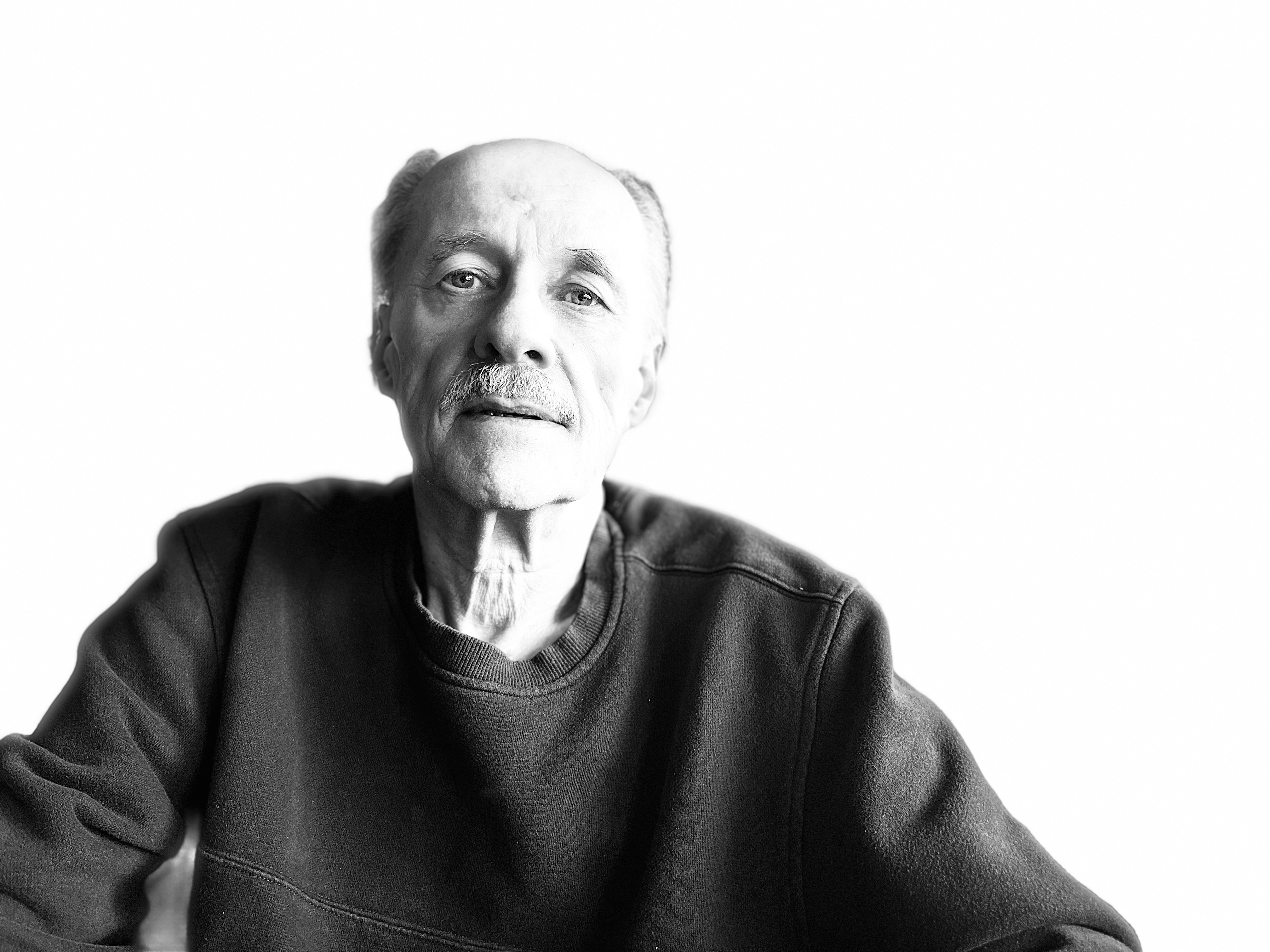
Rick, taken in October 2023, photo by Sheila Quirke.

It remains one of the worst school fires in history.

Officially, a cause of the fire was never determined, but that 10-year-old classmate who whispered into Rick’s ear would later confess to starting the fire during questioning from a polygraph expert and in front of several witnesses. Ultimately, the boy recanted his confession, and a judge threw out the case.

Today marks the 65th anniversary of that terrible fire, that terrible day. For Rick, it still feels like it happened yesterday. He wells up as he talks about it, memories pouring out, clear and detailed.
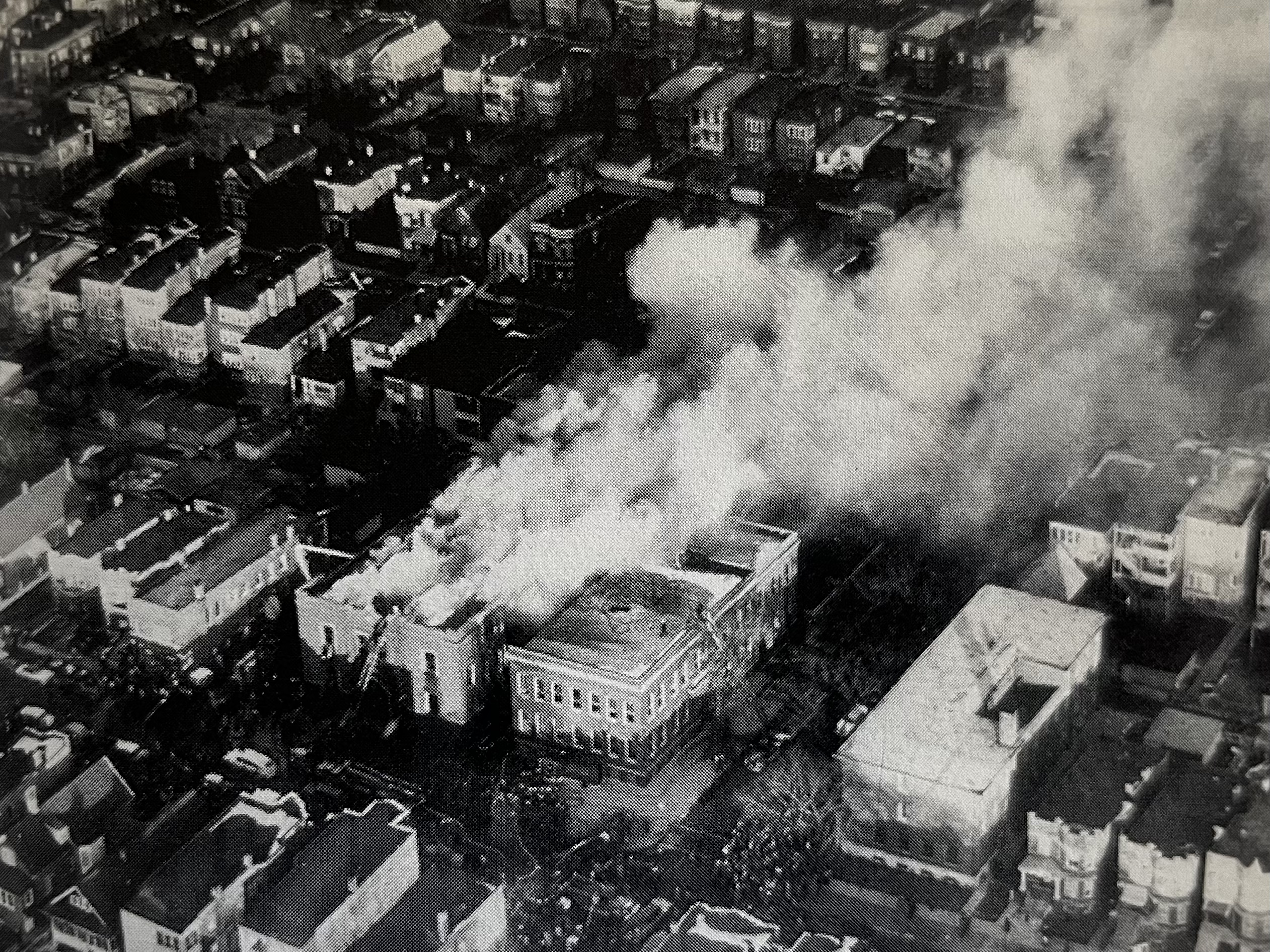
Photo from To Sleep with the Angels, of the OLA School.

Like any other day, Rick woke up and got ready for school on December 1, 1958. He had a slight limp from a recent football game and a large bruise on his leg. His mother decided he should stay home. Rick was mad – he had perfect attendance and if he missed a day, he would lose out on the attendance prize, but his mother insisted, “You can help me clean the house for Christmas,” she told Rick.

Rick remembers wiping the blinds in their apartment on North Trumbull when he first heard the sirens in the afternoon. They were deafening. His mother wondered aloud, “What the hell happened? Did the school burn down?!” Rick cheered at the idea, “YEA! Two weeks off of school!,” just as you would imagine a fifth-grade boy might.

Moments later the phone rang. It was his mother’s friend telling her that, yes, in fact, the school was burning down. “My mom went white and dropped to her knees,” remembers Rick, “She begged for forgiveness.” She ran out to the school, telling Rick to stay home, “Your father will be calling and I want him to know you are safe.”

Rick’s childhood home on North Trumbull Avenue, photo by Sheila Quirke.

Rick’s father did call. He heard about the fire while riding the bus home after work. A friend gave him a dime so he could call from a pay phone. Just as his mother wanted, Rick stayed to answer that call, reassuring his father that he was safe, though he wished he could have gone with his mother. It was his school that was burning and he was worried about his crush — was she okay? How bad was it? How were his friends?

It was bad. Very, very bad.

Later, Rick’s mother would tell him she saw Fr. Joe (Rev. Joseph Ognibene) “punching out windows,” working to free children from the smoke and flames. She saw many other children jump from the high second story windows, trying to escape.

A history of the fire was documented in the 1996 book, To Sleep with the Angels, by David Cowan and John Kuenster. Rick bought two copies of the book the day it was released, one for himself and one for his mother. He has never read it, but it sits on a bookshelf, an important document of one of his most formative experiences, “Maybe one day I’ll be able to take it down and do more than look at the pictures.”

Because he was not in school the day of the fire, Rick has mixed feelings about it, guilt being primary. His teacher, Miss Pearl Tristano, was the one who pulled the fire alarm, alerting those within the school to the danger. All of her 60+ students would evacuate the school safely. Other students in other rooms would not be so lucky.

“The school was immaculate,” recalls Rick, “There must have been an inch of wax on the linoleum.” It was things like the wax and linoleum that contributed to the conditions that made the fire so deadly. In one of the classrooms that had over two dozen deaths (there were three that logged numbers that high), those who died succumbed to smoke inhalation, not flames.

In the days that followed, Rick’s family, just like the rest of the Humboldt Park neighborhood, the larger city, and the whole country, grieved. “We were sad,” remembers Rick, “Mother and Grandmother were crying. Mom took me to four funeral homes to pay our respects, but after the fourth one I heard her say, ‘What are we doing? This is no good for Ricky.’” They stopped going to funeral homes.

Within a couple of weeks, the 1500+ surviving school children of Our Lady of the Angels (OLA) were back learning, tucked away in a patchwork of schools across the near Northwest side. “School and Church didn’t mess around,” says Rick, “We got back to class very soon after the fire.”

Chicago Public Schools and the Archdiocese partnered in opening classrooms to absorb the kids of OLA. Rick was reassigned to Our Lady Help of Christians on Iowa Street. His teacher, Miss Tristano, was gone and did not return. A nun he does not really remember replaced her.

“Everybody was sad,” recalls Rick of those days, “The whole neighborhood was down. Everybody knew somebody who was hurt or who died.” The mood, he says, was somber.

Rick also remembers that no one really talked about the fire or the deaths. He recalls hearing about one nun who “completely flipped out” and was quietly removed from her teaching duties. Rick describes one night he himself broke down, “I started bawling, crying like a baby on our living room floor, sitting in PJs, cross legged doing homework.”

Now, sixty-five years later, Rick believes he still has PTSD. “There was no discussion of the fire ever. ‘Offer it up to God,’ is what we were told. It kind of bugged me,” says Rick. “For my own sake, I would like to get over it.” To this day, Rick never uses candles and is extremely careful in locating fire exits when he is in public spaces.

“I’ll never forget it, ever,” says Rick, “I think about all the people. They were just too young. That fire was the turning point, for people and for the whole neighborhood. It was never the same again. The togetherness was gone. It’s still an open wound, but December 1 is like a holiday for me, a day to just remember.”
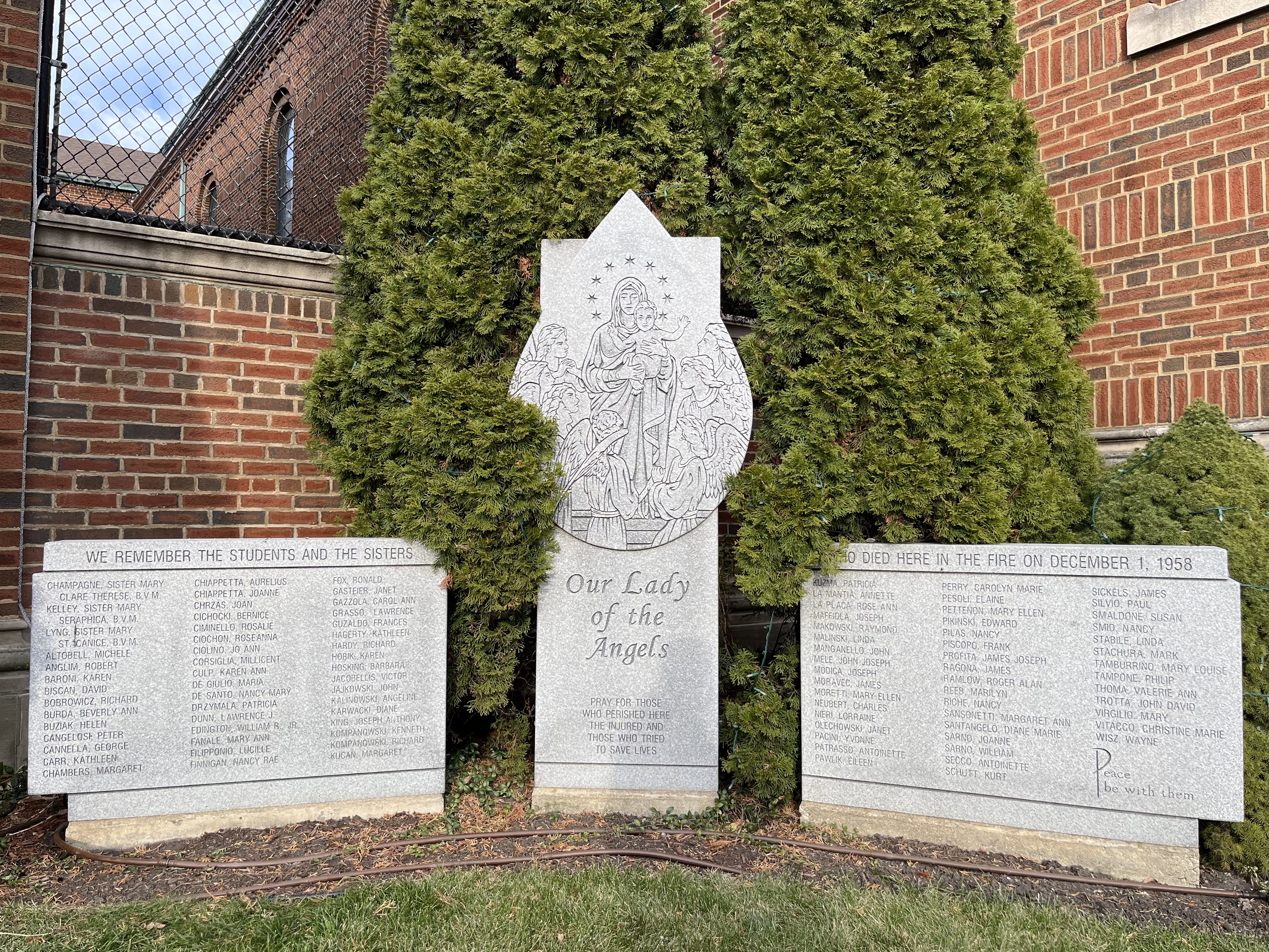
A memorial outside the OLA Rectory, photos by Sheila Quirke.

_______________________________________________________________

Author’s Note: I extend my grateful thanks to Rick. I grew up hearing stories about the fire at Our Lady of the Angels School, so it was always on my Chicago Catholic upbringing radar. I interviewed Rick on a completely unrelated matter and, as we are both prone to do, we got to talking. Before I knew it, Rick was recounting his memories of that fateful day. For me, he was like a history book come to life. I am honored to have been his audience in recounting his memories and humbled he agreed to let me capture them.

Find the Good Where You Can, Even a Grocery Store Parking Lot

Asthma has really put a crimp in my schedule this week.  My little one’s minor cough morphed into an asthma event on Sunday and five days (and counting) of missed school.  He vacillates between being a sad little muffin and a jumping bunny on steroids, because, well, he is on steroids.

My capacity to leave the house has been quite limited.  Doctor visits, school obligations, and the grocery story have pretty much been my only “Get Out of Jail Free” cards since Monday morning.  Life becomes a bit simpler when you don’t really leave the house much.

I learned how to bake sourdough bread (and, lordy, am I going to write the hell out of the metaphors of learning how to bake bread) and did a lot of laundry (lather, rinse, make bed, vomit, lather, rinse, repeat).  My little one has been sleeping with me all week, the husband banished to the guest room, so I have been settling in by 8 or earlier every night.  Everything has slowed down.

There is a liberation to that, the slowing down.  Sometimes I feel like life is so busy and just a series of jumping from fire to fire, water buckets sloshing all the way.  Other times I feel like a pinball in a machine, not in any kind of control over my trajectory, just bouncing off of the hard metal objects around me.  DING!  DING!  DING!

It’s exhausting.

But still, despite the benefits of slowing down, like, say, warm sourdough smeared with butter, I have occasionally felt a wee bit, well, cooped up.  An energetic five year old can be a lot for this old broad to manage, but an energetic five year old on steroids who vomits when he can’t stop coughing is next level.

Twice I got out to the grocery store, which is not a lot for me, as I tend to shop for what we eat in the next day or two.  I go to the store while the kids are at school because dragging kids through mundane errands tends to cue their outrage.  It’s easier and more pleasant that way.  But there was no dragging a coughing, vomiting boy into a grocery store.  Nope.  So, there was not a lot of grocery store happening.

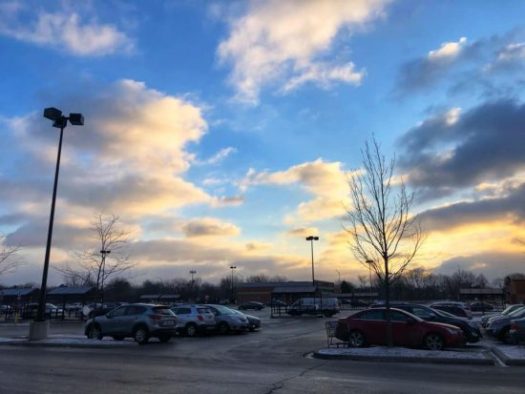
But on Tuesday morning at sunrise and Thursday evening at sunset, both times my husband was at home to take over kid duty, I ran out to the market to pick up a few groceries and some sanity.  And in those off hours, in those moments of the sun rising and setting, I looked up and saw two beautiful cloud filled skies.  And both times I was struck enough to pull out my camera phone and try to capture the beauty above me.

I don’t know if I was successful, as it’s hard to capture the beauty of a gorgeous skyscape on a camera phone, but I captured it well enough that as I was driving home yesterday, with the sky already changed and growing darker, I remembered the sunrise a couple of days earlier in a different grocery story parking lot I had also tried to capture.

Sunrise at the Mariano’s, 3.5.19

Sunset at the Jewel, 3.7.19

Seeing those two parking lot horizons reminded me of those days during my daughter’s cancer treatment when a solitary trip to the  store felt like winning the lottery.  The mundane is not a given.  The ordinary is extraordinary when you are living through sorrow and fear.

Asthma is not like cancer.  Thank goodness.  My son’s illness, while tense and scary at times, is pretty well managed through medicine and care that we have access to when needed.  Those are very good things and I feel lucky for them.

There was enough of a familiarity last night, the sunset behind me, the sense of liberation around me, that I remembered what cancer has taught me  — nothing is promised, nothing is forever, nothing is certain.  Grab what is good when you can.  Notice those sunsets and sunrises.  Look up.  Eat the bread, with the butter.  Take the picture.  Try to capture what you can.  Breathe it in, breathe it all in.


This Polar Vortex Has Me All Up In My Feelings, and What a Privilege That Is

If you’re lucky, the world stops in the middle of a polar vortex.  If you’re unlucky, nothing stops and there you are, working, making, doing, healing, delivering, surviving.   If you’re really unlucky, you are without a home, without proper shelter or food or gear or transportation.

I’m one of the lucky ones this go around with Mother Nature.  Our cars are gassed up, our fridge is fully stocked, the kids are in the background groaning about the iMovie app they’re trying to work on collaboratively.   Coen Brothers 2.0.  It turns out that 5 and 10 year old boys have very different artistic visions that result in noisy conflict.  Huh.

For many of us caught in this polar vortex, it is one of those precious moments that stretch into hours, sometimes days, when the world stops.  Attractions are closed.  Neighbors take the time to talk to one another as they stand in line in the grocery store or shovel out their cars on city streets.  There is a common enemy, shared experience, no blue or red, no north or south, less apparent difference.  It is us, together, against the cold, the chill, the snow.  We’re Chicagoans, strong stock, hearty, we got this.

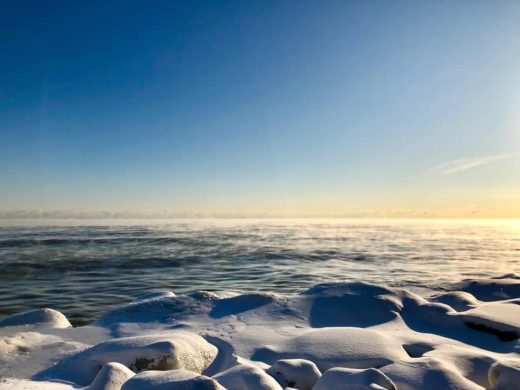
Lake Michigan, 1.29.19. Photo courtesy of Robert McNees (@mcnees).

This weather brings out the sentimental, melancholy Irish in me.  The world is still around me, time feels suspended.  Is it Wednesday?  Saturday?  The outside falls away and the bright sun, thank goodness for the bright sun, shines on the thoughts and memories of other times the world stood still.

I made a pot of spaghetti sauce last night and I marveled that it felt like a hug from my Mom who died fourteen years ago, cliched as that may be.  The wine and the sugar in the sauce, the smell, the comfort of her embrace.  She kept me company in my kitchen last night, shared dinner with the grandsons she never met.  It was lovely.

And I can conjure my Dad in his bright red parka, bought for a steal at the Bargain Nook in Darlington, Wisconsin.  “It’s like wearing a grizzly bear,” he would say, the proudest of proud men, confident in his strength, unfazed by notions as man made as “wind chill.”  There was another day like this in Chicago, before we called it a polar vortex, when Christmas was cancelled in 1983.  I remember layer after layer after layer that he put on before going outside to start the car.  For those moments he was my very own Pa Ingalls.

But most of all, when the world stills like this, I think of Donna.  For a moment, when my daughter died, the world stopped with us, her Mom and Dad.  For a moment,  the world around us hung suspended with us in grief and disbelief and sorrow.  It is the stillness that recalls that core of grief, that moment of departure, that time my heart broke and before it started to repair itself.

Now in the stillness, Donna feels closer.

Yesterday, Block Club Chicago posted a story about a Spanish artist, Eduardo Vea Keating, transplanted to Chicago.  He makes murals out of snow.  They are ephemeral and simple and melt quickly.  I’ve been thinking about his words a lot since yesterday, in the stillness, “That’s usually how life is.  It’s full of moments.  Some are better and some are worse, but life goes on.  [The art] will melt.  Everything will pass.  Just enjoy what you have around you and try to stay positive.”

I can do that, I can find the beauty in the stillness.  Not all of us can.  Chances are, if you are reading these words, you, too, have found some stillness.  Take a moment, look around you, at the steaming Lake, at the thermostat that reads a number starting in a 6 or 7, at the gas tank on “F,” at the smiling/shouting kids wearing pajamas past noon, at the spoon covered in batter waiting to be washed.

There is a beauty and a comfort in the stillness and the cold, if you are lucky.  Can you see it?