Can you see her? She’s there. Right there, always.
My daughter died seven years ago, next month. She was four. The concept of time plays with me on all things related to her. How is it possible that she has been gone so much longer than she was here? How is it possible that I haven’t smelled her or stroked her soft cheek in as many years as her brother has lived? How on earth have I managed things like groceries and laundry and vacuuming under the crushing presence of grief, a cruel master that never leaves you alone?
I walk through my days with my daughter by my side. She is invisible to you, but not to me. I can’t hold her or smell her or nag her to eat her vegetables and drink her milk, but she is there, always. She is there when I talk to you on the playground. She is there when I press the brake at the red light. She is there as I stand in line to buy pajamas for her two younger brothers. You can’t see her, but I can feel her.
It’s not enough, of course. I wish she were here in a way that children are supposed to be with their parents.
My invisible daughter would be eleven years old now. I have no freaking idea how to parent a tween girl. I imagine, often, that it is very different than the parenting I do know how to do — the kind that seven and three year old boys need.
I have no glitter in my home. No hair bows or Nickelodeon tween comedies. There isn’t a lot of purple or animal prints. Sleepovers are not yet much of a thing and I will never drop a dime at PINK. Training bras are something in my distant past, not an actual item in my laundry basket. Do eleven year olds go trick-or-treating? I don’t know. I guess I’ll find out in a few more years.
These are the things I think about without sharing with others. I haven’t figured out how to discuss my dead daughter in polite conversation. Dead kids are kind of a buzz kill.
I miss her, my invisible daughter. On days like this, when the light changes and pumpkins start to appear, my thoughts wander to not only the girl that was, but to the girl that never was, too. Would she like math or history better? Would mean girls have entered her orbit yet? What would eleven year old rebellion look like? Would she have started her period yet? What kind of things would make her laugh?
My daughter is invisible, but she is here. Always. With me, in my thoughts and in my heart and in my mother’s memory. You can’t see her and I can’t see her, but she is there in my tears and in my sad smiles. Science tells me that her DNA still exists deep within me on a cellular level, so, you know, there’s that, too. It’s not the same, of course. Not nearly.
My daughter is invisible. I miss her. I wish we could see her.
This post is part of ChicagoNow’s monthly “blogapalooza” series, where our community manager provides a writing prompt to all bloggers with the only rule being it must be published within one hour. This month’s prompt:
“Write about a period in your life when you were at your best.”
Dammit. This is a tough thing to consider today. Not really where my head is at, you know? But, a challenge is a challenge, so I will give this a go.
I remember October 2, 2011 vividly. It was a beautiful early fall day in Chicago. I was working part time at the Alzheimer’s Association in Chicago, right on Michigan Avenue. I had gone back to work ten months earlier after the death of my daughter in 2009. My profession was social work, but the kind of social work I did before my girl was diagnosed with cancer — working with older adults and their families in a retirement community, providing advocacy and counseling to elders and their families as they coped with aging and death — well, let’s just say that my head and heart were no longer able to do that type of work anymore.
An old acquaintance from graduate school was a VP at the Alzheimer’s Association and knew I was looking for work. I applied to a position she had recommended me for. It was a purely corporate type of gig. Foundation work, not clinical in nature. Part-time. Creating training programs about dementia for paid caregivers and family members. Full disclosure, it was never a good fit, but I appreciated getting out of the house, I liked my co-workers, and it helped me re-connect to part of myself that I had lost when our family moved to Cancerville.
At the same time I went back to work, I started my Mary Tyler Mom blog. I was introduced to online writing through the CaringBridge page my husband and I co-authored through our Donna’s illness. After Donna died, my husband stopped writing, I did not. I came to realize how much I needed the words, the connection, the community. I also came to realize I needed to write about more than cancer and grief.
Mary Tyler Mom was born. The blog was named after one of my childhood icons, Mary Tyler Moore. As a young girl, I always found her spark and independence so appealing. She was gonna make it after all, you know? And, I needed to believe in those early days of my grief, that I was, too.
The first six months of the blog had absolutely nothing to do with grief or cancer. I trashed Gwyneth Paltrow more than once, in erudite and clever ways, and was celebrated with thousands of likes and shares. People, it turns out, really dislike Gwyneth Paltrow. My stomach literally turned when I realized that my clever quips gave other people permission to refer to this woman none of us knew personally as a cunt, a bitch, a whore. I felt lost. You see, I never revealed to my readers that I was a grieving mom. Because I had decided Mary Tyler Mom was not about that, it was about working and raising children. And trashing easy to hate celebrities.
Pffft.
Right after my daughter’s would be/should be 6th birthday, I came out to my readers. I introduced Donna to them. Finally. Timidly. I revealed myself to you readers for who I was, a broken, grieving, sad,but hopeful mom. I peppered anecdotes and memories of Donna in some of my posts, still feeling protective of how both she and my grief would be received, still worried that if I stopped trashing Gwyneth, people would stop reading.
In August of that year I approached my community manager at ChicagoNow, the same one who provided this damn prompt (thanks, Jimmy), with the idea to serialize Donna’s Cancer Story. I pitched the idea of writing about one month of my daughter’s 31 months of cancer treatment each day over the course of September. It was my effort to raise awareness for National Childhood Cancer Awareness Month. I was worried how he would receive it. I mean, 31 days of blogs leading up to the death of my daughter. Not exactly good time reading. Jimmy did not hesitate in his encouragement. Literally. Not a single second passed before he offered me whatever support I would need.
My pitch was naive, in that I didn’t realize what the process would be like. Seriously, who on earth could I have known?
The month started with a “game on” kind of attitude. The day before posting, my routine was to re-read the month’s worth of CaringBridge journal entries for the corresponding month. On September 1, I read about the 30 days that started with Donna’s diagnosis. I would then cross reference the thousands of photos we took of Donna during that same period of time, wanting to represent pediatric cancer both visually and through storytelling. I would generally wrap up the entry for the next day around midnight or 1 a.m.
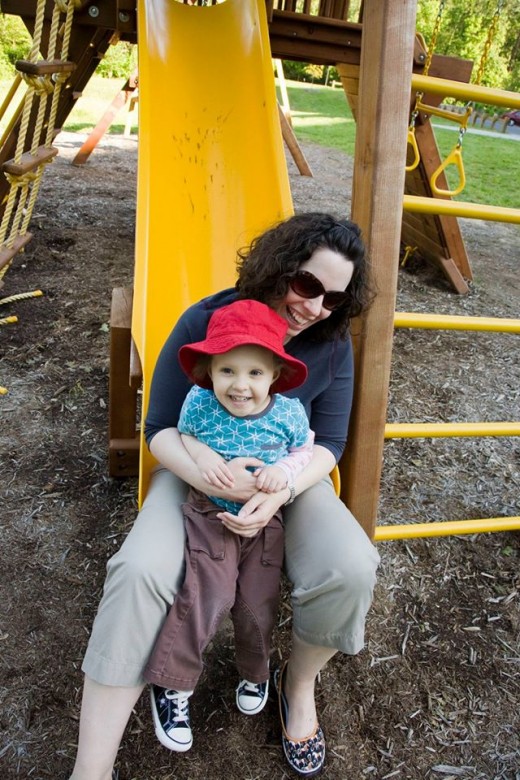
Mothering Donna, my happy girl.
As the month progressed, this routine got harder. I got more tired. I stopped posting first thing in the morning, simply because the posts weren’t ready. I started writing at 9 or 10 in the morning, instead of posting. Again, as the days passed and my fatigue, both physical and emotional, worsened, there were days I didn’t write until my lunch hour at the office, posting later in the afternoon now.
The reader response to Donna’s Cancer Story took me by complete surprise. People were reading the entries like a soap opera, as if I was purposefully generating cliff hangers, as if our life hadn’t been a cliff hanger for those 31 months of treatment. It was wrenching and traumatic for me, writing Donna’s Cancer Story. It was also, potentially, one of the greatest things I will have ever accomplished in my life, telling the story of my daughter, who would never be able to tell it herself.
Oh, Donna. My dear girl. I wrote Donna’s Cancer Story for you, for me, too, selfishly, to keep you near, to keep you close, to alert the world that you lived, that you existed, that you were amazing. My life has changed because of you, and telling your story, sharing your life.
That day, October 2, was to be the very last entry in Donna’s Cancer Story. The final post was an unexpected addition about how to harness and direct the outpouring of help that people wanted to provide after reading of our girl, my Donna. Jimmy, my community manager, had also arranged for a live chat with readers. I was so tech challenged that he agreed to come to my office and help me navigate it. The response astounded me. Floored me. Humbled me. It still does, six years later.
That afternoon, I opted to leave work early. I walked out of the Mies van der Rohe high rise I worked in and out the door, heading to Chicago’s beautiful Millenium Park. I walked amongst strangers, native Chicagoans and tourists from around the world. None of them knew my story, none of them knew the sense of immense accomplishment I carried with me that day, as I enjoyed the warm sunshine.
When you bury a child, you no longer have the opportunity to parent them. That day, October 2, 2011 I got to revel in a month of getting to parent my daughter again, by telling her story, not stopping when the pain and memories overcame me, honoring my daughter in a way that was worthy of her. What a gift.
When I was in college I took a literature course about African American women writers. Zora Neale Hurston, Alice Walker, Toni Morrison, Maya Angelou, Gwendolyn Brooks — so many amazing writers. One of the central themes of the class was something the professor called “motherlines.” Her theory was that these writers used the lessons we learn from out mothers as a tool in their writing, a literary device.
I was nineteen at the time, so I read the books, loved the class, but really didn’t fully understand the concept of motherhood, let alone motherlines. But lately, man, motherlines is heavy in my day-to-day. I feel my Mom in so many ways, that same Mom who died eleven years ago, just a few months into my first pregnancy. It’s comforting, actually, as I carry a sense of guilt about how I grieve my Mom, compared to how I grieve my daughter and Dad.
Our daughter was born five months after my Mom died. I spent the end of that pregnancy both grieving and prepping. It was an odd combination. There were tears and sleepless night writing thank you notes to friends and family, but there was so much joy, too. I just couldn’t collapse into sadness the way I imagined I might. Then just a couple years later, our baby, then a young toddler, was diagnosed with her own cancer.
My Mom got lost in the shuffle of that.
More than missing my Mom, I often felt a relief that she never had to live to see her granddaughter die. When she was alive, my Mom often said that the worst way to die was a brain tumor. We would see a news story about them or a famous person might be diagnosed and there would be my Mom, “Oh, that’s a terrible way to go.” I sometimes wonder if my Mom knew on some unconscious level that she hated brain tumors so much because both she and her namesake granddaughter would die from them. Magical thinking, I know, but still.
After my Dad’s death last year, I feel my Mom’s absence in a completely different way. It’s much more potent to me. I feel her, often, as I pass through my days. The connection feels strongest as I mother and mark the milestones of childhood. A few weeks ago my niece celebrated her First Holy Communion, and, BAM, there was my Mom, dancing through my memories, mothering me as I celebrated my own first communion that May day in 1977.
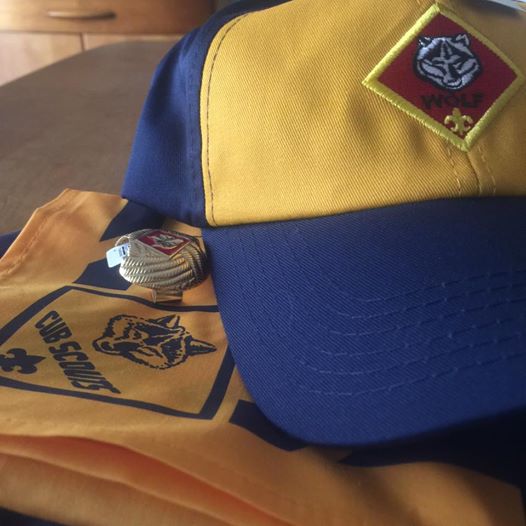
Yesterday I stopped by a small store to buy my oldest son a Cub Scout shirt and hat. BOOM, there was my Mom again, just floating through my thoughts. My brother was a Cub Scout and my Mom and a neighbor managed their den. I was a very little one at the time, so kind of tagged along to all the meetings. I remember how she ironed my brother’s blue shirt and neckerchief and adjusted them just so before meetings.
The connection I felt was visceral and I am so grateful for it.
My years as a mother never overlapped with my Mom’s life and those two things — my life with my Mom and my life as a mother — always felt very separate and distinct. But now, mothering my boys as they grow into older boys, well, I feel the connection and her presence. It is a very welcome surprise. There is a thread, not always apparent, that exists that connects my Mom and I as mother and daughter, and now as mothers — my very own motherline.
I hope to learn from her, remember what she taught, allow her to guide me as I walk this path of motherhood on my own. It can be lonely, motherhood. Feeling my Mom these past few months has helped. Eleven years is a long time apart. I am so glad she’s back and keeping me company.




 Mary Tyler Mom