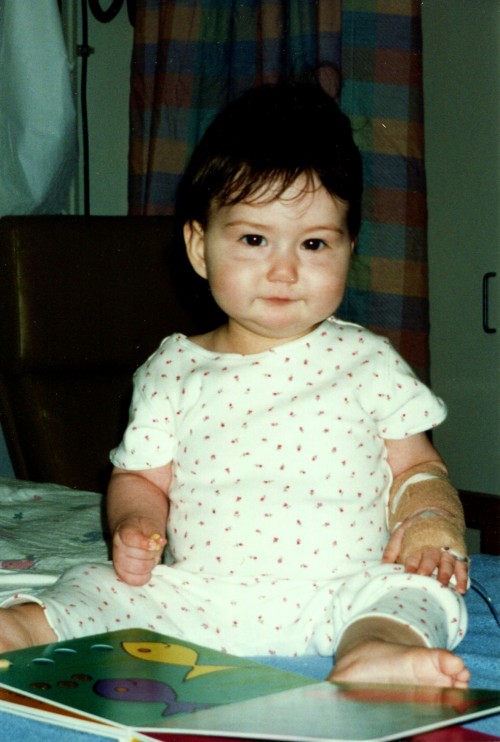
Owen’s Story: Super Owen!

http://embed.newsinc.com/Single/iframe.html?WID=2&VID=25195296&freewheel=90921&sitesection=chicagotribune&height=281&width=500

September is Childhood Cancer Awareness Month. Each day I will feature a different guest blogger who will generously share their personal experience with childhood cancer.  Stories are always more potent than statistics.  The hope is that by learning about children with cancer, readers will be more invested in turning their awareness into action.  Read more about this series and childhood cancer HERE.

By Cyndi Yanke

Owen is 8 years old and obsessed with all things super heroes.  This could be because he has been my hero since he was diagnosed with a rare brain tumor at 13 months old.

Super Owen!
Super Owen!

I remember it like it was yesterday.  On that Monday night we heard the devastating words no parent should ever hear, “Your son has a large mass in his head, we think its cancer.”  What was my response?  “We need to go home, it’s his bath time, then he needs to go to sleep in his own bed, I will call you in the morning.”

It all happened so fast.  The symptoms started on a Tuesday and he was diagnosed the following Monday.  When the pathology came back it was AT/RT, a nasty brain tumor with a very poor outlook for kids under the age of 3.  Once he started treatment I started looking for other kids with the same kind of tumor who were long term survivors.  There wasn’t a lot.  I looked at that as, “Well, someone has to be in that 5% survival rate, why not Owen?”

He was in treatment for about 6 months, including one resection removing about 70% of the tumor, two rounds of chemo with stem cell harvest, another surgery to remove the remainder of the tumor, Intrabeam radiation, then three rounds of high dose chemo with stem cell rescue after each round.  To look back at it now 6 months is not a long time, but back then time was a lot different.  An hour lasted what seamed like days, a week was more like a month, a month I couldn’t even think about things like kindergarten.

Childhood cancer can bring out the best and worst in people.  The second those words came out of the neurosurgeon’s mouth, I knew it was all on me. As we drove home that night we had to stop and pick up some new prescriptions before we left Milwaukee.  My now ex-husband tells me to go to someplace where he can also get some alcohol,and not the disinfecting kind, but the ‘I need to get drunk’ kind.  He spent most if not all of the six months we were in and out of the hospital at the bottom of that bottle.  Well, many different bottles, and some cans too.

I knew I would be the one to stay in the hospital with Owen night after night.  I knew I would be the one talking with the doctors at all hours of the day.  I knew that ultimately I would be the one making all the big decisions.  I knew I would be the one there when Owen needed me.  I was ok with that.

In order to do that I shut down.  There was a handful of friends I could talk to. You could hear it in their voices, the ‘I don’t know what to say because her baby has cancer’ tone.   It was hard to hear about others’ day-to-day life. Everyone else’s life was going on like nothing happened, as our lives were hanging on by a single thread.

I can look back now and see what a completely different person I am today compared to back then.  I thank childhood cancer for that.  I found my voice, which I needed to use more than I would have ever expected to make sure he got the care he needed and deserved.  I don’t know how many times I said “You choose to work in a hospital for children, we did not!” Looking back after 7 years, I was a pain in the ass.  I’m okay with that.  Most of the worst days of my life were spent there.

If having a rare brain tumor wasn’t enough, seizures entered into our lives about a year after diagnosis.  So along with the routine clinic visits, MRIs, and labs, we added EEGs, and more medication.  We tried multiple medication combos, with no luck controlling them.  They started off lasting maybe fifteen seconds, once or twice a day, to being fifteen minutes long, multiple times a day.  Our lives were spent staying close to home or the hospital.  After a year of seizures with no relief in sight, surgery was suggested.

His seizures were caused by some scar tissue from his second resection that included Intrabeam radiation.  I assumed they would just need to remove the scar tissue.  I got a call form the office to remind me of his pre-surgery appointment, a day before surgery.  One word stuck out in the conversation, hemisphrectomy.  I did a bit of research on surgeries to stop seizures, so I knew what she was talking about, but she must have confused us with another kid.  Nope, they planned on taking out the entire  left side of my sons brain!  Are you f-ing kidding me?

I told them to cancel everything. I had some phone calls to make.  Second and third opinions to get.  We went to see some doctors in Madison and our team in Chicago.  It was only until I talked to all of them that it became clear that if I wanted any sort of life for my son, a hemisphrectomy would be the only thing that might help.

We went into surgery expecting another miracle.  We were pros at this now, hospital veterans, we had this in the bag, right?.  Not so much.  We were in the hospital for a month straight.  After a two year break from hospitals, it made it hard to settle back in.  It was a different floor, different circumstances.  With cancer it was a matter of life or death. With surgery for the seizures, this was a choice.  That made it harder.  Since it was my choice, I was overwhelmed with guilt.  It was my fault he was in the hospital.  It was my fault he had tubes draining out of his head.  It was my fault that Owen couldn’t walk or eat.  It was all on me.  Looking back, obviously I made the right decision, but I didn’t know what the outcome would be.  He is still seizure free five years later, clearly the right choice.

So now here we are almost seven years off treatment.  Over seven years cancer free, five years seizure free.  All of this in an eight year old boy.  To look at Owen, most people notice he doesn’t use his right hand right away, he walks with a bit of a limp, he is a little on the drooly side.  Owen gets extra help in school with math and reading, we continue to do PT or as Owen calls it “physical torture” and OT, or “Owen torture” as he calls it.  This is our normal.

What have I learned with all of this?  Hold him close, tell him how much I love him, enjoy the moment.  There are too many families who have lost their children to cancer.  We have a pretty large group of familes we are close to, mostly AT/RT families.  I am thankful for them.  Grateful they get it, they really understand what our life is and was like.  We celebrate all of our successes, we listen for the tragedies, we are a family bound by a common enemy — childhood cancer.

All in all, our life is pretty good.  Owen is an amazing kid with an amazing personality.  He has the imagination of 100 kids.  He has more fight in him than anyone I have ever known.  What do I have?  Owen.  I have everything I need.

It's true!  Owen really IS kind of a big deal!
It’s true! Owen really IS kind of a big deal!

Owen and his Mom are both super heroes in my book.  Our kids shared an oncologist (the fabulous Dr. Stew that you will hear from later this month) and they keep us in pumpkins every October to honor Donna’s death anniversary.  We are grateful for the many friends we have made in Cancerville.

If you’re looking for all of the posts in the  Childhood Cancer Stories: The September Series, you can find them catalogued HERE.  

If you don’t want to miss a single child’s story, you can subscribe to my blog.  Please and thank you!

Type your email address in the box and click the “create subscription” button. My list is completely spam free, and you can opt out at any time.

Cal’s Story: Angel in the Outfield

http://embed.newsinc.com/Single/iframe.html?WID=2&VID=25195296&freewheel=90921&sitesection=chicagotribune&height=281&width=500

September is Childhood Cancer Awareness Month. Each day I will feature a different guest blogger who will generously share their personal experience with childhood cancer.  Stories are always more potent than statistics.  The hope is that by learning about children with cancer, readers will be more invested in turning their awareness into action.  Read more about this series and childhood cancer HERE.

By Tom Sutter

It’s really hard to imagine your 12 year old son, who has never had much more than strep throat, suddenly being diagnosed with the adult form of leukemia as a child.  That is exactly what happened to our oldest child Cal, the oldest in a blended family of seven kids, in June of 2005.  It threw our entire family into a tailspin.

As a parent you want to figure out a way to take this cancer out of your child.  If nothing else, take it upon yourself to fight it, but you can’t, so you prepare as best you can for a battle that I don’t think ever even occurred in my nightmares, but here it was, happening to our family.  What did we all do to deserve this?  How could God do this to such a young boy who was physically fit and an excellent athlete?  Why, why, why?

This scene is familiar to any family dealing with cancer.  The supplies and meds just start to overtake the home.
This scene is familiar to any family dealing with cancer. The supplies and meds just start to overtake the home.

There is no time to search for these answers during the battle – you have to research all you can, learn the ins and outs of cancer and determine how best to keep the entire family together during this fight.  You have a sick child and knowing how cancer seemingly has a mind of its own, you know it could turn on a dime and he could lose this battle.  You also have to be concerned about the other kids and your spouse.  They all depend on you as well and while it’s understood you have to spend more time with the one who is fighting for his life, they too can feel slighted.

Cal’s brother Ryan is a perfect example.  As a 10 year old boy, he saw his older brother getting all these cool gifts – an Xbox 360 when it first came out, iPods, Nintendo DS games, books, games, clothes, money, Yugi Oh cards and on and on.  Ryan made an off the cuff the comment about how he wishes he gets cancer one day so that he can get all this cool stuff too.  Whoa, that’s a real eye opener and a major reason why our Cal’s All Star Angel Foundation makes sure to take care of the siblings of children with cancer.

Our other kids ranged from a newborn who arrived 9 months into Cal’s battle to 8 years old, so there were as many ways of dealing with the situation as there were people in the family.  We made every effort to keep the other kids’ lives as normal as possible – they still went to school every day, had play dates, and participated in sports.  The only difference is that they spent some time with their brother either in the hospital or with him when he was home.  It was this normalcy that kept everyone in check.

I had to also make sure I did not forget about my wife, Stacey, during this very trying segment of our lives.  We had just been married five months before Cal was diagnosed, and I was spending 50% of the time with Cal while he was inpatient for 11 out of 14 ½ months.  Stacey and I remained in constant contact while I was with Cal.  She was the backbone and support of the family while I was away and I was there for everyone while home.  It takes an extra level of communication to keep it all together and an extraordinary level of mental strength to keep you on the right path.

Through an ordeal like this it is very easy to be bitter about everything and towards everyone, including God.  You really don’t know what to think.  Your actions, thoughts, and impulses seem to be on auto-pilot almost occurring on a whim and under their own power.  It takes some deep self-reflection to keep it all in check because one day this will all be over and the “normal life” you left behind will one day be your “normal life” again in which you will have to adapt or change either with or without your child.

Dr. Tom and Silly Kid.  Cancer Dads are sometimes overlooked, but, like Cancer Moms, learn to be de facto med techs to care for their children.
Dr. Tom and Silly Kid. Cancer Dads are sometimes overlooked, but, like Cancer Moms, learn to be de facto med techs to care for their children.

Some people lose everything when something like this occurs.  Their jobs are gone, homes foreclosed upon, cars repossessed, families split apart – you name it, it happens and can happen more easily if you let the cancer that is eating away at your child also eat away at you, your thoughts, and your soul.  It’s a nasty disease that does not discriminate and can claim its victims quickly or slowly and cause collateral damage beyond anything you can imagine.  It can change a person’s innermost thoughts, how they ac,t and what they believe.  This is exactly what happened to our family during Cal’s battle with cancer and even more so after he passed away in August of 2007.

The strength and courage Cal showed throughout is what pushed us to start a foundation in his memory and it is the way he cared about others before he even thought about himself that keeps us on our path to running Cal’s All-Star Angel Foundation – www.calsangels.org – in a manner in which Cal lead his life.  Our main mission and purpose of granting the wishes of kids fighting cancer and financially assisting their families continues Cal’s legacy and it is the real life stories of the battles against cancer of all the families we help that keep us persevering through what at times seem to be insurmountable obstacles.

Cal Sutter
Cal Sutter

Cal’s All Star Angels is sponsoring a 5K race tomorrow, Saturday, September 14, in South Elgin, Illinois.  Click here for details.  I can’t say enough about the good work the foundation does.  I have been lucky to volunteer with them a couple of times and look forward to doing more in the future.  Tom Sutter, Cal’s Dad, has written a book about his family’s experience with childhood cancer and it will be published this fall.  

If you’re looking for all of the posts in the  Childhood Cancer Stories: The September Series, you can find them catalogued HERE.  

If you don’t want to miss a single child’s story, you can subscribe to my blog.  Please and thank you!

Type your email address in the box and click the “create subscription” button. My list is completely spam free, and you can opt out at any time.

Isabelle’s Story: Wintering at Shands

http://embed.newsinc.com/Single/iframe.html?WID=2&VID=25195296&freewheel=90921&sitesection=chicagotribune&height=281&width=500

September is Childhood Cancer Awareness Month. Each day I will feature a different guest blogger who will generously share their personal experience with childhood cancer.  Stories are always more potent than statistics.  The hope is that by learning about children with cancer, readers will be more invested in turning their awareness into action.  Read more about this series and childhood cancer HERE.

By Annie Bares Thomas

We wintered at the children’s hospital that year.  It was a colder winter than most, filled with stinging rain and painful memories.  I recall bringing Isabelle back to the hospital one night, after she spiked a fever and required urgent medical care due to neutropenia.  The sky seemed blacker than usual.  The air crisp and biting.

As much as I dreaded arriving at the parking garage, it was also my favorite place in the hospital.  It was our limbo.  If I was holding Isabelle in my arms in the garage it meant one of two things; either we were at the threshold of the cage-like constraints of being inpatient, about to fly free, or we were heading back in, still with the taste of freedom and home in our very recent memories.  I would never mind having to circle the many levels of the garage to find a spot, for it meant we were free for a few more precious moments.  My husband Alexis offered to drop us off at the front door.  Unless Isabelle was very sick, I always declined.  This was such valuable time for me.  I savored the last breaths of fresh air, in spite of the added smell of car fumes. Every time I pulled Isabelle out of our rusty, early model Volvo, car seat and all, I’d silently remind myself, “You can do this.”

Isabelle and her Mom, Annie, at the entrance to Shands

My usual brisk pace slowed as we neared the east wing.  The mechanical swoosh of the automatic doors foreshadowed the flooded heat of the hospital, immediately bombarding us with artificial warmth.  The smell of the air on the main floor was deceiving.  Fresh brewed coffee from the Java Hut intertwined with chicken from the cafeteria and perfume samples sprayed in the gift shop.  Here in the lobby we would see excited people rushing with balloons and flowers to meet a brand new family member, or swollen-eyed groups, leaving the hospital with weeks worth of belongings and one less in their clan.  As I held my neutropenic baby, I made sure to push the elevator button with my elbow and not my clean fingers.

We called it wintering because we were in a new and exotic place.  Isabelle had never been in a hospital before her cancer diagnosis, for she was born in an old Victorian house under the gentle care of midwives.  I too had escaped hospital life until now, as the only time I spent inpatient was as a healthy newborn, back in the 60s, when all babies were kept for a week.

We were treading on new territory.

I grew up in a large middle class family in a west Chicago suburb.  No one I knew ever “wintered” anywhere but home.  The first reference I heard to wintering was while watching a M.A.S.H. rerun on the black and white TV my sister Maria and I bought with collective babysitting money.   During one episode, Winchester met his match with another snooty officer who was visiting the M.A.S.H. unit.  As it turned out, the visiting officer was the son of a servant, so his experiences of “wintering” were those of the hired hand.  Yet, since he had been to all the right places, he was able to fool Winchester into thinking that he was more refined.  Kind of like us.  Wintering at the hospital, yes, but so very sure we were not like these other people.  We would spend some time here, okay, but we would not stay.  Isabelle would move on.  She would live and survive.  That was the thought that kept our blood flowing and our hearts beating.

Baby Isabelle in treatment.

***

I remember the day my sister Maria and I planned to purchase that television so well.  I was babysitting Leah Simonek.  The money I would make from that visit would bring our savings to what we needed to buy our own television set… a true luxury of the time.  My dad was to pick me up, with Maria in tow, and we would head off to the Service Merchandise to complete our first major purchase.  We had picked out the TV weeks before.  It had a goldenrod frame with two big black dials on the front right hand side, one on top of the other.  The antenna was long, so we were excited about the possibility of being able to harness nine stations.  We longed to have our own television, as it meant we could fall asleep to reruns of M.A.S.H. and the Honeymooners, our two favorite shows at the time.

When my dad came to retrieve me, my sister Maria was nowhere to be seen.

When I hopped into my dad’s car he said nothing at first, other than, “We need to go home.”  I was angry and pouting as I knew we weren’t going to the Service Merchandise as planned, but I didn’t say anything aloud, as my dad was strict and not always approachable.  Mrs. Simonek, the woman I had been babysitting for, came running out to the car.

“Roger!” she yelled to my dad.  “Roger, I had a dream about Liz last night.”  My dad stopped her before she could say anything else.

He simply said, “Lizzie passed away today.”  Mrs. Simonek burst into tears, gurgled something to my father, and then ran for the safety of her home.

Passed away?  What did that mean?  I had only known of old people “passing away.”  Young girls, like my sister Liz, didn’t “pass away.”  As he pulled out of the long drive, my dad turned to me and said, “Lizzie died today.”

I was angry and confused.  I knew my sister had bone cancer, but no one ever told me she could die from it.  I went to the hospital with my mom the night before, at my pleading, and saw Liz.  She was alive and happy.  I remember my mom scolding me for eating food off the hospital dinner tray that my sister wouldn’t touch.  Liz laughed at me for getting in trouble, as she so often did.

“What do you mean, she died?”  I said, although I knew immediately after the words leapt from my mouth how ridiculous they must sound.  My dad’s uneasiness was palpable.  In my childhood experience, my mom would normally be in charge of braking difficult news.   A sigh escaped his lips, not one of aggravation, but of quiet desperation.

“Lizzie died today, Annie.”  The fact that he was calling her “Lizzie” instead of “Liz” clued me in to how serious a circumstance we were facing.  Liz was too cool and mature, in her eyes, to be referred to as “Lizzie” anymore.  Yet, as a child, we called her “Yibbie” first before we could pronounce the “L” that evolved her name to “Lizzie.”  Liz was her “high school” name.  She would be mortified at the thought that anyone would refer to her as “Lizzie” now.

But, according to my dad, Liz, Lizzie, Yibbie, Elizabeth, she was now gone from this world.  The idea of purchasing my own black and white television set no longer seemed like such an important task.  That day would forever be associated with grief; a giant red “X” struck across the little calendar box in my mind.

Liz, the author's sister
Liz, the author’s sister

*****

Because of Liz, my impressions of long term hospital stays did not have happy endings.  They were a slow and emotionally painful journey.  As we wintered with Isabelle, we too followed a slow and painful path.  Our greatest hope and deepest fear, both revolved around the ending, tethered by heartstrings, pulling us in both directions.

And so with that childhood reference to M.A.S.H., I came to the notion that we were wintering with Isabelle.  Maybe because M.A.S.H. took place in a hospital of sorts as well, the idea of wintering simply stuck.  As I would lie in the metal hospital crib at night, curled around my baby and mindful not to put weight on any of the tubes that connected Isabelle to the machines, and to life, I would often think of my sister Maria and me, falling asleep to the dim black and white glow of our television set, wondering silently to ourselves what tomorrow might bring.

Isabelle is doing very well these days, cancer free, thriving.  Grateful thanks to her mother, Annie, for sharing her story of how childhood cancer has impacted so much of her life.  

If you’re looking for all of the posts in the  Childhood Cancer Stories: The September Series, you can find them catalogued HERE.  

If you don’t want to miss a single child’s story, you can subscribe to my blog.  Please and thank you!

Type your email address in the box and click the “create subscription” button. My list is completely spam free, and you can opt out at any time.