Gabe’s Story: Fact, Legend, and Lore

http://embed.newsinc.com/Single/iframe.html?WID=2&VID=25195296&freewheel=90921&sitesection=chicagotribune&height=281&width=500

September is Childhood Cancer Awareness Month. Each day I will feature a different guest blogger who will generously share their personal experience with childhood cancer.  Stories are always more potent than statistics.  The hope is that by learning about children with cancer, readers will be more invested in turning their awareness into action.  Read more about this series and childhood cancer HERE.

By Randee Donovan

When I was growing up, my mom kept all of our family photos in albums.  They sat on a shelf in our living room.  Each album was burgundy, and it was numbered on the spine.  The photos were labeled with our names, dates, and little captions that she carefully hand-wrote on paper that stuck to the magnetic pages.  The first albums began with my parents, then me as a baby, and they went on and on, following all six children in my family through the years.

When my brother and sisters and I were kids, we would sit in the living room, and flip through the albums, admiring ourselves and memorizing our family history:  birthdays, dance recitals, Thanksgivings, and vacations.  Now, some thirty-eight years later, when my family tells the stories of our childhood, we often don’t know what is real or what is built around one of the photos in the album.  Over time, my family’s stories have become part fact, part legend, part lore.  The photos have shaped our memories or become our memories, and no one can say for certain which.

Batman & Robin, Halloween 2007.  Less than one month before diagnosis, I felt like we had everything we could want.
Batman & Robin, Halloween 2007. Less than one month before diagnosis, I felt like we had everything we could want.

Losing a child to cancer has had a similar effect on my surviving children’s lives.  My son Gabriel was born in May of 2006.  He was diagnosed with Acute Myelogenous Leukemia, the childhood leukemia that does not have a 90 percent cure rate, in November of 2007, five days after Thanksgiving.  He was treated at Ann and Robert H. Lurie’s Children Hospital of Chicago, which will always be Children’s Memorial to me.

Gabe’s doctor called us around 6:00 p.m. to tell us that he had leukemia.  We were told to be in Chicago less than 12 hours later so that he could begin his treatment.  His first stay in the hospital lasted a month.  For the less than six months that Gabe survived, he spent one night in the hospital for every night he spent at home.  He died very unexpectedly four days before his second birthday in May of 2008.  His wake was held on Mother’s Day.  He was buried the next day.

My son Jack was four when Gabe was diagnosed.  He was five when Gabe died.  Every weekend that Gabe was in the hospital, Jack was there by his side.  Even as the chemo ravaged Gabe, he would perk up for his big brother, have a bite to eat for his big brother, sit up and play with his big brother.  Today, Jack is 10-years-old.  He is smart, funny, and outgoing.  He is also a little bit nervous, a little bit outspoken, and a little bit angry.

Jack visiting Gabe at Children’s Memorial, December 30, 2007.  Gabe would light up when Jack entered the room.  They spent hours and hours in that bed, playing, eating, and watching TV.  Jack was by Gabe’s side through it all.
Jack visiting Gabe at Children’s Memorial, December 30, 2007. Gabe would light up when Jack entered the room. They spent hours and hours in that bed, playing, eating, and watching TV. Jack was by Gabe’s side through it all.

When he talks about Gabe, Jack remembers how “FUN!” the hospital was, that he got to eat breakfasts, lunches, and dinners from McDonald’s, and that he was a hero for his brother.  When he talks about Gabe, he also remembers helping us pin his screaming and flailing little brother to the floor so that we could give him the oral meds that he hated with a passion, he remembers putting on gloves and a face mask to “help” clean the rubber tubing that was inserted directly into Gabe’s chest to administer IV drugs, he remembers me pounding on the side of Children’s Memorial ambulance that was sitting at a red light in Chicago traffic on a rainy morning and begging the driver to take us to the hospital the day that Gabe died.

My daughter Grace was born 14 months after Gabe died.  Today, Grace is four-years-old.  She is bright, independent, and strong willed.  She is also a little spoiled, a little wild, and a little bit of a handful.  Grace never met Gabe in person.  Yet she also “remembers” Gabe and talks about him too.  Many nights, as we cuddle in her bed before she falls asleep, she says, “Tell me about your baby Gabe.”  And I do.  I tell her about the doctor taking him out of my belly, about bringing home a perfect, beautiful boy and watching him grow to love binkies, bubbles, his brother, his dog, toy tools, and cars.  I tell her about bringing him to the pediatrician and being told that he was very sick.  I tell her about taking him to the hospital where he had to sleep for a long time and get strong medicine that made him bald, weak, and sicker.  I tell her that one day, he died and went to Heaven.  I tell her that we all cried every day and every night for a long, long time.  And I tell her that one day, I asked God for another baby, and God said yes, and that baby was her.

Grace retells me this same story.  She looks at Gabe’s baby photos and the photos that I took nearly every day of Gabe’s treatment.  She inserts herself into Gabe’s story and into our memories.  She calls Gabe her “little brother.”  One day I corrected her and said, “No, Gabe is your big brother.”  She was so angry, and she said, “NO!  I am bigger!”, and I thought, “She is right.”  So now, she calls him her little brother, as in size, not age, and I let her, because technically she is right, and with age and experience, she will make that correction on her own.

So what is the reality of losing a child to cancer?  It is sad and dark and full of pain, anger, and destruction.  But over time, there comes light from memories that are shared and cherished and passed on by the people that were there and by the people that weren’t.  Which parts of Gabe’s story are fact, legend, or lore?  Many days, I’m not really sure.  Some days, I hold a toy that he held or a pair of his pajamas, and I wonder if any of it really happened.  Was he even really here?  But then the memory of that little boy, with the darkest, most beautiful brown eyes that I have ever seen, grounds me.  That boy shaped my family’s past, and he continues to touch every day, every experience, and every future memory that we create.

Jack and Grace, a back to school picnic at Gabe’s grave, August 20, 2012.  Seeing my kids so happy and comfortable eating McDonald’s by their brother’s grave breaks my heart.  It also fills my heart with happiness, because Gabe is a constant part of their life.
Jack and Grace, a back to school picnic at Gabe’s grave, August 20, 2012. Seeing my kids so happy and comfortable eating McDonald’s by their brother’s grave breaks my heart. It also fills my heart with happiness, because Gabe is a constant part of their life.

I got to meet Gabe in the hallways of Children’s Memorial.  Both Gabe and Donna had the same idea of fun — pacing laps around the floor, IVs trailing behind.  I first spotted Randee across a crowded playroom.  No joke, but I instantly loved her and instinctively knew we would be friends. She was my first teacher of what it was to be a grieving mom, and for that I am extremely blessed.  And somehow, whenever we are together, we laugh and we laugh and we laugh.  I love you, Mama.  

If you’re looking for all of the posts in the  Childhood Cancer Stories: The September Series, you can find them catalogued HERE.  

If you don’t want to miss a single child’s story, you can subscribe to my blog.  Please and thank you!

Type your email address in the box and click the “create subscription” button. My list is completely spam free, and you can opt out at any time.

Mia’s Story: Small but Mighty

http://embed.newsinc.com/Single/iframe.html?WID=2&VID=25195296&freewheel=90921&sitesection=chicagotribune&height=281&width=500

September is Childhood Cancer Awareness Month. Each day I will feature a different guest blogger who will generously share their personal experience with childhood cancer.  Stories are always more potent than statistics.  The hope is that by learning about children with cancer, readers will be more invested in turning their awareness into action.  Read more about this series and childhood cancer HERE.

By Lisa Jacobs Gurevitz

When my younger daughter, Mia, was nearing her second birthday in November of 2011, we received news that no parent should ever have to hear. Our lives changed forever in the span of a 5 minute phone call as we were informed, “Your daughter has a mass in her brain.”

We had taken Mia for an MRI of her brain after she fell off the weight and growth charts.   After the call, we were in a state of shock and fear.  Our lives had just been turned upside down. Outwardly we tried to keep things normal, especially for our older daughter, Rachel, who was just five years old at the time.  Inside, my head spun with thoughts no parent ever wants to think about, what no parent should ever have to think about.  After meeting with a neurosurgeon and coming to the realization that we were dealing with a brain tumor and furthermore, due to location, it is classified as inoperable, we were pushed even further into the darkest place imaginable.

A biopsy was done to determine tumor type (benign and generally slow growing, but a brain tumor nonetheless).  A couple of weeks later she received a port to administer meds and draw routine labs to monitor her blood counts. We met her neuro-oncology team and chemotherapy started. The tumor presses on Mia’s pituitary gland, which put her into an anorexic state.  She looked horrible yet remained sweet, silly and playful.

Along with chemotherapy came the vomiting, fatigue and hair loss. We saw what fortitude a child really has, what they can endure.  To boost her weight, Mia was put on 12 hour nightly IV nutrition. We thank our lucky stars for being matched up to the world’s best home health nurse. She taught us what we needed to know to manage the IV nutrition on our own.  She made Mia feel at ease during her weekly visits.  In addition, we spent every Thursday at the hospital for the chemotherapy protocol.

Mia and her family.
Mia and her family.

The hospital became quite important to us, like a second home.  In a strange way, it gave comfort to be there because something was being done to help her.  We were emotionally drained.  Our friends and family took charge.  We had rebuffed any offers of help, wanting to handle it all, feeling uncomfortable accepting help. It’s so much easier to give than to take. Friends and family persisted and schedules were created for meals, Rachel’s care, and ensured I had someone with me each week at the hospital. I was amazed and touched by the outpouring of concern and love that we received.  It helped us function.

Dan worked harder than ever because we now had huge hospital bills that quickly piled up. He jumped in to help whenever he could during the day and would split duties with me at night. Our parents stepped in for long stretches of overnight stays. This was our routine for the better part of nine months until Mia was switched to another type of supplemental nutrition and chemotherapy.  As is typical, Mia also had many inpatient admissions and ER visits.

It took months to accept Mia’s cancer diagnosis.  For a long time I would refer to it only as a benign brain tumor.  Denial helped for a while, but eventually I learned that cancer is just a word. It’s a really crappy word, but it certainly doesn’t define Mia.  We force ourselves to keep our lives structured for both of our girls.   While we live our forever “new” normal, cancer has affected every facet of our lives.  We want to hide from it, outsmart it, and run as far, far away from it as possible.  Yet it’s always there, infiltrating our family and our lives.

I mourn that old life; we will never get it back.  We will never be able to wake up from the nightmare that comes with a cancer diagnosis.  But day by day we accept what we can and try to function the best way we know how.  While much of the time it feels as if we are waiting for the other shoe to drop, it has also taught us to realize what truly matters in life.

With the countless horrors that come with a childhood cancer diagnosis, there are some silver linings too.  We have met other families living with cancer that we have come to care deeply about.  The Cancer World bonds us.  If we could only say we met at school, the park, Starbucks.  We revel in the good news about our kids and our hearts are heavy when the news isn’t so great.  We support one another in a way that only other parents going through this awful situation understand.  We are in the cancer trenches together.

Seeing how Rachel, entering second grade this fall, handles it all is bittersweet. I am proud of her and heartbroken for her at the same time.  It’s as hard for her emotionally, as it is for Mia physically.  My sweet first baby, this has shaped her life forever.

It takes a Village to deal with serious illness.  Our parents walk thru this with us too.  Their lives are shaken having a grandchild with cancer.  Family members near and far are affected. Our friends have been incredibly wonderful, loyal and steadfast. Thank you for being here for us since day one. Getting through this wouldn’t be possible without the help, love and never-ending support from our friends and family — Mia’s Peeps.

This story would be lacking without a huge shout out to Mia’s medical team, our Dream Team.  Your care, knowledge and never ending compassion as you guide us thru this journey means the world.  Thank you for always treating Mia as a person first and a patient second.

So how is Mia after 18+ months of treatment?  She’s a freaking warrior. She’s gained weight, she’s grown, but she’s still at least a head smaller than other kids her age and likely always will be the smallest of her peers.  She’s outgoing, outspoken, loving; full of sunshine and sass and throws tantrums like any 3 1/2 year old.    She’s in preschool, attended camp and loves her weekly dance class and horseriding lessons.

Mia’s scan this past June was her third  stable scan in a row and she’s currently off treatment. Her body will get a break, and while we don’t know how long that break will be we HOPE it’s for a REALLY long time.  While this is something to be happy about, it brings an entirely different set of emotions and anxieties.  She will continue to get quarterly MRIs, but now there’s not even the chemotherapy we love to hate protecting her.

Cheese!
Cheese!  A recent photo of Mia.

So what do we do?  We move forward while collectively holding our breath until her next set of scans.  We try to embrace this life and everything that comes with it — the good, the bad, the barf, the bald.

If you want to keep up with Mia and become one of her peeps, you can find updates at Mia the Warrior and Her Peeps on the Facebook by “liking” her page.

If you’re looking for all of the posts in the  Childhood Cancer Stories: The September Series, you can find them catalogued HERE.  

If you don’t want to miss a single child’s story, you can subscribe to my blog.  Please and thank you!

Type your email address in the box and click the “create subscription” button. My list is completely spam free, and you can opt out at any time.

Sam B’s Story: Befores and Afters

http://embed.newsinc.com/Single/iframe.html?WID=2&VID=25195296&freewheel=90921&sitesection=chicagotribune&height=281&width=500

September is Childhood Cancer Awareness Month. Each day I will feature a different guest blogger who will generously share their personal experience with childhood cancer.  Stories are always more potent than statistics.  The hope is that by learning about children with cancer, readers will be more invested in turning their awareness into action.  Read more about this series and childhood cancer HERE.

By Sandy Barrow

Many people divide their life into “before” or “after” events –“before I got married…,” or “after we moved…”  I am one of those people and my event divided my life like nothing that came before it.  It forever changed the course of my family’s life and continues to do so today. The date is forever etched in time—September 23, 2000.  On this day, my perfectly healthy appearing and acting 3 ½ year old son, Sam, was following his big brother’s lead of rolling backwards off our couch.

He fell and hit his head and started acting like he had a concussion.  We ended up in the emergency room having a CT scan of his head.  I then received the words from the ER doctor, “I have good news and bad news.  The good news is Sam does have a concussion, but there is no skull fracture, no internal bleeding.  The bad news is we believe we found a mass, a brain tumor, located in his cerebellum.”

My world instantly stopped spinning. I had to call my husband on the phone at 2 a.m. to tell him.  Middle of the night phone calls are NEVER good, and this one continued to prove this theory.  That doctor standing there, giving me that news, became the defining moment in my life, the distinct division of time.  Life, as I knew it before that moment, would never be the same.

Sam passed every neurological exam given to him and even his MRI didn’t make sense to the neurosurgeon.  There was no enhancement (typical of brain tumors,) and three of his ventricles were completely blocked and the fourth was barely functioning due to hydrocephalus.  But Sam was hopping around on one foot and playing catch with the doctor.

Four days later, I handed my healthy appearing son over to the neurosurgeon—before this, I thought I had done some pretty scary things.  Nothing compared to this.  He handed me back a very sick, scared little boy who we had to get to know all over again.  Some days, thirteen years later, I feel like we’re still doing that.  It was brain surgery, after all, the organ that contains the stuff that makes us, well, us.

After surgery, the doctor was able to tell us that he removed a golf-ball sized tumor, medulloblastoma, from Sam’s cerebellum. It was as close as it could be without being attached to his brainstem.  It also took more than two hours to drain the fluid that had accumulated in his brain.  We were told that the “window” for symptoms to begin appearing would have been very small and that more than likely, Sam would have lapsed into a coma and died.  The tumor was getting ready to herniate, or “explode” in Sam’s brain.

I was bearing witness to a miracle.

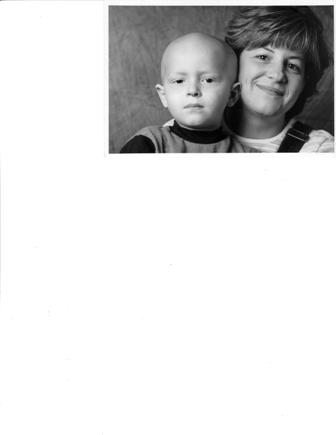
Sam and Mom
Sam and Mom

Sam had a pretty tough time after surgery.  He couldn’t walk, couldn’t talk, could only scream and vomit.  We had about a month of reprieve and healing at home before the grueling and horrendous radiation started.  Every day for six weeks, Sam received radiation to some part of his brain and spine.  He was so sick, and I’m still not sure how he survived that six weeks.

About four weeks after radiation ended, 48 weeks of chemotherapy began.  Sam was not your “smiling, bald kid” during any of this.  He literally kicked and screamed his way through treatment. My Mom says that’s what got him through that part of the journey. He literally fought for his life.  Little did I know at that time, that he would have to fight to live. He slowly began to heal.  Milestones that he had achieved were achieved once again and celebrated vigorously. In December 2001, he was done with active treatment.  A whole new level of scary….what to do now?

After is just a different path on the journey.  It does not mean cured!  Webster defines “cure” as “recovery or relief from a disease; a complete or permanent solution or remedy.”  What Sam, and our family, was left with was neither a relief nor a solution.

Sam’s last 13 years of life has consisted of about thirty MRIs, too many tests/blood draws to count, hearing loss, cataracts removed from both eyes, migraines, learning disabilities, a cavernous angioma, growth hormone deficiency (he’s 16 and 5’1” if he REALLY stretches—that’s it, he’s done growing), hypothyroidism, adrenal insufficiency, and we’re currently watching his male hormones starting to not function. Those are the things we deal with now.  He is at high risk for many other late effects, including other cancers.  They are the “gifts” from treatment.  It’s a fine line that we walk trying to be grateful that we got this far–I was once told that you have to have life to have side effects, but still.

Just as Sam fought through treatment, he has had to fight to live like a “normal” kid.  Soon after him telling his story at a brain tumor fundraiser he organized at school, the taunting, teasing, and bullying started.  We live in a community where differences are pretty much not accepted—they are cause for exclusion and being treated differently.  I realize that kids will seek out whatever they can that they deem “different” about someone—height, weight, hair color, etc.—but to know that Sam being a brain tumor survivor was their “something,” their reason for telling him he couldn’t eat lunch with them, their reason for not picking him to be on a team, their reason to shun and ignore him, their reason to call him “tumor ass,” well, there are no words to describe a mom’s heartbreak.

Not one classmate has stood up for him, not one. I often ask in my darkest moments, “He survived for THIS???”

Sam just keeps fighting. He’s never once asked not to go to school and has maintained High Honor Roll status the last six years.  Take that brain tumor and bullies!  These kids are the ones missing out.  They are missing out on knowing a pretty awesome kid who could teach them an awful lot. My hope is that at some point he finds that one true friend that will accept him for who he is. Maybe then he can stop fighting.

Max, Sam’s older brother, was 7 when Sam was diagnosed.  He dealt with the same worries and fears as his Dad and I.  He’s been there for Sam since the beginning.  He saved his life twice. Once, by showing him how to roll off the couch allowing the tumor to be found.  The second time was a few weeks after we brought Sam home from the hospital.

Sam would just sit on the couch, propped up in the corner, and just look at the world going by day after day.  One day, Max kept crawling by the couch, pushing Matchbox cars.  Imagine my surprise when I walked into the living room and didn’t see Sam on the couch!  He had gotten himself off the couch and was giving everything he had to follow along with Max.  The crawl wasn’t pretty, but he was moving.

From that point, Max has had his back, from helping him learn things, being so patient with him when he works himself into fits of frustration, to being the only student at school to stick up for him.  He had to grow up pretty quick and he’s wise beyond his 19 years.  Max knows what HOPE is and literally carries it around with him.  To honor Sam, he has a tattoo that represents childhood cancer, Sam, and HOPE.  Twelve years later, his worries and fears that he deals with are still the same as his Dad and mine—what does the future hold for Sam?

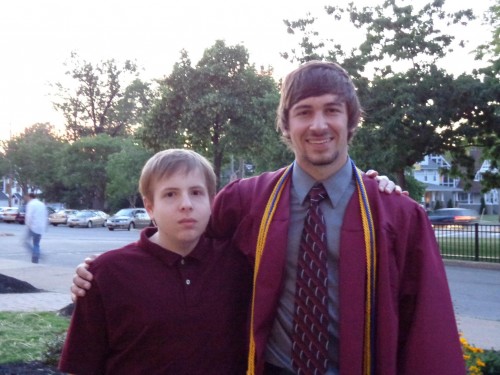
Brothers, Sam and Max

I know that as long as they have each other, things will be okay.

My family’s life before cancer doesn’t get visited very often.  Pictures don’t get looked at and home videos don’t get watched.  There are no winners in the “What If?” game.  I don’t want to go back.  We just have to keep looking forward, HOPING…..ALL ways, always.

If you’re looking for all of the posts in the  Childhood Cancer Stories: The September Series, you can find them catalogued HERE.  

If you don’t want to miss a single child’s story, you can subscribe to my blog.  Please and thank you!

Type your email address in the box and click the “create subscription” button. My list is completely spam free, and you can opt out at any time.