A Tale of Two Chicagos

NOTE:  This blog post was honored with the Peter Lisagor Award for Best Individual Blog Post, Independent 2015 by the Chicago Headline Club and the Society of Professional Journalists.  

One of my potent memories of childhood is packing into whatever used Cadillac my Dad was driving at the time for a weekend day trip, Montovani or Percy Faith playing on the 8 track. We lived in the southern suburbs and would snake up the Dan Ryan, the most infamous of Chicago’s expressways, and head north.  My Dad was always behind the wheel and the windows were usually down, as both my parents smoked.

It was not uncommon for my Dad to exit at the Robert Taylor Homes, in the Bronzeville neighborhood.  These were a collection of high rise housing projects made warm and fuzzy by the 1970s sitcom, Good Times, but in actuality were a vertical concentration of poverty, unemployment, crime, and violence.  And, yes, the windows went up, and the doors were locked.  My young heart beat faster in the few minutes we drove down State Street before re-entering the expressway north.  The buildings were enormous and barren and monolithic and terrifying.  Even as a child, I recognized the disparity between “us” and “them.”  Even as a child, I thought in those terms, “us” and “them.”

Was that racist?  Yes, I think so.  How could it not be?  Every face staring back at me from the other side of the window was black.  I never recall my parents or any of us saying much of anything as we drove down those intimidating streets.  There were no racial slurs on those drives.  Just quiet and heaviness.  I have no doubt that we all breathed a sigh of relief as we got back on the expressway.  Was that racist, too?  Yes, it was.

Those drives would continue all the way north, eventually winding through the posh, leafy suburbs of Chicago’s North Shore.  Places with names like Lake Forest, Kenilworth, Glencoe, Winnetka.  The juxtaposition between the extremes of Chicago’s poverty stricken south side and its tony North Shore estates were jarring then, just as they are jarring now.  Chicago’s disparity of wealth has not changed, other than becoming more intractable.

An important point to make, too, is that my heart raced as fast in those leafy wide lanes along Lake Michigan’s shore, just as they did in the Robert Taylor Homes. The sense of “us” and “them” was absolutely no different as I watched the people in tennis skirts, Lily Pulitzer prints, and pink oxford cloth on the other side of the window.

Was that classist?  Yes, I think so.  How could it not be?  Every face staring back at me from the other side of the window was rich.  I never recall my parents or any of us saying much of anything as we drove down those intimidating streets.  There were no class slurs on those drives.  Just quiet and heaviness.  I have no doubt that we all breathed a sigh of relief as we got back on the expressway.  Was that classist, too?  Yes, it was.

When my Dad died last spring, I prepared a eulogy for his service.  Those long drives on rainy or sunny weekend afternoons would factor prominently in how I remembered my Dad.  I thought of those drives as a lesson my Dad was giving, not in words, but in drives, about some people having more than us and some people having less than us and that we should be grateful for what we had, modest as it might have been in a working class suburb filled with ethnic whites with Polish and Irish and German surnames.

My sister had a completely different take on those drives.  For her, they were about my Dad laying Chicago at our feet — all of it — the good and bad, posh and poor, ugly and beautiful, dangerous and refined, black and white, that Chicago had to offer.  All of it was ours.  We had as much stake in what happened at the Robert Taylor Homes as we did with what was going on in Wilmette.  All of it was Chicago and all of it was our home. Ours.

Thinking about our conversation, I believe that my sister’s sense of why those drives happened was more likely.  My Dad owned every room he ever walked in.  Every single room was his.  Wealth did not intimidate him.  Poverty did not intimidate him.  Color did not intimidate him.  A person’s circumstances, blessed or damned, did not intimidate him.  He was just as likely to strike up conversation with the black man on the street corner as he was the white man dining al fresco and find value in both.

I thought of my Dad last week as I made a drive down that same Dan Ryan expressway, this time headed south, not north, with the Englewood neighborhood as my destination.  I was hoping to talk with Tamar Manasseh, founder of Mothers Against Senseless Killings (MASK).  I had read a news report about Tamar and her efforts to create a grassroots network of moms patrolling violence plagued intersections on the south side in an effort to discourage gun and gang violence.  The mere idea astounded me and galvanized me simultaneously.  Motherhood is a powerful thing and Tamar was proving that.  (You can read my companion interview with Tamar HERE.)

Tamar Manasseh, founder of Mothers Against Senseless Killings (MASK) and the activist behind Moms on Patrol.

I’m not going to lie, as I exited the expressway, that rapid heartbeat I had felt as a girl on those drives returned.  I don’t recall ever feeling quite that well intentioned or quite that white — the embarrassing stereotype of the Lake Shore Liberal come to life.  Yep, that’s me.

It was easy to spot the volunteers dressed in their hot pink t-shirts.  I turned onto Stewart and parked my ridiculous mom car.  True to form, I had brought along water and cupcakes to share.  WHO DOESN’T LIKE CUPCAKES?  Again, the stereotype I am makes me cringe at times.  I was grateful when a young man approached me.  It was clear that he was familiar with the somewhat pensive looking white lady type that I was.  With increasing coverage, more and more volunteers and donations are coming in to support the efforts of MASK.

Armed with a notepad and my iPhone, I set about the business of finding people who would talk to me.  It was easier than I thought.  The legit reporters with trucks and microphones and fancy cameras were across the street, panning the scene.  I was crouched on my knees, something no 45 year old woman can do for too long. People were happy to talk with me.

Tracy, PR Coordinator for MASK, and volunteer Mary.

There was Mary, a volunteer since the effort started on June 29th after the shooting death of a young woman.  Mary’s son was murdered in 2001.  She runs a weekly grief support group at Mercy Hospital.  There was Tracy, a PR executive who volunteers for the campaign every night and manages their social media.  She wanted me to know about the transformation of the young men with gang affiliations who were now regularly coming by to be a part of the nightly watch.  As a sign of respect and cooperation, they were pulling up their pants and wearing shirts.  These things made them less threatening to their neighbors.

Tamar and her cousin Eddie.

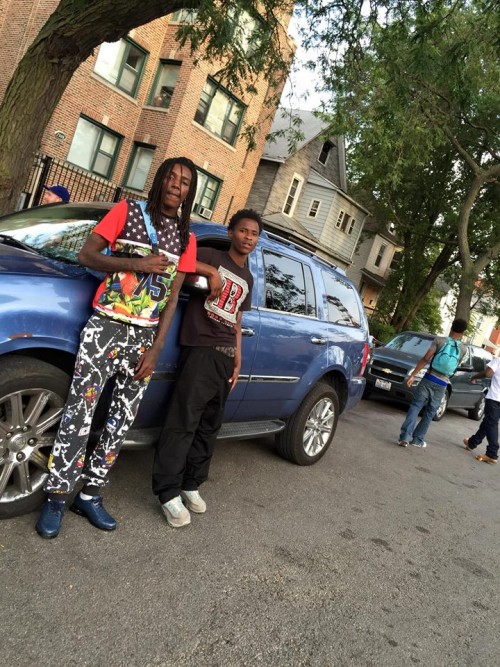
There was Eddie, Tamar’s cousin, who joined the Nation of Islam at 15 years old, three years after his own father was murdered.  There were two young men with dread locks who would not give me their names, but who believed that it would be “business as usual” once the moms packed up and went home.  There was the family down the street who did not want me to photograph them as there were drugs on the porch, but they talked to me about being able to let their little ones up and down the street this summer — something that had not been possible before.  There were the double dutch jumpers, middle aged women just like me, enjoying the pastime of their childhood, if a little more rusty at it.
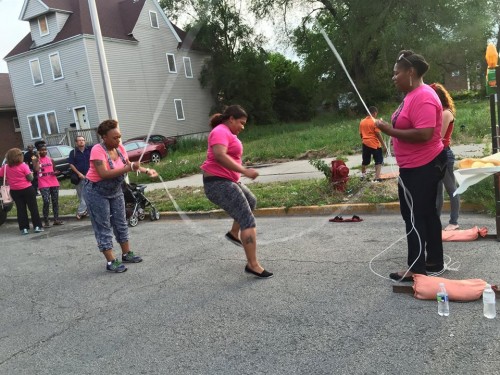
Double Dutch on the corner of 75th and Stewart.
Dreads and cool threads.

There is no question to me that Chicago is deeply divided.  Talking with the good folks gathered at 75th and Stewart last week was like breathing air into a news report.  The “us” and “them” of my youth absolutely exists, but in those 90 minutes I was there, it was suspended.  What separates us is color and opportunity and school quality and access to resources and lack of hope and fear and racist institutions and drugs and crime and so many other factors that are too many to name.

Just as my Dad taught me on those drives so many years ago, this is “our” Chicago, not “theirs.”  When we acknowledge that what happens in Woodlawn and Englewood is just as relevant as what happens in Lincoln Park or North Center, and that the tragedy of one neighborhood is the tragedy of our entire city, only then can we truly call ourselves a Chicagoan.
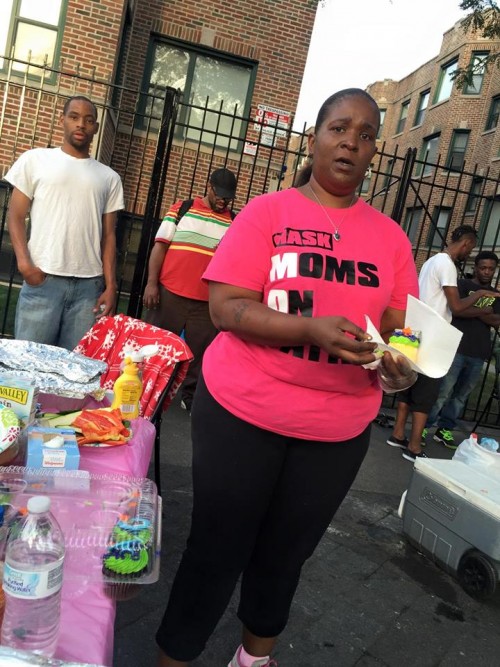
Kim D, manning the food tables that provide a nightly dinner for volunteers and local neighbors.

If you would like to help the efforts of MASK, click here.

**********

You know who can subscribe to my blog?  ANYONE!  You don’t even have to be from Chicago.  Here is how:

Type your email address in the box and click the “create subscription” button. My list is completely spam free, and you can opt out at any time.

Read This Before You Tuck Your Children Into Bed Tonight

Two years ago tonight, twenty families in Newtown, Connecticut tucked their first graders into bed for the very last time.  These children got on their pajamas, some of them might have bathed, they brushed their teeth, complaining about it, I imagine.  Their moms and dads might have read them books and sung them songs.  And then, for the very last time, they turned out the light and said. “Good night.”

Those moms and dads would never tuck their first graders into bed again, as each of them was gunned down in their classroom in Sandy Hook Elementary by a disturbed young man, Adam Lanza, who also shot six brave adults at the school after killing his own mother in her home.

I changed that day as a mother and as a blogger.  I started using my voice against the rising tide of preventable gun violence in America.

Having lost a daughter myself to an aggressive brain tumor, something no one could have ever prevented, my heart broke open to imagine that twenty more moms and twenty more dads would mourn their own young child because of something that could have been prevented.  Losing a young child defies the natural order of how we all imagine life is supposed to be. Losing a young child to gun violence is, for me, unimaginable.

I can try to imagine it, but I stop myself, as it is too painful.  I look at my boy tonight, on the cusp of six himself in just a few short weeks, a gap in his smile where his very first tooth fell out last week, the curl that covers his forehead, the weary smile on his face after a day of birthday parties.

The idea of blood on him, his blood, turns my stomach.  The idea of holes in him turns my stomach.  The idea of the fear those children must have felt in their last moments on earth turns my stomach.  The idea of what the screams in that classroom must have sounded like turns my stomach. The idea of how the events that day two years ago in Sandy Hook Elementary have become a political hot potato turns my stomach.

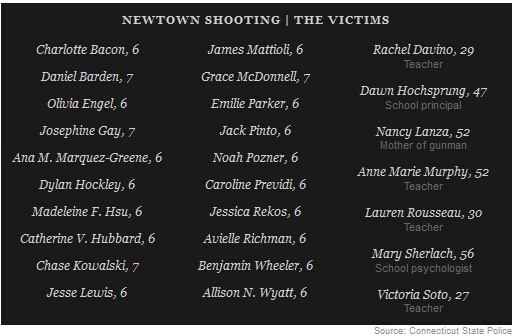
I know some of you are tired of reading my words about guns.  I certainly know that I am tired of reading the hateful comments I receive when I write about them.  But I will keep doing it, as, to me, it seems the most effective way I can encourage change in our world.  Tonight, though, I don’t want to debate, but instead remember.  I remember those 26 individuals who died in a school in Newtown, Connecticut two years ago.

Newtown Victims

And as I remember that day two years ago, I think about those moms and dads I have never met, but who have somehow managed to wake up each and every day since and keep moving forward.  I think about how sudden and shocking their losses have been.  I think about how some of them might choose to sleep in their dead child’s bed tonight, grasping at any sliver of a chance to feel their little one close again.  I think about all the families who will visit a cemetery tomorrow, and lay a wreath on the stone of someone who was taken from them much too soon.  I think about the names and the faces and the missing teeth of all those first graders.  I think about all the tears that are falling right now, as the sorrow of their loss overwhelms.

I hope you do, too, as you tuck your own little ones into bed tonight.

**********

Click HERE to read a post written by Nicole Hockley, mother to Dylan Hockley, Sandy Hook victim, aged 6.

**********

I always have an opinion to share.  You should subscribe.  Here’s how:

Type your email address in the box and click the “create subscription” button. My list is completely spam free, and you can opt out at any time.

The NRA’s Mom Problem

As a mom who has written about gun legislation and senseless gun violence for almost two years now, I’ve learned a few things about the Internet, human nature, American culture, gun advocates, the NRA, and myself.  I came to write about guns after the tragedy at Sandy Hook Elementary School in Newtown, Connecticut in December 2012.  That dark day changed me in profound and lasting ways.

Another mother impacted by that day’s events was a gal by the name of Shannon Watts, an Indianapolis mom and former communications executive.  Where I was moved to write about the incidents of December 14, 2012, she was moved to create a grassroots campaign ultimately called Moms Demand Action for Gun Sense in America.

Some might say that Ms. Watts has been successful because she has created a movement that has drawn a tremendous social media presence. Some might say her success can be measured by aligning herself with former NYC Mayor Michael Bloomberg’s well oiled gun control campaign, Everytown for Gun Safety. Others might suggest that her success can be seen in national chains like Starbucks and Target rethinking their gun policies after feeling the heat from her organization.

I think her success can best be measured by the NRA clearly being afraid of her.

And, yes, I do believe the NRA is afraid of a mother.  One mother.

How else would you explain the takedown piece they published recently in their propaganda publication, America’s 1st Freedom?  Written by Dave Kopel, the article seems to suggest that Ms. Watts is pulling a fast one on America by painting herself as a stay-at-home mom, when in reality she is nothing more than a shill for Bloomberg.  A highly educated, very experienced shill.  A trained strategist, if you will, in mom jeans.  Pffft.

Ignoring the ridiculously sexist graphics that accompanied the article, Kopel does little to move the NRA’s agenda forward with his article. Instead, he is pandering to the same kind of ill informed, misogynistic, far right base that got the Open Carry Texas movement in such hot water earlier this summer.

When faced with women who dare to speak out against gun violence, women who support education around gun safety, women who coordinate campaigns to educate others about common sense gun laws, these gun advocates — most of them men — use gendered tactics, primarily fear and intimidation, to try and silence us (and yes, I count myself among them, having been visited by more than a few online trolls).  Spitting, rape threats, publishing addresses and phone numbers of gun sense advocates who also happen to be moms, are just some of the cowardly tactics used.

The thing is, though, it’s not working.

In my years of being a Cancer Mom and now childhood cancer advocate, I have frequently used the phrase, “Never underestimate a committed mother.”  Shannon Watts is a committed mother.  She is also an advocate, communications professional, intelligent and composed speaker, and force of nature.  Those things, you see, are not mutually exclusive.

While Mr. Kopel seems to suggest in his article that being a stay-at-home mom only involves the cooking and the cleaning and the wiping of noses and bottoms, he fails to grasp the wealth of abilities so many women who opt out of the work force to focus on families hold.  Hell, our First Lady is a prime example of this.

And so am I.

As a professional with a graduate degree, I was thrust into the role of stay-at-home mom with my daughter’s cancer diagnosis in 2007.  Her treatment was too intense and exhaustive in its scope and required a stay-at-home parent.  Truth be told, I was a bit of an employed mom snob before cancer came a callin’, never thinking I could be fulfilled by full-time child care and home maintenance.  And double truth be told, I am still not completely fulfilled by those things.

That’s why I blog.  That’s why I advocate.  That’s why I fundraise for childhood cancer research.  It’s probably why Shannon Watts does what she does, too.

What the NRA fails to grasp is that mothers are allowed to be multi-dimensional.  We are allowed to be competent care providers and homemakers and still hella talented as gun safety advocates or childhood cancer advocates or as whatever the hell we want to be.  Part of what makes mothers so successful as advocates are because we hold those dear children we are raising so close to us — their well being fuels our fires.

When I write about guns, I brace myself for the comments that will follow. I know that those posts will find readers that don’t reflect my typical reader.  I have learned that the comments will be mean and sexist and threatening and relentless.

I don’t care.  And neither, apparently, does Shannon Watts, which is precisely why the NRA has a mom problem.

Hey-O!  If you don’t want to miss a single post, please subscribe to my bloggy blog.  Here’s how:  

Type your email address in the box and click the “create subscription” button. My list is completely spam free, and you can opt out at any time.