How Facebook Came to be the Most Depressing Place on Earth

I’m not quite sure exactly what happened, when the tipping point was, but Facebook is really starting to harsh my mellow these days.  It is depressing as hell over there. Between dentists decapitating lions, black motorists dying after traffic stops, and political hijinks, I’ve about had it.

The thing is, none of these things are new.  Wealthy men with small penises have always opened their wallets wide to get help putting a new animal head on the wall of their man cave.  Racism in our criminal justice system is not something “on the rise,” as its been the norm for as long as our criminal justice system has existed.  And politicians just suck, everyone knows that.

Maybe part of the problem is that Facebook allows me to know things about people I love dearly or just met once or twice.  In a different era, I might not be privy to where my acquaintances stand on controversial issues like choice, marriage equality, or the displaying of the Confederate flag.  Now I know.  Because they tell me.  Often.

I am just as guilty.  Facebook has become the ultimate bully pulpit.  I use it myself to raise funds for pediatric cancer research, rail about the state of public education, and try and educate folks about America’s unhealthy and dangerous obsession with guns.

Here is a sampling of my own posts from the past few weeks:

Heading to my son’s school for an evening meeting. Thanks to Obama, Duncan, Rahm, and the CPS powers that be, it feels like I’m heading into a crime scene. And, yes, I do hold Obama partially responsible. His education policy truly sucks.

Bobby Jindahl tells us that what we can do for the victims of tonight’s theater shooting is send our prayers and hugs. I respectfully disagree. We can start to demand shock and outrage at these continued shootings.

And my kid now has a 7:30 AM start time for his CPS school. That means a 5:45 AM bus pick up for some classmates. This is not good. Not good at all. All to save $ that was squandered by politicians. But I guess we all need to make sacrifices, right?

We have lost any sense of collectivism or social responsibility. We embrace this mentality of taking care of our own, and no others.

My guess is that many of my “friends” find me insufferable, politely scrolling past my Facebook activism, believing that our connection from grade school or cancer circles or blogging merits me remaining on their friend list, just as I do with them.

And the thing that strikes me as the most oppressive is the indignity we all seem to have, again, including myself in this.  The shaming, the outrage, the hell fire and brimstone response to everything that happens.  Everything, big and small. Facebook’s currency is making mountains out of mole hills.

Here’s an example.  Cecil, the feline national treasure of Zimbabwe, is stalked and killed by a dentist from Minnesota. People are outraged.  An actress posts the dentist’s address on Twitter.  He is almost universally reviled (at least on my feed).  Cue the contrarians. Now a whole other set of folks are outraged that the dentist outrage is so out of control.  Where is the outrage about street violence in America?  Where is the outrage about violence committed by cops?  Where is the outrage about hunting closer to home?

It goes on and on and on, the outrage.

Caitlyn Jenner is crowned with an award certifying her courage in the midst of her transition from man to woman.  Cue the contrarians. Where is the courage award for veterans who have lost limbs?  Where is the courage award for young women basketball players struck down by pediatric cancer?  Where is the courage award for [insert cause of choice here]?

Witnessing this outrage and indignity is unhealthy and oppressive.  Seriously.  It is depressing and heavy and ugly and fills our hearts with goop, and not the expensive Gwyneth Paltrow kind.

Human nature, it seems, can be kind of awful.

I need a break.  It used to be that people complained about the nightly news.  “If it bleeds, it leads,” was the saying.  But, the thing is, that evening news was contained.  It was an active decision to turn on the news at 5:30 or 6 or 10 or 11 to learn about the world around you, near and far.

These day, just the mere act of trying to stay connected with friends and family places you in this arena of ick that is Facebook.  We have all somehow decided to slog through the muck of black lives matter/all lives matter, cops suck/cops are heroes, the sky is falling for Confederates/Chicago public school kids/the Supreme Court/Christians/etc.

Staying in touch with one another never required so much fortitude.  And I’m pretty certain this is not what our forefathers hashed out in the Constitution.  Oh wait.  That’s another discussion entirely.

See, that’s the thing.  Everything has gotten all jumbly-wumbly.  A person’s concern about animal cruelty really can be separate and apart from their also present concern about local gun violence. Cops can, it turns out, be both good or bad, and they are also allowed to be individuals, meaning one bad cop does not condemn an entire profession.

This constant exposure to anger, outrage, shame, indignity, and Kardashians cannot be healthy for any of us.  Why, then, do we stick around?

  • I stick around because it’s where I learn that a fellow set of Cancer Parents who also lost a little daughter to cancer are traveling home from China with their newly adopted daughter.
  • I stick around to see how that micro-preemie is doing since she was discharged from the hospital.
  • I stick around to celebrate my friend’s kids graduating kindergarten and junior high and high school and college.
  • I stick around to learn about a mother in Chicago’s south side who has created a grassroots band of other mother’s who sit in lawn chairs on dangerous street corners every afternoon in an attempt to curb gun violence, believing that no one will shoot a gun under a mother’s watchful eye, even if it is not their mother.
  • I stick around to share my blog posts that I work hard to ensure are not all doom and gloom and, hopefully, contain words that inspire and help people feel connected to one another.
  • I stick around to nurture virtual friendships made with people I would have never, ever encountered in my typical day-to-day life.
  • I stick around to keep in touch with cousins that live in Las Vegas and Virginia and Ireland — folks I might never see again in person, but whom I care about and value and treasure.
  • I stick around because a friend in Amsterdam I have only met a handful of times posts some of the most life affirming photos of flowers I have ever seen.
  • I stick around because when I am writing a blog post about children’s literature, I can tap one of several Facebook friends who just happen to be children’s lit authors.  How cool is that?

Okay.  It’s sunshine and lollipops for you, folks, just for slogging through this blog post. No rainbows, though, because Facebook reminds me that rainbows are now considered controversial symbols of the evils of marriage equality, and I am not jumping on that outrage bandwagon.

FB2


FB1

Facebook isn’t always easy, but it is, most likely, how you came to find my words, how you came to learn about my dear daughter Donna, how we manage this connection we have, close or distant, near or far, friend or acquaintance.

Damn you, Zuckerberg, I fear I will never be able to quit you.

How the Childhood Cancer Community Gets It Wrong

It’s happening again.  The childhood cancer community, a group I am both honored and sorrowed to call myself a part of, is getting it wrong again in a very public way. National news outlets are now reporting on what I have seen on my private Facebook feed almost immediately after the announcement — sour grapes over Caitlyn Jenner receiving the ESPY Arthur Ashe Award for Courage rather than our own community’s Lauren Hill.

For those of you who don’t know (those of us in the childhood cancer community require no introduction), Lauren Hill was a 19 year old college basketball player at Ohio’s Mount St. Joseph who died of one of the most vicious forms of pediatric brain tumors, DIPG, on April 10, 2015.  Diagnosed shortly after her 18th birthday, Lauren inspired thousands with her courage and selfless focus on the importance of research for other children, knowing full well she herself would not benefit, as DIPG remains a terminal diagnosis. Before her death, Lauren directly inspired over $1.5 million in donations, and that number has risen significantly after her death.

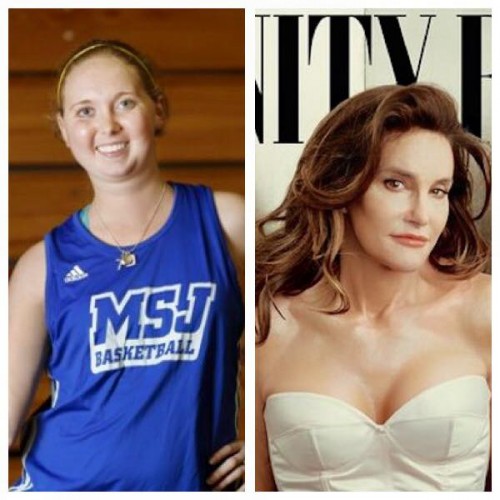
Lauren Hill and Caitlyn Jenner.  Does one of these women have the corner on courage?
Lauren Hill and Caitlyn Jenner. Does one of these women hold the corner on courage?

There is absolutely no question that Ms. Hill demonstrated extraordinary courage in how she lived with cancer.  She represented the best of humanity at a time of tragic loss for herself, her family, and her loved ones.  Her selflessness inspired those within our community and a national audience to better understand the need for research and learn how severely underfunded pediatric cancers are within the larger world of cancer research.  I salute her and remain awed by her grace.

And while this may be presumptuous to say, every indication is that Lauren would be ashamed of the childhood cancer community’s response to the ESPY award announcement.  Like petulant children, I have seen countless activists bemoan Jenner’s selection for a courage award, demanding that Lauren be recognized for her clear superiority over someone who undergoes elective surgery.  The rhetoric has been shameful, though most of it is couched in politically correct terms so as to ensure everyone knows that the childhood cancer community fully supports the struggles of the transgender community.  Those disclaimers and assurances do little to demonstrate empathy for a condition that results in up to 46% of transgender or gender non-conforming individuals  attempting suicide.

Please.  And enough.

This is not the first time the childhood cancer community has created a public ruckus in response to something they disapprove of.  Last summer it was the ice bucket challenge for ALS.  For weeks I read blogs and saw angry status updates from Cancer Parents about how ALS was getting the support and recognition that our children with cancer should have.  Like with Jenner, the unspoken suggestion is that childhood cancer is worse — worse than ALS, worse that gender confusion, worse than any cause or effort that eclipses our own.

It is shameful to me, and embarrassing.  The childhood cancer community is acting in ways that, I hope, we as parents would discourage in our own children.  If siblings were squabbling about not getting enough of this or that or things within the family not being perfectly equitable, our parental instinct would be to shut that s&%$ down.  We can recognize that behavior as petty and immature and demand it stop.  And yet, somehow, we cannot see it within the larger childhood cancer community and how we harm our cause by engaging in it ourselves.

It is time to stop the nonsense, the petty behaviors, the entitlement.

For that to happen, though, some hard truths need to be addressed.  The childhood cancer community has no singular focus to rally around.  There are many charities doing outstanding work on behalf of our children.  I am honored to know some of the major players in the arena and, like with Lauren Hill, stand in awe of their efforts.

But not everything is rosey.  As the mother of a daughter who died of an aggressive brain tumor, I have had other Cancer Parents ask why our family supports the work of St. Baldrick’s, given that their efforts are not exclusive to pediatric brain tumors.  The suggestion is that the $365K+ our events have raised for research is somehow being misappropriated because it is not specific to childhood brain tumors.  And, yes, people actually say this to me.  The truth, from the mouth of our own beloved Dr. Stew, Donna’s oncologist and a renowned researcher, is that were we to donate $50K for research with the requirement that it be specific to Donna’s type of cancer, papillary meningioma, he would have to refuse it, as Donna’s cancer is not even being researched.  How about them apples?

Perhaps the hardest truth of all is that our children with cancer have become symbols for folks wanting to feel connected to the next feel good story of the year.  This month a documentary about Bat Kid will be released.  You remember Bat Kid, right? Huge swaths of San Francisco shut down in November 2013 to accommodate the wish of young Miles Scott, a beautiful little boy diagnosed with leukemia, to the delight of an international audience who monitored the day via almost half a million tweets covering the events.  The documentary is described as “humorous and touching.”  Ouch.

1 in 5 children diagnosed with cancer will die of their disease, 1 in 2 children diagnosed with a brain tumor will die, and yet documentaries are being released that focus on the “humorous and touching” aspect of pediatric cancer.  We allow that.  Hell, I think our childhood cancer community, to a certain degree, encourages that.

I have said it before and I will keep saying it.  We need to center and focus on one thing:  research.  R-E-S-E-A-R-C-H.  Our government is not helping, the pharmaceutical companies are clear that there is no profit in devoting resources to childhood cancer, so they will not help.  We must do it ourselves, as no one else understands.  But we do not help our cause or our children by public displays of entitled, petty behaviors that cast stones on the hard work of other diseases and disabilities.

As the mother of a child who died of cancer, I understand the pain and frustration we all feel.  We shout and we shout and we shout and our efforts don’t always have the impact we wish they did.  This public nonsense, I realize, comes out of both exasperation and fear that our children will be forgotten.  I live with that very real fear every day, so I understand, but it is no excuse.

We must stop the petty, immature, entitled behavior and remain focused on research. Period.

I have a lot of strong opinions.  Think of me as the kinder, gentler Matt Walsh.  Want to subscribe?  Here’s how:

Type your email address in the box and click the “create subscription” button. My list is completely spam free, and you can opt out at any time.

What Your White, Privileged Kid Should Know About Martin Luther King, Jr.

Mary Tyler Son and I were hanging out over the weekend when we both realized that school would be closed on Monday in honor of Martin Luther King, Jr. Day.  I was curious what that meant to my white, privileged six year old kiddo, so we talked about it right there on the kitchen floor where we had been chatting.

“Who is Martin Luther King, Jr.?” I asked him.  “A leader of the American civil rights movement.”  Whoa.  And wow.  “Okay, yes, well, so, what exactly is the American Civil Rights Movement?” “I don’t know,” my kiddo responded, happy and chipper.  That’s fair coming from a six year old and gave me a great place to focus the rest of our discussion.   But I still wanted to know more about what Mary Tyler Son knew.

“Do you know what Martin Luther King, Jr. did that we honor him in January?”  “He ended segregation.”  “Can you explain segregation to me?” “Segregation is the separation of black and white people.”  “Yes, that’s right.  Why is it wrong for people to be segregated?”  “Segregation is mean.”

When you talk with your kiddos, they give you so much information.  In many ways, my boy knew more than I realized about Dr. King and civil rights, but much of it was superficial and lacked context.  He was repeating historical facts, but minus the human cost and factor of those facts on black America, and, yes, on white America, too.  We were both also ignoring the reality that America is not nearly so black and white in 2015 as it was in the 1950s and 1960s.

It can be overwhelming as a middle class white person of privilege to know how and when to tackle discussions like the American civil rights movement with young children, especially when so much of what the media presents is characterizing civil rights as something historical, in the past, as if the movement’s goals have been reached.

So what can parents do to breathe a little life, empathy, and context into something like Martin Luther King, Jr. Day?

I took my lead from my son who loves to consult technology for his information.  “Let’s use Brain Pop!”  For those of you who don’t know, Brain Pop and Brain Pop, Jr. are fantastic, super terrific apps available for your phone or tablet.  They each feature a robot named Moby who chats with a human, either Tim in Brain Pop or Annie in Brain Pop, Jr.  The junior edition is geared towards kids in grades K-3, but my kindergartener likes both apps and the content of the regular app is not too advanced to be prohibitive for him.

Each of the apps is now featuring a “movie of the day” about MLK, Jr. that are both actually really well done.  The movies use animation to explain the basics of Martin Luther King Jr.’s history, mission, goals, obstacles, and accomplishments.  They are short, under five minutes, and don’t go into any detail, but they do address his assassination and the pain that segregation caused America.  They are a great starting place for you and your kids to start a discussion.

I encourage you to chat with your child’s teacher, as well, to get a sense of what type of curriculum the school is providing to educate about Martin Luther King, Jr. and the civil rights movement.  It was clear that Mary Tyler Son knew the basics and was able to recite facts, but didn’t have a deeper understanding to complement those facts.  That’s our job as parents to provide those things.

Another suggestion I made, which Mary Tyler Son was all in favor of, was to watch Dr. King’s speech from the March on Washington in 1963, most commonly referred to as his, “I have a dream” speech.  I am ashamed to say that I had never actually sat and watched it before.  I have fond memories of meeting my sister at a truck stop near our home in 1983 as she traveled cross country as part of a rally to commemorate the speech in DC, but, no, I had never actually watched the speech in total.  If you haven’t watched it, you should.

Now my six year old got fidgety in parts of it, but for much of it he was paying attention and listening.  1963 marked 100 years since America’s Civil War, which right there adds a tremendous amount of depth to Dr. King’s words, but here we are, over 50 years past 1963, still taking the “tranquilizing drugs of gradualization.”  Things like police brutality, poverty, marginalization, educational disparity, voting rights, and institutionalization are as much a part of the black experience in America as they were 52 years ago.  That’s a lot for a six year old to absorb.  That’s a lot for a 45 year old to absorb, too.  But we have to try.

Another way to honor Dr. King and his legacy is to participate in the National Day of Service that coincides with MLK Day.  There are cities and organizations across America that sponsor volunteer opportunities for families and individuals to give back to honor Dr. King and remember his peaceful, non-violent methods.  Simply Google “National Day of Service” to find opportunities near your home.

Most importantly, talk with your kids.  Start the conversation.  Show enthusiasm and curiosity and interest and respect.  If you don’t know enough on your own, learn with your kiddo.  Sit side by side at the computer or tablet or library and learn together.  It’s hard to think of a greater way to honor such a great man.

Seriously, just Googling "Martin Luther King, Jr. Quotes" under images will give you a huge window into how singular this man and his mission was and must continue to be.
Seriously, just Googling “Martin Luther King, Jr. Quotes” under images will give you a huge window into how singular this man and his mission was and must continue to be.