Cancer is Not About Winning or Losing, So Let’s Change the Narrative Already

Throughout the day, anytime I dipped into a few minutes of the Book of Face, I saw status posts and articles about an ESPN anchor, Stuart Scott, who, at 49, had just died of cancer.  I had never heard of Stuart Scott before this morning, but now, twelve hours later, he is one of my heroes.

People all over the media are reacting to a few choice words Mr. Scott had about cancer at last summer’s ESPY Awards.  “When you die, it does not mean that you lose to cancer.”

Amen.  Preach.  Can I get a witness?

Those words were spoken by a man who described himself as “battling” cancer.  Here he was, on stage, accepting a prestigious award that he himself acknowledged he didn’t feel worthy of receiving.  This man is fit. Handsome.  I mean handsome.  Determined.  Articulate.  Focused. Inspiring and inspired.  Everything about him shouts vitality.  He appears healthy, at the top of his game. And yet, cancer.  He was living with and dying of cancer, even if it didn’t look that way.

There is no shame in that.  There is no shame in dying of cancer.

Stuart Scott

One does not “lose a battle” with cancer.  Fuck that noise.  The mere idea of it is insulting and dismissive and diminishing to every single person who lives and dies of cancer, and yet this is the preferred verbiage we as a culture have somehow agreed best describes whether an individual, man or woman, adult or child, survives their cancer diagnosis.  Again I say, fuck that noise.

It makes my skin crawl every time I see it or hear it, and having been a part of the cancer community since 2004, I see it and hear it way too damn much.  I’ve written about the subject before, gotten in Facebook tussles over it with friends I greatly admire and respect, and even sent letters to reporters asking them to rethink their language, knowing and believing that words really do matter.

If some people “win” their battle with cancer, if some folks “beat” cancer, it stands to reason that some people “lose” their battle with cancer. Where there are winners, there must also be losers, following that logic.  And that is the concept I reject.  People unlucky enough to die of their cancer diagnosis are not losers.

Stuart Scott went on in his speech to say:  “You beat cancer by how you live, while you live, and in the manner in which you live.”

That is some profound wisdom right there and could apply to most anything in life.  We all “beat” challenges XY or Z that are assigned to us in life by how we approach those challenges, how we cope with those challenges, and how we proceed in our life amidst those challenges.  This is true of cancer or whatever that challenge might be.

Two of the people I have loved most dearly on this earth have died of brain cancer.  My mother and my daughter, my Donnas.  Neither of them lost their battle with cancer.  When my daughter initially responded so positively to the hardcore chemotherapy regimen she endured, she was not more of a winner than she was when her cancer fate turned and she became terminal.  When my mother had the misfortune of having the tumor in her head (the one no one knew existed) bleed out as she played a slot machine in Biloxi, Mississippi, she did not become a loser, and there is nothing, not a damn thing, she could have done to “beat” her cancer diagnosis.

If two children are diagnosed with cancer on the same day, one with leukemia that has a 90% cure rate and one with DIPG that has a 100% mortality rate, the surviving child is not a winner, just as the child who dies is not a loser.   That child who survives her diagnosis did not “beat” her cancer, so much as survive her cancer.  The nuance there is crucial to understand.  Both children, no doubt, would have tried to cope with the brutal treatments they endured in the name of cure and both children, no doubt, demonstrated bravery and strength throughout their treatments.

Stuart Scott detailed this brilliantly in his ESPY Award speech.  Rather than romanticize his cancer “battle,” Mr. Scott shared details about how tough cancer treatment is.  How long hospital stays can be.  Tubes and wires popping in and out of every part of his body.  The fatigue.  The inability to fight some days.  The dependence on others.  The inability to plan.  The tears that come, even when you’re a 49 year old national TV sports anchor.

I honestly think I fell in love with him watching his seven minute acceptance speech.

Many, many, many people die of cancer.  They are not “lost” to cancer and their dying does not make them “losers” who “gave up.”  They are people who have experienced the misfortune of receiving a cancer diagnosis that was not responsive to treatment.  As heartbreakingly simple as that.

I applaud Stuart Scott for the bravery he displayed in just speaking the truth — not his truth, but the truth.  People in cancer treatment, no matter the age or diagnosis, are faced with incredible challenges and the vast majority of them face those challenges — the pain, the illness, the fear, the isolation, the loss of income and security and autonomy — the best way they can.

Surviving a cancer diagnosis is not just about being strong or maintaining a positive attitude.  Surviving a cancer diagnosis is about having errant cancer cells that respond to treatment, whatever that treatment may be. One’s approach to that treatment, no doubt, can have an impact on how the treatment is experienced, but cancer, its treatment, and the emotional and physical space it requires, is often hard, brutal, relentless at times, and, yes, not everyone will survive it.

But that has nothing to do with winning or losing.  So let’s stop suggesting it does.

**********

HEY!  Do you want to do something about cancer?  Do you want to help children with cancer?  SAY YES, WHY YES I DO!  If so, please click HERE to register as a shavee for the fourth annual Donna’s Good Things shave event for St. Baldrick’s on March 28, 2015 at the Candlelite in Chicago, or if you’re not in a position to shave, please consider a donation — every dollar counts!

Leave Amanda Bynes Alone

Amanda Bynes has a mental illness, there is no question about that.  She is in pain, clearly, and living through some fairly confusing times for her brain. I know this, somehow, not because I am seeking this information out, but because it keeps flashing all over my social media feeds.

This morning I got sucked into the Amanda Bynes is in need of help rabbit hole after ignoring it for about a week.  But this morning I was noodling around the Internet and had a few moments of leisure.  Why I chose to spend those moments watching a young gal in the midst of active delusions stalked and obstructed by paparazzi while having what looks to be like a staged call about how her father is the worst person on earth, I still don’t know.

Honestly, I feel ashamed of myself.

Amanda Bynes then and now.  This is what mental illness looks like, and it is not pretty.  Were this you, or someone you love, can you imagine celebrity sharks following them everywhere, capturing the inevitable decline?
Amanda Bynes then and now. This is what mental illness looks like, and it is not pretty. Were this you, or someone you love, can you imagine celebrity sharks following them everywhere, capturing the inevitable decline?

This girl’s illness, her pain and heartbreak and decompensation, are none of my damn business.  It’s none of any of our damn business, but clearly, it sells, so there is a market for it.  I wish that were different.

The other thing that has stuck with me from the video I watched this morning were the other travelers in the airport.  Some of them were just trying to get past Ms. Bynes and the throng of snapping and shouting paparazzi that surrounded her.  Others took out their smartphones and started shooting themselves.

Man.  I really hope that if I were ever in that situation I would leave my phone unused.  What does anyone gain by capturing another human in pain, clear distress, in the midst of some kind of psychotic break?  What do you do, exactly, with that footage, those photos?  Do you put in on your own Facebook wall, “WOW.  Look who I ran into on my way out of town! What’s her name, even — I forget?”

Allow me to extrapolate to prove a point.  You’re coming off an airplane, trying to get out to your car or your family waiting for you.  You come across a former celebrity (does such a thing even exist? once a celebrity always a celebrity?) who is in some sort of clear distress.  Is is a heart attack, a seizure, a diabetic episode?  Whatever it is, something is clearly wrong and this person is not themselves.  Is your first inclination to whip out the old smart phone and record their obvious distress for all your friends and family to see?  If so, please, think again.

Mental illness sucks.  Loving someone with mental illness sucks.  The stigma attached to mental illness sucks.  It all just sucks.  I can’t even imagine being or loving a celebrity with mental illness.  There are some, like Robin Williams or Catherine Zeta Jones, who manage to separate their public persona from their private anguish.  And yes, where there is mental illness there is anguish.  Others, like Brittany Spears and Lindsay Lohan and Amanda Bynes have whet America’s appetite for watching the inevitable decline of someone in the midst of a break.

Is it a coincidence that all of these gals are pretty faced young women who look good in short skirts?

Ugh.

Let’s just stop that.  Let’s not click on the stories from TMZ and Radar Online and Perez Hilton — any outlet that profits off someone else’s clear pain and illness.  Let’s just walk right past the rags at the grocery store cashier.  Let’s call the more legitimate news outlets out when they, too, jump on the ‘so and so did some outrageous things today’ bandwagon.  It is not news.

Really CBS?
Really CBS?

That’s what I’m committing to anyway.

Today I spent some time thinking about Amanda Bynes and her family. When you love someone with a mental illness, your capacity to help them can be quite limited.  The HIPAA (Health Insurance Portability and Accountability Act) privacy protocol ensures that.  People with mental illness are accorded rights that practitioners must honor, even when it is clear that the tendency to isolate and self destruct is so common a symptom of so many mental illnesses.

With mental illness, you watch someone you love make decisions that you know will hurt them and are helpless as it happens.  Pain begets pain. Imagine a diabetic denying themselves insulin, a stage I cancer patient refusing chemo, ensuring the disease progression, or a cardiac patient refusing their blood pressure meds, leading to the inevitable but entirely preventable heart attack.  And all the while, that person has the support of the medical field who can simply tell you, “It’s their choice.”

Like I said, mental illness sucks.  Let’s stop buying into it.

Dying with Dignity: How Brittany Maynard is Changing the Conversation about Elective Death in America

http://embed.newsinc.com/Single/iframe.html?WID=1&VID=27528748&freewheel=90921&sitesection=chicagotribune&height=320&width=500

Brittany Maynard will die November 1, 2014.  She knows this because she chose that date carefully and consciously.  She will take her own life despite being able to say, “There is not a cell in my body that is suicidal or that wants to die,” during a recent interview with People Magazine.

Ms. Maynard was diagnosed with Glioblastoma Multiforme, the most lethal and deadly type of brain tumor in adults earlier this year.  Her cancer is progressing rapidly and this spring she was given a prognosis of six months.  She is using that time in an extraordinarily selfless way. She wants to change the way America thinks about elective death, or dying with dignity as it is most commonly referred to in legislative circles.

As it currently stands, there are five states that have death with dignity laws on the books.  At the time of her diagnosis and disease progression, Brittany was living in her home state of California, not one of the five (Oregon, Washington, Vermont, New Mexico, and Montana).  Knowing what her future held for her, and coming to understand that as her brain tumor progressed that future would inevitably end in a difficult, painful, and debilitating death, Brittany and her family made the decision to move residence to the state of Oregon, where the death with dignity act was legalized in 1997.

She explains it better than I ever could.  Take a few minutes and watch this:

It is Brittany’s wish for any American to be able to exercise the right to die when faced with a terminal diagnosis that would result in a lingering, painful death.  She sees it as unjust that just because she and her family have the economic resources to pick up stakes and move to accommodate her literal dying wish they are in a position of privilege that most Americans are not.

I salute her.  And today I will do whatever I can to support her efforts.

The last time practicing compassionate choice at the end of life consumed so much media space was with Dr. Jack Kevorkian, or “Dr. Death” as he was so often derided.  Brittany Maynard is the antithesis of Dr. Kevorkian, despite their goals being identical.  She is a wife, a daughter, a young woman, a beauty that will be cut like a rose in its prime.

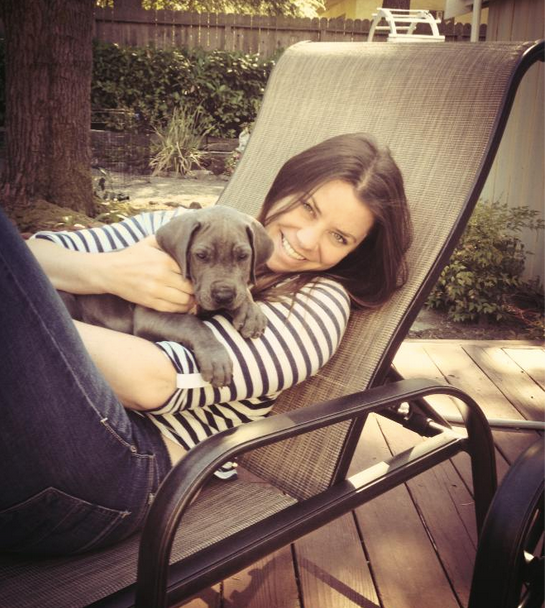
Photo from The Brittany Maynard Fund website.

Last night, as I watched the video above, my tears started flowing.  I cried for Brittany and her mother and husband, but I also cried for me and my Mom and my own family.  The death that Ms. Maynard and her family moved across state lines to avoid is the very same death that my Mom experienced as we sat helplessly by.

Glioblastoma Multiforme, or “GBM” as it’s called in Cancerville, is a beast. My Mom was diagnosed with it in the spring of 2004.  She died eleven months after her diagnosis, but make no mistake, the prognosis was apparent from practically day one.  After her tumor resection, my Mom’s surgeon walked into the tiny, windowless family conference rooms all hospitals have for this purpose and said the words, “She will die from this.”

And she did.

Along with other family and paid caregivers, I provided care for my Mom in the nine months it took for her to die after that surgery.  I bathed her and fed her and toileted her and brushed her dentures and washed her sheets and did everything a human body requires when it is paralyzed and no longer works as it was intended.  These were loving acts that prepared me for motherhood and my own daughter’s brain tumor just two years later.

Whether or not my Mom would have wanted to exercise a more dignified death than the one she had is not a question I can engage in.  That choice would have never been mine to make.  And whether or not my daughter would have benefited from a death hastened and softened by medication is not a question I will engage in.  That choice is too personal for public consumption.

But having seen two loved ones, my mother and my daughter, die from the effects of aggressive brain tumors, I know first hand what awaits Brittany Maynard.  And with that intimate knowledge, I support her right to choose her time and circumstances of death.  And let’s be clear, folks:  Brittany Maynard is not choosing death.  Death chose her.  Brittany is exercising her right as a citizen of the state of Oregon to die with dignity.  She wants every American to have access to that same right.

**********

If you want more information on The Brittany Maynard Fund, a campaign organized by the Compassion & Choices organization, click HERE. They are currently working with five states to expand death with dignity legislation.  Those states are California, Colorado, New Jersey, Massachusetts, Connecticut.  

**********

Like what you are reading?  I always have an opinion to share.  You should subscribe.  Here’s how:

Type your email address in the box and click the “create subscription” button. My list is completely spam free, and you can opt out at any time.