A Walk in the Woods: Finding the Teachable Moment

It was a beautiful day in Chicago — warm, bright, white blooming clouds in a brilliant blue sky.  I had seen the forecast, so promised Mary Tyler Son a morning at the local nature center.  Gratefully, the weather man was right, so off we went.

Woods 1

A perfect picture, right?  Yeah, a bit too perfect.  It all started out well enough.  We began our adventure in the actual nature center of the nature center.  A window box honey comb with very active bees, animal skulls of every stripe, pelts galore.  The kid was stoked.  So was I.  We started on the Savannah Trail.

Within two minutes, the boy was ready to turn around and go back to the nature center.  I couldn’t quite figure out why, but he was easily convinced to keep walking.  A few minutes later, bored with the finding and picking up of leaves, he asked again to turn around and get back to the “nature house.”

This continued for a while, Mary Tyler Son asking to turn around and me cajoling to move forward.  Finally I asked what was so special about the nature house when we were right here in nature?  “The puppets!,” he said.  Oy.  Some ratty old puppets of animals and insects.  I remember we never let Donna touch the things as they had been handled by a thousand other kids.  For Mary Tyler Son, germs are not an issue, but the plan involved being outside, not inside.

At least, I thought that was the plan.  Mary Tyler Son’s plan involved pouting.  Lots and lots of pouting, worsening when I told him we were going to stay outside, not inside, and that the whole point of our walk was TO BE IN NATURE, dammit.  Harumph!  Ugh.  I had taken the bait.
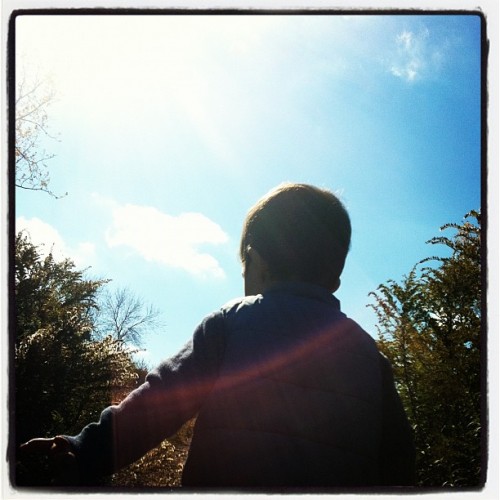
Woods 3

You never win in a power struggle with a three year old.  They are faster, have more stamina, and lack reasoning ability.  It’s a rookie mistake to engage in the first place, but engage I had.  Never take a three year old’s bait.

Before I knew what was happening, I was walking twenty feet ahead, Mary Tyler Son was lagging behind, stomping in his fireman boots.  “Fine, I said, we’ll just go home.  If you don’t want to walk, we can go home,” and I meant it, walking even faster to prove my point.  So there we were, out in nature, both stewing and pouting in our own way, for our own reasons.

Then we came out of the woods, both literally and figuratively.  The sun shone brighter upon us, there were a few ponds and bridges to cross, the grass grew tall as Mary Tyler Son and tickled his face as he walked past.  We collectively decided to take the longer trail back to the nature center, as it had more bridges.  The bridges are windy and have no sides to them, making them feel a little dangerous/exciting to a three year old boy.
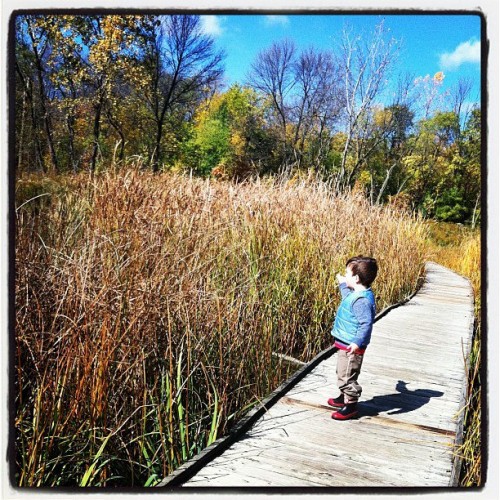
Woods 4

We both held our faces up, basking in that glorious autumn sun.  Our pouting was over.  We walked together, hand in hand, except when I asked him to walk ahead to “lead” us, which is mommy code for I want to take your picture.  There were hills and trees and that endless blue sky above.  Mary Tyler Son spied a hawk.

As we got in view of the nature center, almost having come full circle, I asked my boy to sit down and talk.  I am a talker and when I tell my boy, “we need to talk,” he knows that there is a lesson to learn.  It is our thing.  It works.

I told him what I had learned in our time in the woods — that if we are more focused on what comes next, like puppets in the nature center, that we are missing what is all around us, right now, right here.  “Look around,” I told him, “what do you see?”  Tall trees and puffy clouds and hills and furry plants that reminded him of his stuffed animals at home and a plane that looked like a rocket ship and purple flowers and weeping willows and blue, blue sky and “so much more, Mama!”  We agreed it was all very fine.  And worth paying attention to and enjoying.
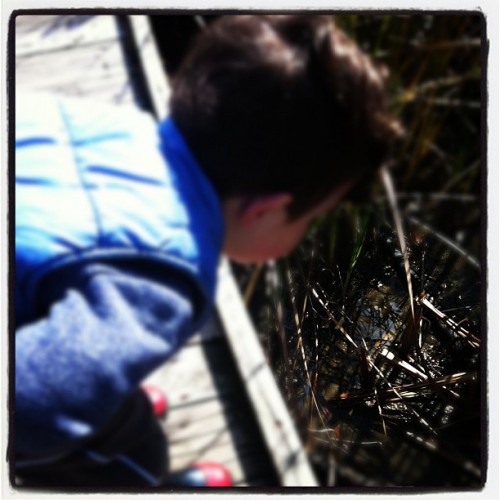
Woods 2

We all need that lesson, don’t we?  We rush around always trying to get to what comes next without paying attention to what is now.  Sometimes, now sucks and rushing through it feels justified, but sometimes now is remarkable and when we rush we miss it.  I was as guilty of this as Mary Tyler Son.  In those early moments of the walk, I was thinking ahead to what I thought was inevitable — a tantrum, our lovely day ruined, me wanting to teach the boy a lesson.  Harumph, indeed.

My parenting lesson for the day was to own being the parent.  I am able to set the tone.  I do not have to react to the flighty whims of a three year old.  When I do react to the flighty whims of a three year old, we both lose.  Mary Tyler Son is going to test — that is his job.  My job is to try and not feel testy.  Or tested.  Today, I got an A+.  Tomorrow might be different, but proving my point, I’m just going to enjoy today.

Governor Romney, Hope Matters

Let me preface this post by assuring you it is not a political entry, despite being inspired by the words of the current Republican presidential candidate.  I fully realize that the context of Governor Romney’s words pertained to his issues with President Obama’s stance on Mid East turmoil.  I am not writing about Mid East turmoil, or Republicans, or Democrats.  I am not writing about politics.  I am writing about hope, something I do a lot of around here.  Please do not view this post through a political lens.   

Yesterday, as I was prepping dinner, I was listening to NPR.  I turned the radio on mid-story, and heard a clip of Mitt Romney addressing the Virginia Military Institute.  “Hope is not a strategy,” is what I heard.  It was a bit like a slap in the face, as hope is my strategy.  Hope is what gets me through my days, you see.  On the bad days, I hope for better days, and on the good days, I hope for more — more joy, more life, more of the Good Things that keep me going.

Governor Romney, of course, was not discussing Cancer Moms and what they need to get through their day.  He was discussing foreign policy specific to the Middle East.  I know that.  The man is in the midst of the fight of his life and he is doing his best to connect with voters, appear presidential, and do what needs to be done to move in to that Oval Office come next January.  I get it, I do, but still, I was struck.

It made me think about hope and what it means to me, to you, to our world.  Merriam Webster’s online edition defines hope as, “to cherish a desire with anticipation,” or “to desire with expectation of obtainment,” or this, “to expect with confidence.”  Huh.  Not only do I not agree with Governor Romney on this, I don’t agree with Merriam Webster either.  Dictionary.com does better, “the feeling that what is wanted can be had or that events will turn out for the best.”  Still no cigar, but it is closer to my own definition of hope

In the midst of Donna’s illness, in June of her last summer, after we learned of the terminal nature of her cancer, my in-laws sent a book along to us.  Written by Jerome Groopman, M.D., it was called The Anatomy of Hope:  How People Prevail in the Face of Illness.  I picked it up with trepidation.  Self-help books are not my bag, and this looked suspiciously like a self-help book, complete with a single green leaf on the cover.  Yeah, I’m too cynical to do self-help. 

And I am absolutely one of those gals who judges a book by its cover.  I’ll look it over, but if the blurbs and first few paragraphs don’t grab me, I will put that sucker down.  This is the first paragraph of the Introduction to The Anatomy of Hope:

“Hope is one of our central emotions, but we are often at a loss when asked to define it.  Many of us confuse hope with optimism,  a prevailing attitude that “things turn out for the best.”  But hope differs from optimism.  Hope does not arise from being told to “think positively,” or from hearing an overly rosy forecast.  Hope, unlike optimism, is rooted in unalloyed reality.  Although there is no uniform definition of hope, I found one that seemed to capture what my patients had taught me.  Hope is the elevating feeling we experience when we see – in the mind’s eye – a path to a better future.  Hope acknowledges the significant obstacles and deep pitfalls along that path.  True hope has no room for delusion.”

At what, I hope, were the most devastating moments of my life, Dr. Groopman’s words spoke to me.  Choosing hope is not a pie in the sky venture.  It is not all lollipops and tutus and rainbows and ice cream.  It is stone, cold, hard work.  Work, people.  WORK.  Choosing hope, my personal strategy of choosing to be hopeful, does work for me.  Every day it works for me and every day I am grateful that I have hope in my life.  I see parents who have lost children to cancer who do not have hope.  They scare the bejesus out of me.  We bob along in the same ocean, those parents and I, but we are not in the same boat. 

I wrote a Facebook status about Romney’s words last night and one of my friends wrote the most profound response, “Dismissing hope can only be done by people who have never needed it to survive.”  I dare say this friend (yo, Amber) is right.  I will be the first to admit that I need hope.  I need it like I need oxygen, sunlight, and water.  Hope is necessary to my very existence these days and without it, I would be joining those other folks in the sad, bitter, angry boat.  I don’t want that for me, my husband, or my son.  I want better for us.  I want the joy that hope invites into my life, the possibility of a better future, the lightness of love and wonder and peace.  I want hope. 

So to you, Governor Romney, I say, “Hope IS a strategy.  And it works.  And we need more of it, all of us, to see us through these troubling times we find ourselves in.” 

I am Mary Tyler Mom and I approve this message.

Strange(r) Encounters: STFU Edition

This week has been a banner week for strangers telling me what I did wrong during Donna’s cancer treatment.

Before I go any further, though, let me preface this entire post with the very real fact that Mary Tyler Dad and I have no regrets about the choices we made.  Got that?  NO REGRETS.  That is one of the few blessings we have had bestowed on us in Cancerville.

By publishing Donna’s Cancer Story on Huffington Post this year, I had hoped to reach a whole new audience and expose them to the harsh realities of pediatric cancer.  Every indication is that it is working.  And again, similar to last year, is the awkward reality that new readers are not immediately aware of Donna’s death.  Is it my responsibility to break that news? I’ve opted not to, thinking that anyone with any curiosity would visit Mr. Google to meet all their curiosity needs.

Oddly, not everyone thinks the way I do.  Yesterday I received a private message that went a little something like this:

This will sound like an attack, but I promise it is not. I heard you mention feeding her [Donna] McDonalds for breakfast and it is what made me think of what I am about to tell you. The food we put into our bodies can be the best forms of medicine or the slowest forms of poison. McDonalds is toxic. My young boys actually broke out in a rash from eating there and as far as we know they have no known allergies.   I am by no means a doctor and I would strongly advise you to still listen to your doctor, but it is worth looking into, right? I think it could really save your daughter’s life. Please feel free to ask me for more information if you are interested.

Sigh.  Where do I even begin?  It’s pretty much a given that when someone starts out an exchange with the words, “This will sound like an attack, but I promise it is not,” you’re about to be attacked.  Prepare for battle.  I believe this individual was not acting maliciously in any way, shape, or form.  I also believe, knowing that said individual was under the impression that my girl was still alive, that telling me that McDonald’s was toxic poison was crossing the proverbial line.

Trust me when I say that Cancer Parents know from toxic poison.  Chemotherapy is toxic poison.  We know this because it comes in industrial grade plastic, is handled with RNs wearing blue gloves (and there are always two RNs present for chemo administration), and is thrown out in bright red biohazard bins that you learn not to go near.

Admittedly, McDonald’s is crap masquerading as nutrition.  We all know that, right?  Yes, we can all agree that it is not best for our bodies.  Damn you, delicious chemicals (shaking fist in air for greater effect)!

But, honestly, believing, as this person did, that Donna was still alive, was it really necessary to personally message me with the newsflash that McDonald’s was not the healthy diet my daughter needed?  I think not.  Was it really necessary to “strongly advise me” to still listen to our doctor, as if a stranger’s note on Facebook would vastly alter the course of our daughter’s cancer treatment?  And was it really necessary to speculate on what could and could not save my daughter’s life, three years after her death?  That a side of McDonald’s french fries two days after brain surgery would be the tipping point between life and death?

I just sigh and shake my head at the stupidity.

When I posted this on Facebook, which is where all daily frustrations land these days, there was a thread 260 comments long, bashing the unthinking soul who dared question my nutrition choices.  It seems I am not alone in getting worked up over some silly nonsense posed by a stranger.  Sure, there was the occasional voice of support confirming that McDonald’s is indeed unhealthy fare, but pretty much universally, folks agreed the well intentioned stranger should have kept their hands off the keyboard and their mouth closed.

Tomorrow I will explore another exchange with a stranger about Donna’s cancer treatment.  In September, I am like a freaking magnet for this stuff.  That tete a tete, though, is a little more nuanced, a little more interesting.  Stay tuned.

Strange(r) Encounters:  Listen and Learn Edition