What’s a Parent To Do?: Watch ‘Modern Family’ and Learn

Modern Family Portrait

‘Modern Family’ captures and holds my attention like few sitcoms.  Part of it is its humor.  Part of it is Phil Dunphy (so sweet, so cute).  Part of it is how they tackle current parenting issues with wit and aplomb.

My own family looks nothing like the Pritchetts.  I don’t have a hot Columbian step-mother; I have a dead mother.  I don’t have a sassy, gay brother-in-law; I have a mostly humorless, tense brother-in-law who really doesn’t like me.  I don’t have three kids that are distinctly different and yet perfectly complementary; I have a toddler son and a daughter who is buried in the earth.  I don’t have a fancy home in close proximity to my father and sibling’s fancy homes; I have a condo with neighbors that make too much noise. Sigh.

Sometimes real life sucks.  Perhaps if a humor writer took a hand at Mary Tyler Family, there would be less cancer, less loss, less fracture.

Whatever.  My point is that I look forward to those twenty-two minutes a week that I can suspend my own family issues and laugh with the Pritchetts.  Big belly laughs.  Full on laughs that both have me identifying with the parenting issues of the week and cringing just a bit by the bold honesty of it all.

In the past two episodes alone ‘Modern Family’ has covered leashes, or “child safety tethers” on young kids, aging, failing marriages and compromise, lying and cheating kids, infighting over different parenting methods, and marital jealousy.  Sounds depressing, but it’s not.  It’s refreshing, which is so much better.

There is an openness and bright light that ‘Modern Family’ brings to modern parenting that I completely appreciate.  A week or so ago a friend with a blog (hard to believe, but I have dozens of those), made what I thought was a pretty innoculous Facebook observation about seeing a toddler in a leash. Yes, a leash, not a “childhood safety tether.”  She had never used one herself and wondered, innocently enough, if kids in leashes are getting enough exercise.  Well, the Internet parenting snipers reigned down on her.

Scout’s honor, this gal is on of the sweetest, most rationale, and loving women I know.  Her observation was directly in line with the content of her blog (family nutrition and health) and the judgment in her words was non-existent.  The comment thread was full of vitriol, much of it geared towards her.  How dare she? was the common denominator.  How dare she ask such a question.

In modern life, judging has somehow become equivalent to stoning.

Modern Family handled this leash/tether issue with grace and humor.  Cam, the stay-at-home dad of young Lily, “a bolter,” was all for it.  Mitchell, her working dad, hated it, mostly because of how it would be perceived by others.  Well, Mitchell, of course, was right — as he was judged by family and strangers alike.  That’s what I call equal opportunity judging.  When the weight of all that disapproval got to be too much, the leash came off and Lily bolted.  Of course.  What’s a parent to do?

That simple question — what’s a parent to do? — and the fact that it is asked in the first place, is why ‘Modern Family’ is courageous television. Truth is, there is no right answer and there is no easy answer.

In last week’s episode Cam, good old, well-intentioned Cam, informed Claire, his Type A sister-in-law, that they were using a new parenting method and no longer saying “NO” to Lily.  Naughty Lily, who was a guest in Claire’s home, and doing naughty, annoying, wasteful things.  In modern life, there is no such thing as the “village” that Hilary Clinton immortalized.  It no longer takes a village to raise our children, it takes tomes and tomes of parenting theory books.

These books and parenting theories work hard to answer that question of what’s a parent to do?  They do it by telling us exactly, precisely, and definitively what to do.  Problem is, these parenting books are like bubblegum — they come in a hundred and one flavors and lose that flavor quickly.  Claire and Cam, in a tense and hilarious exchange, come to blows over her not respecting his new rule.  He leaves in a huff, his parenting ego bruised, angry at Claire and no doubt embarrassed at the exposure of his new rule as bunk.

And this is where the good folks in ‘Modern Family’ differ from my own family.  Somehow, someway, they continue to love and respect one another in their differences.  Their individual styles and quirks and failings and parental idiosyncrasies are tolerated, and better yet, acknowledged and laughed over.

In my family, our idiosyncrasies turn into a bunch of idiots, sins, and crazies. Sigh.

The Good Enough Mother

I’ve been stewing about this post for months.  MONTHS, people.  I wanted it to be perfect:  Clear.  Concise.  Informative.  Witty.  Earnest.  Knowing.  Comforting.  Wise.

Bah!

My need for perfection is so completely counterproductive to this discussion and a direct slap in the face of my intent, but it took me until just this second to realize that.  What can I say?  I’m slow like that sometimes.  Settle in, folks, and let’s chat, mother to mother, mother to father, parent to parent, failure to failure.

Once upon a time there was a man named Donald Winnicott.  He was a pediatrician and psychoanalyst in mid-20th century Britian.  For psychology wonks like me, he is a rock star.  I learned about him in graduate school and he changed my life for the better.  He’s not cool enough to have cured cancer, but his theories were significant enough to include in my wedding vows.  And that tells you something about me — I included psychoanalytic theory in my marriage vows.  God bless Mary Tyler Dad.

Winnicott
This man taught me everything I know about mothering.

Winnicott developed a theory in 1953 called the ‘Good Enough Mother.’  Now before I upset any Dads in the house, know that this theory, in my belief, applies to you as well.  But in 1953, there weren’t a hell of a lot of stay-at-home dads running around.  And those that did exist were probably shunned a bit.  So please understand Winnicott’s language and theories through their historical context.

In a nut-shell and in Winnicott’s own words:

” . . . a mother is neither good nor bad nor the product of illusion, but is a separate and independent entity: The good-enough mother … starts off with an almost complete adaptation to her infant’s needs, and as time proceeds she adapts less and less completely, gradually, according to the infant’s growing ability to deal with her failure. Her failure to adapt to every need of the child helps them adapt to external realities.”

The failure Winnicott refers to is not specific to bad things that mothers do that damage their children, but instead, the perception of the child as the child grows and develops that Mom is no longer able to “fix” everything or make it all better.  No parent can ever meet every single need of a child from the child’s point of view.  If so, the toddler temper tantrum would not exist.  Think about those states of mind kids get into with the dramatic mood swings and crazy demands.  No way in freaking hell that those whims should be catered to by a parent, hence the concept of a parent’s “failure.”

When I first read this theory, I was about as far away from parenting as one could get.  I was single, living in a dimly lit studio apartment in Chicago, working half-time and going to graduate school full time.  The whole concept of parenting was not on my radar.  I was in my mid-20s and way more interested in dating, clubbing, learning, and as I fondly like to say, “developing a personality.”  Because I was such a squirrel growing up — no interest in sex, drugs, or rock and roll — I embraced the late bloomer thing fully at this stage.  So, yeah, parenting was not on my agenda.

But those words — good enough — spoke to me in a way that made an impression.  I carried them with me, mentally, and applied them as needed.  The graduate school mantra of “turn something in,” regarding papers, etc. was nothing more than “good enough” applied to course work.  The Christmas gifts hastily purchased and wrapped just moments before they were opened were “good enough.”  Throwing all my laundry into one load was “good enough,” as clean skivvies were more valued than spending $ on small loads of properly sorted piles.

After Mary Tyler Dad proposed to me, I applied the concept of “good enough” to our wedding planning — nothing fancy, nothing spectacular, no Bridezilla here.  Truth be told, Mary Tyler Dad was way more freaked out on our wedding day than I was.  The food was okay, the dress was acceptable, the wine was passing.  Somehow, though, the total effect was sublime.

‘Good enough’ had served me well in the planning of the wedding, so I decided to integrate it into my marriage by vowing to be the “good enough wife and mother.”  I take my vows seriously.  Irish sentimentalist that I am, I laminated copies for Mary Tyler Dad and I right after the honeymoon that we both carry in our wallets.  I wanted those words to be more than fancy promises, so my vows were about Cheerios, work-life balance, and good enough wifing and mothering.

The concept frees me with its liberation from expectations.  I never have to be perfect, I only have to be good enough.  If you read further into Winnicott’s theory, you learn that striving for perfection is a sure path to screwing your kids up in epic proportions.

Something else to recognize is that my version of good enough is going to be vastly different than your version of good enough.  What is acceptable to me just might be considered neglect by others.  And what you consider standard practice is something I might never condone for Mary Tyler Son. That sounds extreme, but my infamous Facebook car seat debacle was proof that parenting standards are hard core personal.

My point is this:  Embrace the concept of “Good Enough.”  Breathe it in, breathe it out.  Let it wrap around you and soothe your tired, worried, guilty soul.  You will fail your child.  You will.  It will happen. Some of us do it daily. Some more spectacularly than others.  What Winnicott tells us though, assures us from his mid-century psychoanalytic throne, is that it is okay. Everything is going to be okay.

If you like this, like me on Facebook.  Good times.

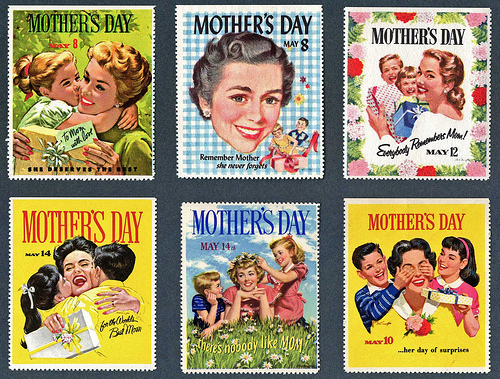
The Other Side of the Mother’s Day Coin

Retro Moms

Mother’s Day is Sunday.  Sigh. 

For me, Mother’s Day is like Valentine’s Day for the broken hearted, Christmas and Thanksgiving without family, and New Year’s Eve at home alone.  All on the same day.  You know those holidays manufactured to make you feel badly?  Yeah, that’s Mother’s Day at my home.  No need to play your violin, as every day stings a little for me.  I’m mostly used to it. 

This is my ode to those of us who struggle at this time of year, when the media turns to images of pretty young moms embracing their kids or older matriarchs beaming with pride over her tribe.  We’re encouraged to up our consumption of flowers and brunch and manicures.  For a few weeks in May, everything turns 50 shades of pastel (and from what I hear, 50 shades of another color is what moms are really hoping for this Mother’s Day).  Here’s to us, folks, the ones who turn to puddles in the middle of May. 

  • For those of us who’ve lost a mom (suck it cancer, stroke, heart disease, Alzheimer’s, insert dastardly disease here __________________);
  • For those of us whose mom is sick (see above disease culprits);
  • For those of us whose mom didn’t know how to be a mom;
  • For those of us who wonder who our “real” mom might be;
  • For those of us who feel guilty about that;
  • For those of us with two moms (bonus!), but with double the above troubles;
  • For those of us who have a mom, but don’t much like her.

It’s tough to not have a Mom.  Mine died when I was pregnant with my first child.  She was a great Mom, like butter that could be hard or soft, but went well with everything.  She was my family’s glue, our Switzerland in the midst of garden variety familial dysfunction.  With her gone, my family is altered to the point that it is almost unrecognizable to me.  Now we’re a group of islands looking at one another in the distance.  I miss you Mom.  I understand you better now.  I’m so sad for the family that was and know you must be, too.  I hope you are in a better place, enjoying your granddaughter, with a book and a cigarette, and a Coke close by. 

  • For those of you who’ve lost a child through illness;
  • For those of you who’ve lost a child through accident;
  • For those of you who’ve lost a child to drugs or addiction;
  • For those of you who’ve lost a child at birth;
  • For those of you who’ve lost a child through miscarriage;
  • For those of you who try and try and try to conceive, but can’t;
  • For those of you who wish to adopt, and are waiting and waiting and waiting and waiting;  and still waiting;
  • For those of you who wish to adopt, but can’t afford it;
  • For those of you who don’t wish to be a mom, but feel the scorn that so often creates;
  • For those of you who mothered so well that your kids done grown up and left you, for you, too.

I am so grateful to have Mary Tyler Son to care for and fuss over.  He was born in the midst of my daughter’s cancer treatment and I have a distinct memory, near his first birthday, two months after my girl died, of seeing him for the first time.  Really, truly seeing him — separate and independent from grief and sadness and his sister.  Seeing him.  I am so grateful my eyes were open to his joy and wonder.  I thank my lucky stars every time his toddler antics get the better of me.  And I think of those mothers that are reflected above, gals that are still mothers, women who will always be mothers, but with no one to mother.  I hold you close this Mother’s Day and I think of you.

  • For those battling their own illness;
  • For those battling their own addiction;
  • For those mothering, but who probably should not be, for a thousand different reasons.

I think of you, too, this Mother’s Day.  One of the most amazing things that has come to me through writing has been hearing from different moms whose struggles look nothing like mine own, but who identify with the struggle itself.  A reader wrote to me in the midst of her own illness, when we were in the thick of Donna’s.  She was hopeful, but excrutiatingly aware that her children, her daughters, would most likely grow up without her.  She was right.  I learned later that she had died in the midst of transplant surgery.  And now her girls are motherless, grappling with their own sadness this Mother’s Day.  Another reader wrote to me about her addiciton and how reading about Donna made her see her own toddler, neglected through that addiciton, in a new and necessary way.  She is now clean and sober over five months.  That mom has a shot at a real and joyous Mother’s Day, and I wish her the best.

This post is for all of us on the other side of the Mother’s Day coin.  Kraft och omtanke to you.  Strength and consideration instead of flowers, or brunch, or manicures.  Soon it will be Monday and we can all breathe a sigh of relief.

Blue Jays