Hitting on Donald Trump: Pinata or Effigy?

I am not a fan of Donald Trump.  This is no secret.  Should he be elected the next President of the United States of America, I fear greatly not only for America, but for the world.  We talk about politics at home, so our sons have no doubt overheard us and we’ve certainly answered questions about the upcoming presidential election and the candidates when posed by our son.

Last weekend my older boy and husband went to a neighborhood block party.  It was an end of summer celebration on a warm day.  Lots of food and drink and good cheer.  Oh yeah, and a Donald Trump pinata, too.

I first heard about the Trump pinata sensation a few weeks ago at a party with the parents of my kid’s classmates.  I laughed with the others, thoroughly enjoying the irony of Candidate Trump’s likeness being made into a pinata — a symbol of celebration so closely associated with Mexico, our neighbor to the south that Trump intends to build a wall of separation from as a welcoming card.

But here’s the thing — enjoying the irony of an idea is a completely different thing that learning my son was taking a whack at a likeness of our Republican presidential candidate, even if it is a man I fear and don’t respect.  When my husband texted me an image of the pinata surrounded by young kiddos greedy for candy and the ring of smiling adults around them, I won’t lie, it made my stomach turn.

Photo courtesy of Matt Farmer.

We are better than this, folks.  At least we should be.  At least I thought we were.

I asked my son about it when he returned.  He was fairly animated, telling me that when it was his turn to hit The Donald with a stick he thought about how angry he would feel if Trump were elected president.  Oh, man. I can’t lie, that was hard to hear.  The thing is, a seven year old, even one as precocious as my son, doesn’t typically hold anger and ill will towards people he doesn’t know personally.  It is clear that the thoughts and feelings my husband and I share about a Trump presidency have trickled down to our boy.

While I am A-OK with introducing politics to children, encouraging them to think critically, ask questions and come to their own conclusions, I draw the line at whacking an effigy of someone we disagree with, not only politically, but morally and ethically as well.

My boy and I had a chat about how I disapproved of the pinata.  We talked about anger and disagreement and conflict and how best to handle those things. We talked about pinatas and effigys and how those things are better off separated.  They are, in fact, very different things.  I told him that when I was a girl watching the evening news (remember when we used to actually watch the news?), it always scared me to see effigies of Uncle Sam or American presidents being destroyed.

As adults, we have to be responsible about how our own views and opinions are perceived and often embraced by our children.  It’s not so easy, though.  For me, my personal values — those things I wish to instill in my sons, are very much present in my politics.  Of course I support candidates whose values most closely mirror my own. It is an important aspect to the privilege of voting and democracy — choosing a candidate that best reflects our own views.

But here’s the thing:  I could easily see Donald Trump whacking away at a Hillary Clinton or Barack Obama pinata, laughing and hitting, hitting and laughing the whole way through.  The act of whacking an effigy is an ugly image.  It is base and primal and unsophisticated and not something I would ever condone, a lot like Donald Trump himself.  It would be hypocritical of me to condemn Trump for his hate and ignorance, then engage in hateful and ignorant behavior myself by whacking an effigy of the man.  And if it’s not good for me, it’s not good for my children.

This political season is one for the books.  It is ugly and dirty and only going to ramp up in the next two months.  During that time, as we listen to the news, comment on the latest outrageous sound bites, watch the debates, I am going to think critically about what I am adding to the situation that my son’s will see and absorb.  There is enough hate and ugliness in the world.  Our children don’t need to see more coming from their parents.  Disagree, discuss, clarify to your heart’s content so that the values you hold dear are what your kiddos see instead of a hanging effigy in the front yard being whacked for fun.

When Your Seven Year Old Asks If Slavery Is Still a Problem in America

This has been a difficult set of days in America.  It started with back to back point blank lethal shootings of two African American men by police officers last week. On the heels of that, a sniper in Dallas killed five police officers while wounding seven others during a protest rally organized against the first two killings.  Like many Americans I have been feeling helpless, hopeless, stunned, and, yes, a bit paralyzed by my privilege.

When the phone rang Friday morning with an invitation to head to the beach with my boys on a warm summer day, I gladly accepted.  The blue sky, the white clouds, the warm water, the golden sand, families of all shapes and sizes playing and relaxing — it all added up to the balm I needed.  It’s pathetic, really, that even as an insulated white lady, I still sought respite from the racial storm that is America these days.  My thoughts kept returning to people of color that don’t get to feel better or restored with a trip to the beach because racism follows them everywhere.

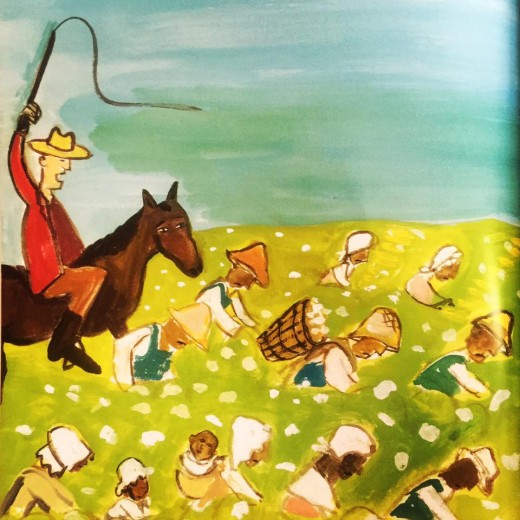
In the car on the way home, totally out of the blue, my seven year old asked from the back seat of the car, “Mom, is slavery still a problem in America?”  Whoa.  Where did that come from?  I quickly determined that he was referring to the slavery he knows about.  The slavery that propelled our country into civil war 155 years ago.  The slavery that he has read about in children’s books his liberal parents make certain find their way onto his bookshelves.

Illustration from the children's book "Looking at Lincoln," written and illustrated by Maira Kalman, Copyright 2012, published by Nancy Paulsen Books.
Illustration from the children’s book “Looking at Lincoln,” written and illustrated by Maira Kalman, Copyright 2012, published by Nancy Paulsen Books.

I could have responded with a quick, “Oh no, honey, slavery ended long ago with the Civil War,” but my boy is bright and that answer felt like a cop out.  I could have responded with a more candid explanation that slavery does still exist in America today, in the form of human trafficking, but the kid is seven and that seemed a bit sophisticated for him right now.

Instead, I used the moment to talk about racism, something all of us need to be doing more of these days.

I explained to my curious boy that slavery was once considered a lawful practice where white Americans owned black Americans and that those same black Americans were considered property, without rights, less than human.  Black slaves were bought and sold, traded and discarded, not unlike pieces of machinery, dehumanized.

My kid knows about the Civil War and the Emancipation Proclamation.  He knows, again, from the age appropriate, simplistic histories in children’s books that many people fought and died over the issue of slavery.  What he doesn’t know is what followed.  It’s not as simple as black slaves walking away from plantations into the sunset, free men and women and children living lives of instant equality.

So in that car last Friday afternoon, I tried.  I tried to explain that less than seven generations ago black Americans were considered property and that a race of people imported and mistreated for decades and decades and decades, relied upon for economic gain, are not simply treated as equals because they are freed. An entire race of people does not magically recover from being owned simply by the decree on a piece of paper.

I tried to explain the Civil Rights movement, an effort that resulted in legal equality for African Americans a full hundred years after the end of the Civil War, but that even legal equality does not result in true equality.  I tried to explain that even today, over 150 years after the Civil War, true equality does not exist for black Americans because of entrenched ignorance and bigotry.

I introduced the word “racism” to him, which I defined as treating someone differently because of the color of their skin, or believing that all people with different colored skin share qualities, better or worse, than others.  I talked about how racism makes life harder for people of color than for he and I with the fair, pale skin we live in.

It was too much for my kiddo, I know, as I spied in the rear view mirror that he was checking out.  I wrapped it up, my perhaps overly earnest and simplistic explanation of the connection between yesterday’s slavery and today’s racism.  The idea of racism, its reality and existence, is too much for many grown-ups to acknowledge and identify, so I cut my seven-year-old some slack.

But I will keep trying and keep talking and keep identifying for him, in bits and pieces, how life in America is different for people depending on the color of our skin.  We were pulling into our driveway at this time, a convenient end to an unexpected lesson in America’s past.

As a mother, I can’t stop indiscriminate killing of black Americans or police officers under sniper fire, but I can teach my boys the realities that exist.  I can teach them to understand that in many, many ways their lives will be made easier because of the color of their skin and how other children with different colored skin will have more difficult lives.  Kids easily embrace the unfairness of that reality.  I wish more adults could do the same.

RELATED:  6 Valuable Tips for Talking About Race with Young Children

RELATED:  A Tale of Two Chicagos

You Be Happy, Mama

Sometimes it’s a question, sometimes a demand posed to me by my two year old.  “You be happy, Mama?” has become a common phrase in our home over the past few weeks.  My little one with his bright blue eyes and red, red lips and long blond curls looks up at me, pleadingly, “You be happy, Mama?”  He needs and wants for his mama to be happy.

Smile!  Be happy!
Smile! Be happy!

No matter where I am or what I am doing when I hear these words from my little one, they make me pause.  My heart momentarily cracks and leaks, wondering what is behind his often asked question.  Am I doing something wrong with this mothering thing that my two year old feels a misplaced responsibility over my mood? Does he mistakenly believe that we all need to be happy all the time?  How should I respond?

What I typically do is feel an immense sense of mother’s guilt as I pull my kiddo close and say, “Oh, honey.  You don’t have to worry about Mama.  Mama is happy.” The thing is, sometimes that’s a lie.  Often when Mary Tyler Toddler poses the question, “You be happy, Mama?,” it is immediately after I have reprimanded his brother for leaving his yogurt wrappers in the living room or his socks under the dining room table.  In those moments I am frustrated and mad.  Sometimes the little one catches me in a moment of sadness or reflection, thinking of our girl and how she would be turning 11 this summer.

Full disclosure, I am not always happy.  Nope.  Not even close.  And I’m okay with that, because I’m not always sad or morose either.  My emotions are a continuum and they fluctuate.  Sometimes daily, sometimes hourly, sometimes from moment to moment.  Emotions are exhausting, yo.

I understand that my heart breaks a bit when my boy poses this as a question because what he is saying with his words is that he needs for me to be happy.  No pressure, Mom, but get it together and slap on a smile for your little ones.  Stuff the anger, the frustration, the sadness, the grief and be happy, dammit!  It’s for the kids!

If only it were that easy.

I do believe that, overall, our kids do want and need for their moms to be happy.  Happy is secure, safe.  Happy brings hugs and kisses and chocolate milk and adventures.  Happy is calm and peaceful.  Happy is good.

I will never forget, just  a few months after the death of our daughter, I was sitting in my hairdresser’s chair, talking about, well, everything, when she stopped me and said, “Your son (just a year old at the time) deserves a happy mom.”  Her words have stuck with me ever since.  I believed them then and I believe them now, seven years and one additional son later.

I will never forget the therapist we were mandated to see when we were working to qualify for adoption.  The adoption agency was very concerned that my husband and I had never received professional counseling after our girl died.  In an individual session I had with the therapist I revealed that my truth was that I was sad every day.  Sadness is a fact of life for me, like having blue eyes or brown hair.  It just is.  She corrected me, in a coaching manner, to reframe that as “I remembered every day.”  Pffft.  No.  I am sad every day.  I remember, too, sure, but the act of remembering often leads to sadness.

There are messages all around us about the importance of being happy.  “Choose happiness” is a catch phrase I see more and more.  The stick figures on the bumper sticker proclaim that “Life is good.”  Those are wonderful sentiments, but not always realistic.  Some days, happiness will elude you, and life is decidedly not good for all people at all times, sometimes life downright sucks.

But back to my toddler and his need for his mama to be happy.

Two years old is a little young to consider the nuance of emotions.  He won’t right now be able to necessarily hold that when I am frustrated trying to hustle two little kids out of the house in the morning, it isn’t a sign that his safety and security are in jeopardy.  For him, in that moment, they are.  I need to respect that.

Where I can help him better understand and slowly come to appreciate emotion is when he demands me to be happy.  “You be happy, Mama!” is quite a different beast than the more vulnerable and empathic, “You be happy, Mama?”  The question form has a kernel of empathy attached to it and an awareness that, in that moment I am not acting happy, while the demand form is almost brutish.  BE HAPPY, DAMMIT.  Because I say so.  Nope.  Changing my emotion based on the demands of my toddler is not a good thing, methinks.

Motherhood and parenting is hard.  So much of it is working to stay in tune with the emotions of our little ones.  What messages are they sending us?  What is the subtext in their communication, especially when words are not fully in place?  What are they needing from us right now, in this moment?  Another part of mothering is modeling for our children that emotions are healthy and natural.  They are to be felt and not feared.  And they’re not like watching TV with an OnDemand button.