So the husband and I celebrated 15 years of marriage last week. It was lovely, actually. We spent a weekend in the small town where we got married, showed the boys the opera hall where our ceremony was held, had a spontaneous vow renewal, enjoyed a fancy dinner and show. Really lovely. And, then, you know, it’s Monday again and the chaos of day-to-day life resumed.
As I was emptying the dishwasher, it struck me that I was putting away dishes and glasses and silverware that were gifted to us for our wedding. I took a quick survey of the things in our lives that we use regularly that we’ve had for 15 years. Sure enough, there were 15 of them. BLOG POST.
When you get married, or commit matrimony, as my Dad always used to say, so much of the focus is on the wedding day and not all the days that will follow. Equally skewed are the things we register for when we get married — fancy things that rarely get used and sit tucked away in their original packaging. I took some flak for not registering for china or silver, but I don’t regret it for an instant. I love to use these things and I love that they’ve been part of our day-to-day lives for fifteen years.
What better gift to give than one that gets used? Think about that, brides-to-be, as you prepare for your own wedding. My advice to you is to spend as much time thinking about the marriage as the wedding. And grateful thanks to all who gifted us these things. We think of you often!
“Married with kids” is both a description of who I am, but also what I do. I am married with kids, yes, but I also think of marriage and kids as verbs. Marriage is work, a process, a state of being. Having kids, raising kids properly, is certainly work. Perhaps more of a vocation, really.
I come from a long line of “married with kids,” too, as my parents did not divorce. I am the youngest of four. My husband descends from the “married with kids” lineage as well. And, yep, all our grandparents do, too.
As we wrap up the closing of my Dad’s home, the last connection to my parents as anything other than memories, I feel reflective. So, please, if you will, indulge me. I think it is the photos that are doing it to me.
Portrait of the blogger as a young girl. Can you tell I really liked Little House on the Prairie?
Boxes and boxes of my parent’s photos sit downstairs in my home, waiting for the day that all four of my siblings can sort and organize them together. I am curious to look through them myself, but it seems a bit unfair, somehow, me having access that my brother and sisters do not. So, sit they will. I snapped a few photos of photos as we did a cursory sort over the holidays and I keep coming back to them, swiping my thumb back and forth, watching the history of my parent’s marriage unfold.
When I was a child and imagined myself as an adult, I was always alone, living in a high rise, doing amazing things (magazine editor! flight attendant! psychologist!) and, always in my imagination, wearing knee high boots. My adult reality looks nothing like that. I am married, the mother of three, live in a condo, and earn a little money writing, but for the most part am a stay-at-home-mom. Married with kids.
My own marriage looks, I think, quite a bit different than my parent’s marriage. We have more money than I did as a child. There is more grief, for sure. Our roles, while on the outside appear very traditional, from the inside are quite egalitarian. We don’t fight the way my parent’s fought. Our two boys are having quite a different childhood than I had myself.
Today’s “married with kids” is, I think, a lot more kid focused. A child’s needs and wishes are front and center in many modern marriages. Is that a reaction to our own childhood where kids were present and appreciated, of course, but not the focus of the family? Methinks so, yes.
Both sets of my grandparents were immigrants. My Father’s parents were born in Ireland and my Mother’s parents came over the great ocean from Croatia. They had childhoods and lives that looked absolutely nothing like my own.
My Irish grandmother came over hoping to find a better life than the one she had in a small cottage in western Ireland. She worked as a domestic for wealthy families on Chicago’s Lake Shore Drive. My Irish grandfather first spent time in Massachusetts before claiming Chicago as home. He owned his own wholesale candy distribution business before he lost everything in the Depression. He raised his family in a series of apartments in Chicago’s now infamous Englewood neighborhood.
My Croatian grandmother came to America as a very young child, originally settling in St. Louis. She, too, found more promise in Chicago and worked as a seamstress for the Pullman Rail Company. It was her history with them that allowed me to become a Pullman Scholar in college and qualify for some much needed scholarship money. My Croatian grandfather grew up in the mountains of Croatia, outside Split. His family were farmers. He fought in WWI, but for the other side. Like many Croatian immigrants, he found work in Chicago’s steel mills and earned enough to buy a modest sided bungalow that was almost lost in the Depression, but for the kindness of a single banker.
All of my grandparents were gone by the time I was a young, single woman, when marriage and kids were but a twinkle in someone else’s eye. I never got the opportunity to ask them about raising children or being in a long term marriage. I would hazard a guess that having the luxury of musing or writing about marriage and child rearing would be outside of any of their experiences. Perhaps they would have little to add. Their lives, at least some of their adult lives, were all about survival, not if their oldest was being challenged enough creatively in his gifted elementary school.
My, parents, too, I think would also have a hard time relating to being “married with kids” in the way my husband and I are. I had been married only three years before my Mom was diagnosed with cancer. She truly adored my husband and was proud of my career, I think, but it was her being sick and needing care that helped me realize I myself was ready to be a mother. Before her illness, I was looking for excuses to put off the family my husband wanted to start.
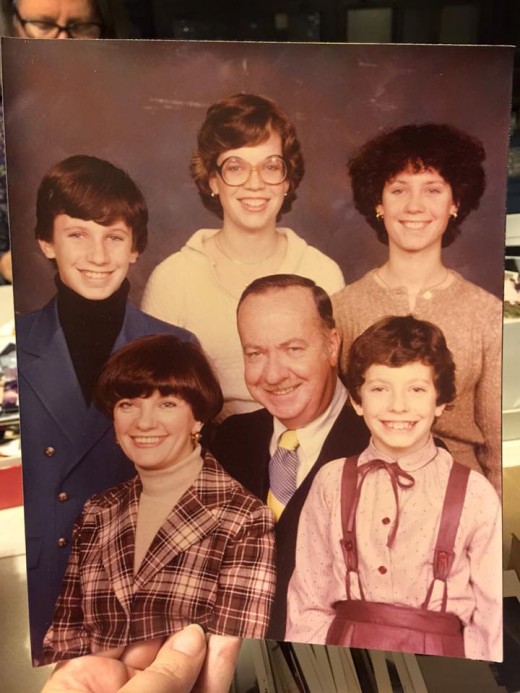
1976 portrait of my family from the Parish Directory — the only family portraits we would ever sit for.
This period of reflection I am wading through this past year has me thinking a lot about being “married with kids.” Looking at photos and imagining my parents’ and grandparents’ own experiences with something so common and yet so profound as being “married with kids” is sparking a much welcome connection to them.
We each approach our lives coming from a specific generation and our own unique experiences. My grandparents or parents never lost a child to cancer. My husband and I never lost our livelihood due to global economic duress, or had to move from small apartment to small apartment. We have never had to assimilate into a country of people different than ourselves. We never have had to rely on food stamps or the generosity of strangers to put food on our table. We’ve never left friends or family across an ocean, searching for better or more.
So many struggles across so many generations and through them all, marriage and children. I am grateful for the connection.
I’m taking a break. No one I love is allowed to need me in any extraordinary capacity for the undefinable future. No sickness. No breaks. No demanding needs. No crisis allowed. Like I said, I’m taking a break.
For long (or short, depending on how you look at it) swaths of my life, I have been a caregiver. I was a professional caregiver for ten years working with older adults. I got paid to care and provide support to older adults and their families as they navigated aging. It was important work and I both loved it and was good at it. It challenged me. I hope, if only in small ways, that I provided some comfort for a few people along the way.
One day almost twelve years ago now, I was readying a presentation with a mentor I was to give the next day for a room full of seasoned therapists and social workers. I don’t even remember the specific topic, but it was something about caring for older parents. I was nervous as hell, but prepared and excited. For a clinical social worker, I was hoping to enter the big leagues where Chicago’s most well respected therapists might actually learn who I was and what I was capable of, clinically speaking.
That afternoon I got a call from a nurse in a Biloxi, Mississippi ER. My Mom had been admitted and she was alone. They wanted someone who knew her to talk to her. My Dad had been contacted and was on his way, but wouldn’t arrive for at least an hour. Was I Sheila Quirke, daughter of Donna Quirke? Yes, of course, that ‘s me, my heart beating fast.
Found in my Dad’s wallet. I keep this on my bureau, looking at it frequently, remembering my Dad, my Mom, being the caregiver they needed. I hope I was worthy of a note like this.
That, right there, over the telephone, was the moment I became I caregiver. I grew up in the time it took that nurse to dial my number. It didn’t matter that I was in my 30s and married with a career and an office with my name on it. I wasn’t a grown up until that moment I became a caregiver.
My Mom’s speech was slurred. She just kept saying “okay” over and over, but it sounded something more like “ooohhhhh-k-aaaaaayyyyyy, ooohhhhh-k-aaaaaayyyyyy, ooohhhhh-k-aaaaaayyyyyy.”
Her voice scared the hell out of me.
I would spend the next year helping my Dad and sister (and some very loving and compassionate paid caregivers) take care of my Mom who no longer was able to walk or talk or bathe or eat or toilet independently. I would not trade that year for anything. The foundation of my life shifted in that year, but I was too busy washing sheets and cooking meals to realize it.
It was a privilege to care for my Mom, who, it must be noted, was amazingly gifted at receiving care. She was gentle and receiving and patient and kind, despite her injuries and insults that prevented her from ever enjoying the life most of us take for granted every day. She taught me so much in that year without words. She shaped me in ways that only a mother can.
Just a few months after my Mom died our daughter was born. We didn’t learn of her sex beforehand, but knew if I delivered a girl, she would be named after my Mom. The first word I ever spoke to my first child, when I held her in my arms the moment after delivery, was “Donna.”
Donna was a joy and a gift and healed my family in so many ways.
When young Donna was herself diagnosed with a brain tumor at 20 months old — the same thing that my Mom died of — the caregiving I did reflected the intense love a mother has for a child. For 31 months I cared for my child with cancer. The cancer took Donna from us and life will never be the same. We are changed, my husband and I. Cracked, but holding. Damaged in invisible ways.
My father, who throughout my Mom’s illness, when he needed to let off steam, would say, “I’m going to collapse when this is over,” somehow didn’t. He held it together after my Mom died. He sold their home and moved into an apartment in the city. He became a widower after 46 years of marriage, but figured it out. He was happy enough, as they say. He would pop by unannounced. He would sometimes babysit for little Donna. I loved living near him, keeping tabs on him.
After little Donna died, my Dad did collapse. Two months after we buried her, he suffered a heart attack on the operating table during a knee replacement he had been putting off for years. He fell into a terrible, intractable depression. The losses he had experienced finally permeated and he just surrendered. I spent much of that first year of my grief worrying over my Dad, getting him to appointments, cajoling and supporting and prodding and screaming in frustration over what depression does to a person.
It passed, finally, his depression. Slowly, slowly, slowly, slowly, slowly he recovered. I didn’t worry as much. I didn’t have to fuss or prod as much.
In the ten years my Dad lived after my Mom died, we had a lot of conversations about our grief, about aging, about quality of life, about his wishes. We had a plan, tentative and abstract as it was, that my Dad would live with us when and if the time came. If ever a person was not cut out for institutionalized living, it was my Dad. He hated authority, always had, even as a young boy with nuns telling him that two plus two equaled four.
But the best laid plans of fathers and daughters often go awry.
When my Dad required caregiving, like my Mom, it happened suddenly and without notice. Unlike my Mom, he was not a gracious receiver of care. He was a King Lear who fought it every step of the way. He roared like a lion, saying the most painful of things, wounding with words. He hated needing help, fought against dependence (literally and figuratively), got angry at those providing care.
We didn’t know it at the time, but cancer was advancing in his body and it changed him neurologically and cognitively in ways that brought out the worst in him. I did the best I could for him, advocated with doctors, cajoled nurses, managed his finances, found adequate housing when it was clear that our home would never be an option — as it turns out, a raging older man, even a beloved father, and two young children don’t really fit together.
My Dad’s illness was short, blessedly so. From his neurological changes to death, only six months had elapsed, but those were six of the longest months of my life. They changed me, too, just as the months caring for my Mom and daughter had. One of my life’s greatest gratitudes is that my Dad returned to some version of himself before his death. His last weeks were absent those personality changes that had been so painful to witness.
Now I feel empty. Spent. Done.
I was the best caregiver I could be for my Mom and daughter and Dad. I was committed and present and passionate. But now I fear I have reached my quota of caregiving. Interspersed between all these caregiving episodes, I have raised and am raising young children. Between three children spaced four years apart overlapping three episodes of intense caregiving over roughly the same period, stick a fork in me, because I am done. Finished. Don’t call me in case of an emergency, because I don’t know if I will be able to help you.
If you are a caregiver, I salute you. May the force be with you, because you will need it. I watch from afar as some of my friends go through their own caregiving experiences — some lasting year upon year upon year — some making my own caregiving look like a ride at Disney. You have my utmost and everlasting respect. I hope someone is there for you the way you are there for the ones you love. May you, one day if not today, know peace again.
If you know a caregiver, please, give them a break. Or a hug. Or a Starbucks. Caregiving can be such an isolating experience. It demands your full attention, to the detriment of so many other things you would or should be doing. Know that what they do, sandwiched in between going to work and shopping for groceries, is sacred.
And if you have not yet been a caregiver, but will be some day, I salute you, too. Not everyone can do it, and that’s okay. But if you are called to it, out of choice or necessity, may you find what you need to provide for those you love.




 Mary Tyler Mom