‘A Day Without Women’ Is Not As Simple As You Might Think

Last night I read an article in the Chicago Tribune, “Chicago Businesses Prepare for ‘A Day Without a Woman.”  Reading the comments made me realize, in a visceral way, why the concept of a women’s strike is still an important, though complicated, tool in 2017.  Here is just a smattering:

  • “Driving should be easier and parking too.”
  • “Hooters just won’t be the same.”
  • “A lot of women may find out that no one misses them. Then they can start up a whole new victimization scam.”
  • “Did America suddenly become Saudi Arabia?”
  • “This is so stupid. So silly.”
  • “Any excuse not too work.”

The messages these comments send are important to understand and acknowledge.  In a nutshell:

  • Women are not competent or capable
  • Women are easily reduced to their breasts/tits/boobs
  • Women complain too much
  • Women should be grateful to have any rights at all
  • Women are silly
  • Women are lazy

Yeah, no.

The concept of the strike behind ‘A Day Without Women’ was introduced by those same gals that first conceived of the Women’s March in January protesting the election of Donald Trump, and it was scheduled to coincide with International Women’s Day.

women-strike

International Women’s Day has as its origins a group of 15,000 New York City union garment workers, all women, who coordinated a strike on March 8, 1908, working to achieve shorter working hours, higher wages, and the right to vote.  The next year, that strike was formally honored by the Socialist Party of America.  In 1910, the movement went global at the International Conference of Working Women in Copenhagen.

In 1911, just a few days after the 2nd International Women’s Day was held, 146 workers died in the Triangle Shirtwaist Fire in NYC on March 25. 123 of those workers were women, mostly Italian and Jewish immigrants.  The conditions the women worked under were brutal and were what, in part, led to the original strike in 1908.  Alas, that effort did not result in workplace improvements.

A women’s strike in Russia in 1917 was one of the contributing factors preceding the Russian Revolution.  Women, protesting over two million deaths of Russian soldiers in World War I, began a strike for “bread and peace,” which lasted over four days and encouraged other workers to strike, directly leading to the abdication of the Czar and the newly instilled government granting Russian women the right to vote.

People who discount or diminish the impact and effectiveness of women banding together in solidarity to achieve common goals do not know their history.

That said, ahem, changing the course of history is never easy and achieving solidarity requires work, compromise, and cooperation. A friend, just this morning, posted this public Facebook status:

https://www.facebook.com/plugins/post.php?href=https%3A%2F%2Fwww.facebook.com%2Fpermalink.php%3Fstory_fbid%3D10208666395717134%26id%3D1227930123&width=500
Everything Cherie says is to be noted and considered.  And what, you ask, is ‘intersectional?’  Theorized by civil rights scholar Kimberle Crenshaw, intersectionist feminism, very simply stated, is that the oppression women experience is dependent on other factors beside their gender, including their race, religion, and class, among other factors.

The original feminist movement, at its core, was not an intersectional movement.  Betty Friedan and Gloria Steinem were champions of the needs and issues most keenly experienced by white, middle class women, but not women of color.  The counter argument to holding today’s ‘A Day Without a Woman’ is that it does not take into account the challenges women of other races and classes would face in holding a strike on a Wednesday in America 2017.  Tia Cherie, in her status above, captures why this is problematic.

Personally, I am honoring International Women’s Day / ‘A Day Without Women’ by simply not spending money and listening. Solidarity via withholding my dollars, empathy via openness.  My husband is away on business this week and the kiddos still need to get back and forth from school and eat and all that good stuff they simply expect from mom.  Solidarity and empathy are the tools I can utilize today while still taking care of business.

While I respect and salute those women who are striking today to take an important stand on the call for gender equality, I also respect and salute those women who are simply unable to opt out for economic reasons.  Hell, Imma go all inclusive here and say I respect and salute those women who think all of this is a bunch of hooey.

What I believe to be true is that women are a powerful force who are more vulnerable today than we were a year ago.  We are stronger together, united, than we are divided.  The experiences of women of different colors and classes than middle class white gals need to be welcomed, integrated, and valued in a way they historically have not been.

Solidarity and empathy are the tools I can utilize to achieve that, too, not just today, but every day.  Why?  Because those commenters on the Internet are real people with real power who like to demean and diminish and objectify women every chance they get, and those folks are never taking a day off.

The Women’s March: Stop Raining On My Parade

I count myself among millions of women (and men) who marched in protest last Saturday, the day after our 45th president was inaugurated.  What a fantastic, tremendous, momentous experience.  Chicago was enjoying an almost 60 degree day, with the bright sun both warming us and lightening the mood and spirits of us marchers.

It seems cliche to say there was an electricity in the air, but damn, there was an electricity in the air.  Happy anticipation was palpable as the crowd gathered and grew and grew and grew and grew.  I stepped on the train believing I was going to enter a crowd of 50K.  I stepped off the train, where we were packed like joyful sardines, and overheard the crowd estimate had been raised to 70K.  Soon, I heard were voices around me saying, “There’s 100K of us!”  Helicopters circled overhead as we came to Michigan Avenue.  Only later would it be confirmed that the crowds surpassed 250K.

march6

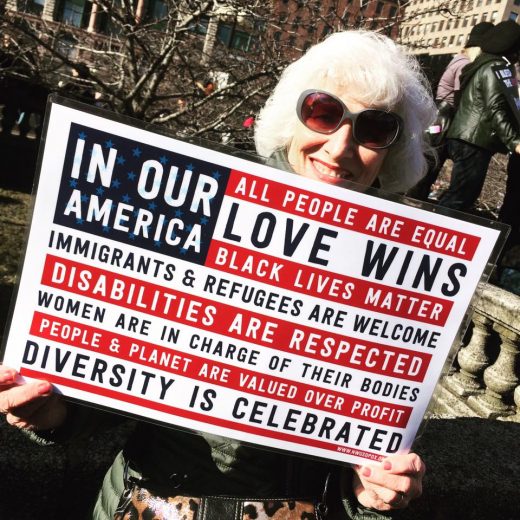
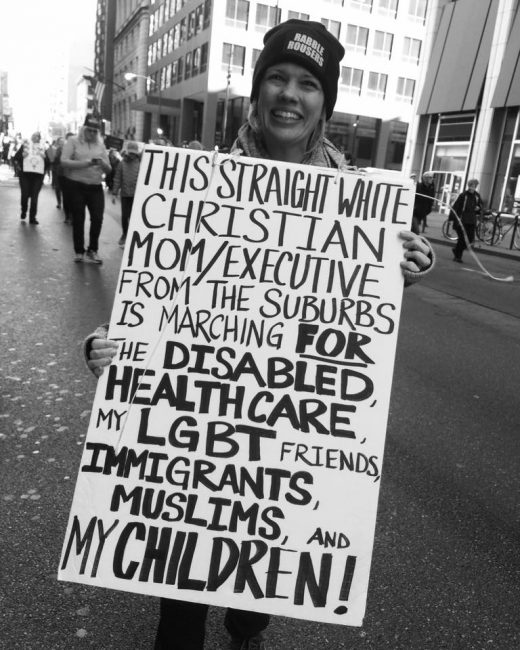
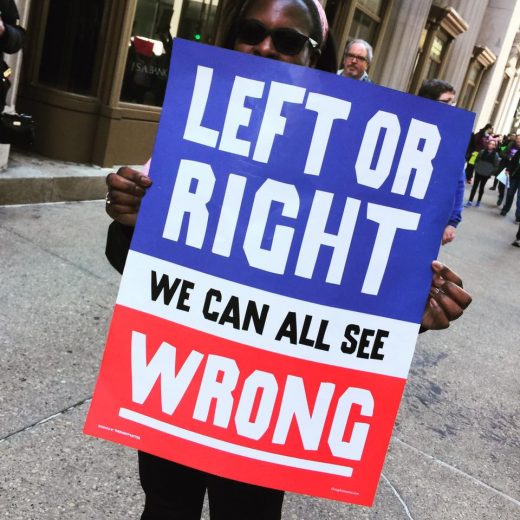
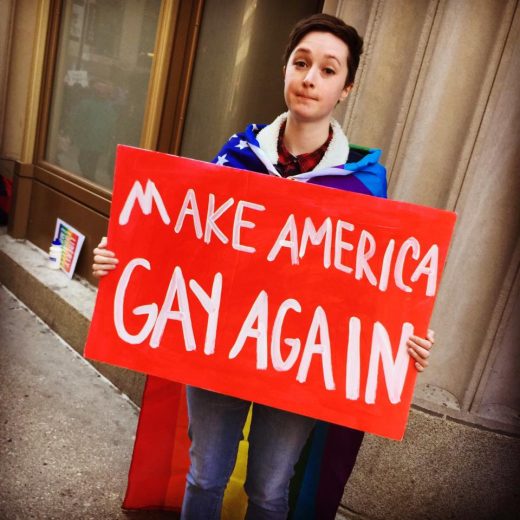
It was a sea of people.  Motivated, hopped up, angry, passionate, energized people.  My beloved Michigan Avenue was closed, full of humans as far as my aging eyes could see.  They held signs about public education and women’s reproductive rights, and black lives mattering, and LGBTQ rights, and climate change, and immigration, and religious freedom, and access to health care, and kindness, and love, and hope.  So many signs about hope.

I was with my tribe.  It felt good.

march2

Twice during the event, my sister and I positioned ourselves in places where we could watch the marchers around us.  I wanted to take some photos, but I also wanted to have some time to experience the scope of what was happening.  When you march, you sort of move in a pack.  It is a powerful statement and experience, but it limits your ability to see the bigger picture.  Stepping back and observing what was going on around us is a choice that I am grateful we made.  This is what I saw:

  • The crowd was primarily white women with healthy doses of white men, African American women (just a few African American men), Latinas and Latinos, Muslims, Arabs, and Asians.
  • There were families there aplenty.  Many with infants and young children, some with aging parents, some with three generations represented.  So many strollers, so many walkers, so many wheelchairs.  Hats off to all who required wheels on their march.  I also saw a few sibling groups — older brothers and sisters (folks in their 50s and 60s) marching together.
  • Lots of ages were represented.  I saw babies, young children. tweens, teens, Millennials, Generation X, Baby Boomers galore, and a smattering of the Silent Generation, who it turns out, are not always so silent.  Age diversity was a true strength of the march.
  • People marched for wildly different reasons, identified by the signs that they carried.
  • A few folks walked carrying flags.  There were American flags, rainbow flags, UN flags, transgender flags, pan-African flags, and Palestinian flags were among those I saw.  At one point, I was moved to say thank you to an older man carrying an American flag, as there is nothing more American than gathering to register protest.  He stopped, asked me to hold his bag, and fished out two American flag bows for me and my sister.  A kind gesture.
  • Joy was palpable.  Early on, three generations of Muslim women (granddaughter in her early 20s, her mom, her grandmother) walked past me as I was snapping some photos.  The mom smiled and waved at me, then she and her daughter briefly stopped and smiled for my camera.  That moment was full of peace and happiness, acceptance and awareness.
  • Hope was potent.  At one point during the march, chants of “This is what democracy looks like!” all around us, a young Arab man, probably early 20s, turned to me and said, “I have not felt this kind of hope in months.”  We smiled, I agreed with him, it was everywhere.  In that small moment, anything seemed possible.
  • People talked to one another.  We came with our own folks, but there was a great feeling of community and reaching out.  Post-march, after things were officially over, but before the police cleared the streets, a rousing concert took place smack dab in the middle of Dearborn Street.  Spontatenous dancing and singing occurred.  Art unites because of its humanity.

Saturday’s march was a beautiful, singular experience I will never forget.  I am so proud to have been a part of it.  I am honored to live in a country that (at least for now) allows me to exercise my right to gather and protest.  I stand by my belief that it was a worthwhile way of demonstrating my concerns about what direction the US, and the larger world, seems to be moving — one of increasing fear, intolerance, nationalism, and isolation.

march5

And then Sunday happened.

Initially, the criticisms came from the outside.  “Vagina screechers,” was the term a local school board member used to describe marchers.  There were lots and lots and lots of disparaging comments made about the weight or level of attraction of marchers.  As women under this administration, this is something we all need to get used to.  No matter the quality of intellect we have or the depth of our compassion, a woman will always be judged on her looks.  We are acceptable if we act in the manner we are told to act.  We are acceptable if we stay in our lane.  We are acceptable if we submit.  And it does not require a man to exert these limitations.  Fellow women are very happy to suggest other women are unacceptable.

march4

Soon enough, though, the criticisms came from within.  Those who were present, those who marched side by side, started jabbing at one another.  Handcrafted pink hats are elitist symbols of a hyper-sexualized binary gender interpretation of what womanhood means. White women who thanked the police accused of being racist.  Those same white women crying foul without pausing to listen and engage and absorb.  Women of color were not visible enough.  Using vulgar language or symbols denigrates our collective message.  If we don’t have a single unified message, the march was futile.  What was the point anyway?!

I’m not gonna lie, the day after the Women’s March sucked on the social media landscape.

But here’s the thing, as my sister (whose old lefty street cred is impeccable) reminded me, democracy is messy.  Creating a movement is messy.  Nothing is linear.  Total agreement will never be achieved.

march3

This is what I believe:  Participating in a protest that demonstrated such vast numbers and scope was an empowering experience.  For a few brief, shining moments, I was surrounded by people who both looked and did not look like me and we shared a bond of hope. We are at the beginning of a marathon, not a 50 yard dash.  White feminism is flawed and needs to be more inclusive.  Black lives matter. It is far easier for police to contain and manage a crowd of 250K  folks that look like their mom and sisters and grandmothers and daughters than a crowd of 1K that do not.

march8

I am okay with some messiness.  Those who are not may not be up for what is needed to sustain their involvement.  And all of that is okay.  As I try to do with most things in my day-to-day life, I will consciously work to act with compassion, empathy, respect, and an open mind.  I have my limits, to be sure, and I fail all the time, but I am reporting for duty, fired up and ready to go.

march7

march1

Thanks, Obamas

I watched the very last press conference President Obama will ever hold this afternoon.  The final question was a personal one from a reporter who had been covering him since he was a State Senator from Illinois, some twenty years ago.  She asked how the outcome of the election had impacted the two first daughters, Malia and Sasha.

In one of his final official responses as our country’s POTUS, Barack Obama got to brag on his daughters.  He responded as a dad and father, not as our nation’s president, just hours away from the end of his gig.  It seemed fitting, somehow, as this man has never hidden his fondness for parenting or the woman he parents with, Michelle.  He proudly (and cheekily) refers to her as FLOTUS.

They are unmistakably in love with one another.  As a fan and supporter of both Michelle and Barack as individuals, the combination of them is like a one-two punch to the “I want that” valve in my heart.  As incredible and accomplished as they are on their own, together, well, I just kind of fall into a fan girl worship of them.  File their relationship under #lifegoals, you know what I mean?

obama3

When Michelle first referred to herself as “mom-in-chief,” around the time of Obama’s first inauguration, I’m not gonna lie, it rubbed me the wrong way.  I fancied myself an outraged feminist, and initially bristled at what seemed like a diminishment of her role and skill set.  Let’s all remember that when they met, Michelle was Barack’s boss.  Eight years further into my own role of motherhood, I simply salute her.  I get it now in a way I did not eight years ago.

She has been honest with the pros and cons of being America’s First Lady.  Unlike their time when Barack was serving in Illinois’ State Senate, or the years he was based in D.C. as a U.S. Senator while Michelle and the girls remained in Chicago, during his eight years as POTUS, consistent family dinners together were possible for the first time.  As a team, the Obamas seemed to manage it all — global crises, tween drama, garden growing, economic calamity, and dancing on Ellen.

We learned to trust in their capacity to stay high, even when the rest of us were losing our damn minds.  And, let’s be honest, as the first POTUS and FLOTUS of color, they did not have the luxury of being anything other than exemplary.

The First Couple have, somehow, maintained a grace and dignity, a fierce capacity to stay above the fray during their White House years, despite unprecedented ridicule, much of it ugly and racial in tone and content.  There was a comfort to their calmness.  They seemed unflappable.  We learned to trust in their capacity to stay high, even when the rest of us were losing our damn minds.  And, let’s be honest, as the first POTUS and FLOTUS of color, they did not have the luxury of being anything other than exemplary.

Their strengths — their joy and humor and intelligence (both emotional and intellectual), their resolve and style and verve, have brought me much comfort over the past eight years.  These days, I find myself able to connect to hope only when I listen to them as they prepare to take their leave.  There is a groundedness they embody and inspire in others.

Even as a 47 year old woman with some hardcore life experience under my belt, the strength and steady presence of the Obamas seemed to parent me, in a slightly warped way.  Everything was okay on their watch.  I will miss that.

Now, on the cusp of their departure, my worry returns.  Who will ground us now, I wonder, as Barack and Michelle enjoy, I hope, a much needed and well deserved stepping back.  Where is our new anchor?  Who might that be in these troubling times?

The mark of any good parent is instilling the ability to care for oneself, sending children off with the necessary skills to flourish on their own.  I see whispers of this in both the farewell comments from POTUS and FLOTUS.  A reassuring reminder that they will be there, but that it’s time to claim some responsibility ourselves for the messiness of democracy and stop relying on someone else to do it for us.  They want us to want it.  They want us to stop taking it for granted.

For all they have done, for all that they are, thanks, Obamas.  We are better for having known you.