The Dao of Da: Own Every Room You Walk Into

This is the third in an occasional series where I will try and capture some of the life lessons my Dad (Da to his grandchildren) taught me through the years, the goal being to preserve them for his children, grandchildren, nieces and nephews. 

Lesson 3:  “Walk into every room as if you belong there.”

I have written before about how my Dad was as comfortable talking to a king as he was a pauper.  In my suburban Chicago childhood, that played out in watching my Dad approach and begin conversations with Chicago mayors and Illinois senators as easily as he would  a panhandler.  For some reason, that always embarrassed me.

It would play out frequently in my childhood, me trying to slink into some invisible corner as my Dad inserted himself in places and with people he had no business being, or so I believed.  The story is as old as time, honestly — a child being embarrassed by their parent’s actions, but remembering those moments, man, the struggle was real.

On one summer vacation, we visited my aunt and uncle in Washington, D.C.  My uncle had a senior position at the Federal Reserve, which was, from my 7th grader eyes, a majestic position at a majestic building, integral to the functioning of our country.  Important stuff happened there that I didn’t begin to understand.  After a day of capital sightseeing, all of us sweaty and tired, my Dad insisted on going to visit my Uncle in his office, hoping my brother and I  would see for ourselves and appreciate more fully where such important financial policy occurs.

Ugh.  It was a 7th grader’s worst nightmare.

And, as the story played out, my Dad basically  willed his way into the bowels of the Federal Reserve, his two kids in tow, vacillating between sweet talking and strong arming every security officer he met along the way.  Why?  Because he belonged there.  He belonged everywhere, was the thing.

There was the time he campaigned for Barack Obama at Chicago’s South Side Bud Billiken Parade.  If you’re not from Chicago, perhaps this doesn’t strike you in any way at all.  If you are from Chicago, you appreciate that the Bud Billiken Parade is a longstanding proud African American tradition, a parade that is decades old and whose origins were to celebrate the African American child and provide them with a sense of being special and enjoy a celebration in their honor.  Now imagine a 75-year-old white man campaigning for who would be our nation’s first African American president there.  And I haven’t even told you the part where he ran into Common and his entourage during that particular day.
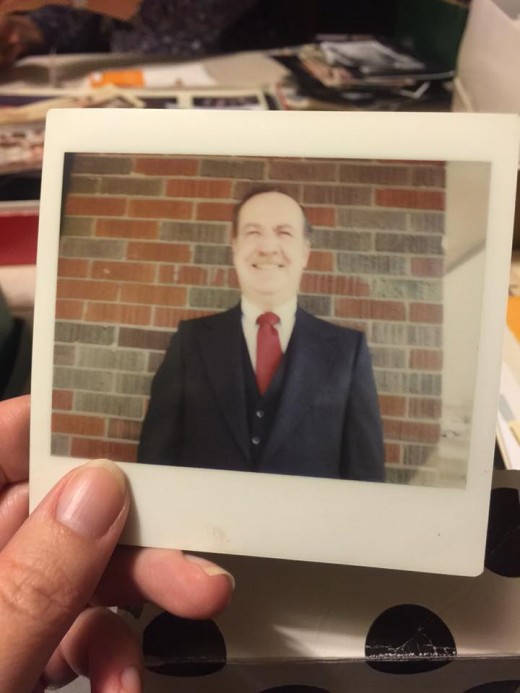
A Polaroid of my Dad looking dapper in his suit.  Early 1980s.
A Polaroid of my Dad looking dapper in his suit. Early 1980s.

There was the time he carefully explained to me that if you’re wearing a suit and looking spiffy, with a determined and distracted look on your face, that no one would question you, because, of course, clearly you belonged where you were going.  He encouraged me to practice that look and gait, to hold myself with authority and purpose, especially when I was seeking entry someplace.  He was part hustler, my Dad, there’s no question about it.

Some of his favorite people were the security guards he would sweet talk and cajole and charm to get into places most other folks were restricted from going. His greatest enemies, thorns in his side, were other security guards who weren’t buying whatever jive my Dad was selling that day and would use their authority to restrict his access to places he believed he belonged.  Oh, did those security guards get his proverbial goat.  He would rail on them, as he walked away, complaining that they had a power complex and felt inferior, so would abuse whatever little power they did have.

I had a front row seat for so many of these interactions my entire life.  You never knew if they would turn out in joyful satisfaction or fitful anger.
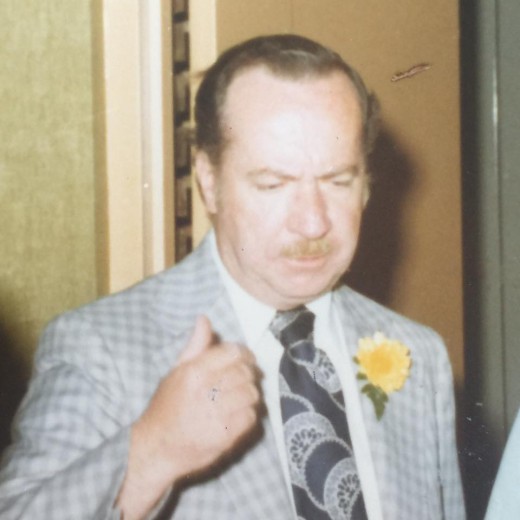
I'm not certain where this photo was taken of my Dad, but I recognize his expression.  He is unhappy, eyebrows raised, gesturing.  No doubt, he had just been told something he did not like.  Lord, did he buck authority.
I’m not certain where this photo was taken of my Dad, but I recognize his expression. He is unhappy, eyebrows raised, gesturing. No doubt, he had just been told something he did not like. Lord, did he buck authority.

As I look back and think about the lessons my Dad has taught me in my life, those lessons I want to pass on to other generations of my family, there are inevitably some cringe worthy moments.  That was my Dad. Sometimes he could make you cringe.  I could sugar coat the memories and focus solely on the victories where my Dad and his entourage of my brother and I were permitted entrance to some pretty incredible places and met some pretty astounding people, the moral of the story being to own your pride and your place, but that would only be half the story.

The other half of the story, the not so pretty half, was a white man who wanted what he wanted and believed he should have it, well, because. Rules be damned.   Come to think of it, there are some pretty important lessons there, too, even if they are not the lessons my father intended.

My takeaway, as an adult, is this:  Have pride in yourself, carry yourself, always, with purpose and dignity.  Know that you belong in this world, whether that be in the company of movers and shakers, the political and financial elite, or if your audience is less grand, in the company of the poor and indigent.  But don’t ever get so big for your britches that you think the rules stop applying to you.  You are one of many, no better, no worse.  And if you start to convince yourself that rules no longer apply, that your needs supersede those around you, well, check yourself, my friend, as you might need a wake up call.

I think my Da could embrace that lesson, even if he found it hard to practice himself.


The Dao of Da: “That’s What Bumpers Are For!”

This is the second in an occasional series where I will try and capture some of the life lessons my Dad (Da to his grandchildren) taught me through the years, the goal being to preserve them for his children, grandchildren, nieces and nephews. 

Lesson 2:  “That’s What Bumpers Are For!”  

My Dad loved to drive.  Loved it.  He was proud of his driving abilities, enjoyed the independence a car symbolized, and had a knack for finding used Cadillacs being sold by little old ladies who only drove their Sevilles and DeVilles to church on Sunday mornings.  He spent most of his working years in the railroad and public transit.

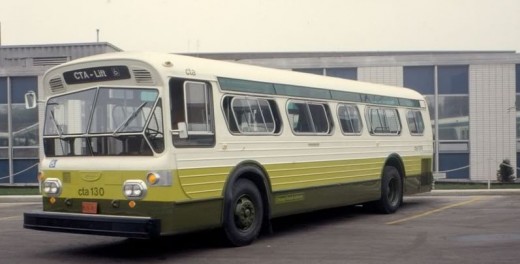
When I was an itty bitty little girl, my Dad drove a bus in Chicago for a short while.  One summer day, much to the surprise of the entire neighborhood, he pulled up in a city bus in front of our suburban home.  Kids across the neighborhood packed onto that bus for the joy ride of their five and six and seven and eight year old lives. Liability be damned.  Aaaahhh, the 1970s were an awesome time to be a kid.  My Dad was a certified hero that day.

CTA bus, or 1970s childhood fairy tale?

The truth is, I have dozens and dozens of stories about my Dad and transportation.  It was his jam, you know?  After my Mom died and he began his life as a bachelor, his walls were littered with framed prints of steam engines, buses, trains, carriages, depots.  Going places and how to get there were matters of great interest to him. There was not a neighborhood in Chicago he couldn’t drive through with authority, maps an unnecessary nuisance to him.

While it was a high school gym teacher that taught me the specifics of driving, watching my Dad throughout my lifetime provided the nuances of driving.  He added the art to the science.  After I moved to Chicago in my early 20s, my Dad gave me a lesson on parallel parking.  To this day, I think of his instruction every time I put my car in reverse.  It was all about lining up the backseat passenger window with the rear winshield of the car in front of the spot you wanted.  “Cut the wheel and don’t be afraid to tap the bumpers — that’s what bumpers are for!,” he would exclaim, frustrated by my initial timidity.

Twenty some years of living in the city has erased any timidity I had in those early days of city driving.

I can recall, with great clarity, watching my Dad fit into tight spaces with literally one inch on either side of his bumper.  And he always drove old boats, none of these foreign compacts.  Cadillacs and Crown Vics were his style.  I still marvel at the experience.  How did he do it?  It was as if a magnet had gently pulled his car into the seemingly too small spot.  But you know how he did it?  He tapped those damn bumpers, that’s how he did it!  Why?  Because, “That’s what bumpers are for!”

Of course.

Equal parts white man entitlement and total confidence (perhaps those are one and the same?) are what got my Dad into those tight spaces.  He was always a bit of a bull in a china shop, uncareful and uncaring of what damage might occur due to the space he took up.  It was his space to take, you know?  He and his Cadillac were entitled to that space, dammit (thought he would never swear, but that’s another post).  Now, mind you, that didn’t mean ripping apart or damaging those cars that straddled his parking spaces, but it did mean that they would get close and personal with his bumper.  Those bumpers were all up in one another’s business.

Da had three daughters, all of whom have grown into strong women, both in temperament and accomplishments.  He wanted the same things for his daughters as he did for his son — to know their place, to own their place, to push boundaries, to not always cede to authority (except, of course, his authority) which, as it turns out, is a lot like tapping bumpers to ensure you get your space.

A man, his bumper, and 2 of 3 daughters.
Da, his bumper, and 2 of 3 daughters.

His message to us, in driving and in life, was to not be afraid to tap those bumpers — push for what you want, what is possible, what is available to you.  Don’t be restricted by the idea of something, don’t hesitate because you worry you won’t make it, don’t stop yourself without trying.  Make it happen, carve that spot out for yourself, use your resources, tap those bumpers.  Bumpers are meant to bump, it is their function.

It’s a worthwhile lesson, both in and out of the car.  Thanks, Da, for helping me always find my space.

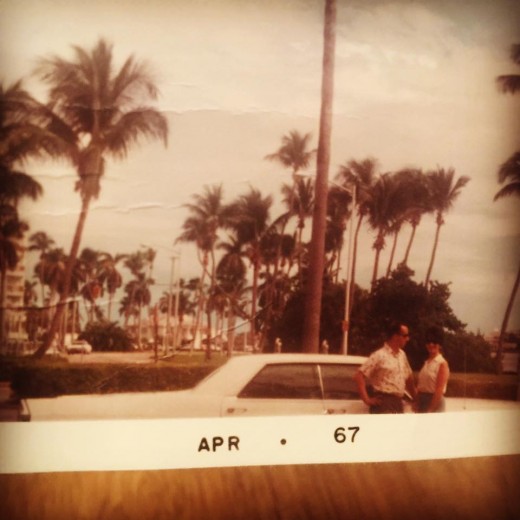
Da and my Mom.  You don't ever parallel park a car this long without tapping a few bumpers along the way.
Da and my Mom. You don’t ever parallel park a car this long without tapping a few bumpers along the way.

The Dao of Da: “Every Day Over 50 Is Gravy”

This is the first in an occasional series where I will try and capture ten of the life lessons my Dad (Da to his grandchildren) taught me through the years, the goal being to preserve them for his children, grandchildren, nieces and nephews. 

Lesson 1:  “Every day over 50 is gravy.”  

I first heard this lesson at a variety of wakes or funerals we would attend for older relatives when I was a young child.  When you grow up Irish Catholic, you attend a lot of those things.  At that time in my life, my Dad’s words made absolutely no sense to me.  Gravy was something my Mom put on the table for special occasions like Thanksgiving or a Sunday roast. What it had to do with age was beyond me.

Later in life, the mechanics of what my Dad was imparting with those words made sense to me, but even at 20 and 30, the idea of being 50 felt far, far away.  Not so much now that I’m 46.  As I inch closer to that milestone that held such significance for my Dad, I understand in a much deeper way what his point was, even if it won’t exactly ring true for me or many of my generation.

When an older person dies, it is a loss, for certain, a sadness, but it is no tragedy.  It is expected, the natural order, to be felt, but not dwelt upon.  There is a practicality of feeling, an economy of emotion, inherent in Da’s words.

The point my Dad was trying to make would be best addressed to those who follow a traditional path in life.  Childhood, education, marriage, career, kids — you know the drill.  His belief was that if you were to die at age 50, which would seem early to many, but really wasn’t.  By that point in your life, he believed, you would (or should, ahem) have accomplished much of what you were charged to accomplish, namely, raising and supporting a family.  Once the kids were grown and out of the house, your greatest life’s work was behind you.  The rest, as he would say, was gravy — unnecessary, but adding to the overall experience.

Wise words, actually, for those who assume that traditional path.

Dao of Da1

So for instance, retirement was gravy.  Grandchildren were gravy.  Travel and leisure were gravy.  Raising kids, paying the mortgage, having enough money in the bank to cover Catholic school tuition for four kids, well, those things were the meat and potatoes of life — things that were necessary and obligatory and a man’s purpose in life.  Once the kids were old enough to be on their own, assuming you were 50 years old by that point, that was the time to start enjoying the gravy of life — seeking out its different flavors, if you will.

There is a lot of wisdom in that idea.  Following his own words, Da enjoyed 31 full years of gravy before he died.  That’s a lot of gravy.

When I am 50, I will be mothering an eleven and six year old.  I won’t even be close to enjoying that proverbial gravy until I’m at least in my early 60s. Ha ha ha, or should I say, sobby sob sob?

They way that I take meaning from my Dad’s words in my own life is a bit different.  I apply his wisdom to the losses I have experienced.  My Mom died at 70, my  Dad at 81.  Both my folks saw their four kids settled, for the most part.  Settled enough, certainly.  They lived full lives, perhaps not nearly as rich or interesting as some others, but full enough, as they say.  There were hard times and heartbreaks and conflicts and scary things, but they stuck together, spent ten years of retirement together, enjoyed winters in a warm climate during that last decade, got to meet and enjoy some of their grandchildren.  Their gravy boat of life wasn’t brimming, but there was enough to enjoy and appreciate and make the meat and potatoes of their lives better, tastier, richer.

His words, as I grow older myself, help me experience grief in a different context.  When an older person dies, it is a loss, for certain, a sadness, but it is no tragedy.  It is expected, the natural order, to be felt, but not dwelt upon.  There is a practicality of feeling, an economy of emotion, inherent in Da’s words.  Feel sad, yes, but know that the life that is lost once one’s major functions and obligations are fulfilled, is a life that was well lived, and at its natural completion.

It seems harsh and cold, as I type it out, but it doesn’t feel harsh or cold.  It feels a lot like life.  Life through Da’s eyes.  Thanks, Da.

Da, John, long before his life enjoyed any gravy.
Da, or John, long before his life enjoyed any gravy.