An Insignificant American’s Memories of September 11, 2001 (for my sons)

“Today is September 11, Mom,” said my son this morning, looking mournful. I wondered what that meant for him, 9/11, and did he wear a sad expression because that is what you are supposed to do when you’re a 5th grader and have no memory of such events other than knowing the date is significant? It was the first time that I can remember one of my kids attaching an emotion to the events of that day. A fan of history, he hoped they might talk about it in school.

Later, recovering from my morning walk and listening to the radio, I listened to a man talk about how America has changed in the years since 9/11, how many young people — those born just before or in the years since, have very little emotional attachment to the events that have shaped so many others. That younger people think of that day as the start of the Iraq War without understanding the significance of it, the before and after of it.

These memories, my memories of that day, are for my boys, so that they might have a window into what September 11th and the days immediately after were like for their mom, an average, insignificant American, living far away from the planes and the towers and the fields and the smoke and the mayhem.

  • It was a beautiful day in Chicago, a Tuesday, crisp with a hint of cool. They sky was clear and the light had that specific quality only found in September. NPR was on the radio during my drive into work. The announcers were talking about a plane that had flown right into one of the towers of the World Trade Center. That was a jolt, as I had celebrated my 30th birthday there the previous fall. I made a mental note to find a TV when I got to work, a large 40 acre retirement community.
  • Things had worsened in those few minutes it took to park my car and walk into campus. A second plane had hit the other tower. I was watching the news in a conference room, alone, when it was reported that the Pentagon had been hit by a third plane. That impact, more that the towers being hit, somehow solidified for me that the United States of America was under an attack. It was an awful kick to the gut, an unbridled fear that was new to me.
  • Eventually, though I wanted to sit and watch the news, I knew I had to get to work. As a social worker in a retirement community, it struck me that the people I cared for were folks who had all lived through Pearl Harbor, the only other attack on American soil I knew of. There was an odd comfort found in that. Later that afternoon, a memorial service was held in the chapel and while I wasn’t religious, I took comfort, too, in the words we use to do just that — find comfort and solace. Surrounded by older people, some of whom had fought in WWII, I took heart in the notion of American resilience. Simply being in that room of folks, all grieving and a little shell shocked by the events of the morning, was a comfort.
  • The skies were utterly empty in those days. Clear blue and empty. Not a plane to be found anywhere. Eerily blank and silent. It was discomforting.
  • I wore a navy blue military styler blazer that day with a white blouse, gray slacks, and my go to Franco Sarto loafers. Why I remember that I do not know, but the smart pewter buttons I saw on my wrist as I turned the volume up on the car radio to hear the news sit with me still. That jacket hangs in the downstairs closet and I can’t imagine getting rid of it.
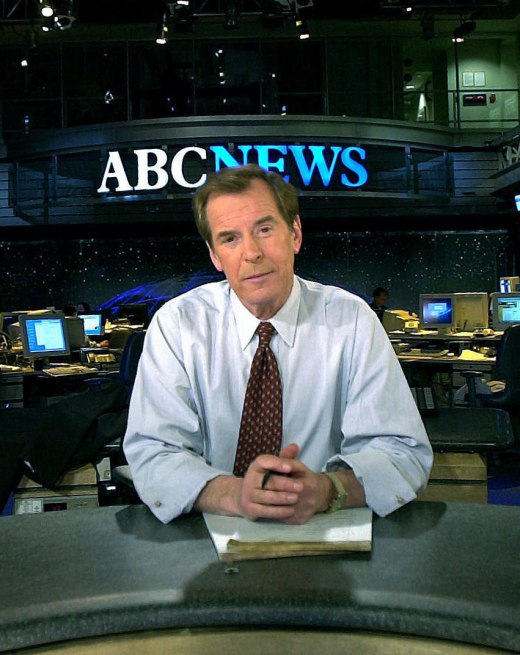
  • There was so much TV in those early days. It was exhausting and relentless and impossible to turn away from. I started eating dinners in the bedroom — the only place your Dad and I had a TV back then. I could not stop watching, nor did I want to. ABC’s Peter Jennings brought a sense of familiarity, of level headedness, of compassion that we used to take for granted from our news anchors. Not so anymore. On the Saturday morning after the planes hit, he held a townhall style meeting geared towards children. That, too, was comforting and reassuring. You took your comforts where you could find them in those days.
  • Auntie Carol watched the towers burn from the relative safety of her Brooklyn apartment. Her kitchen window was more immediate than any news coverage. Uncle Quinn, who worked in lower Manhattan at the time, walked home across the Brooklyn Bridge, surrounded by so many other commuters. They were both safe. And weary. So weary.
  • My Cousin Dave, a captain in the Navy, was at the Pentagon that day. I remember my Mom hearing from her sister, Dave’s mother, that he was home safe, but that he could not be accounted for for hours that day and the family was worried sick.
  • About three weeks later, in early October, we had tickets to visit Auntie and Uncle in New York. There was a lot of conversation about would we go, should we stay home? Commercial airplanes had morphed into weapons and that was a scary time to fly. Protocols were changing, new security rules were being put into place. Uncertainty felt heavy and was everywhere. We went anyway and the mere act of flying felt brave.
  • We took the subway into Manhattan from Brooklyn and nothing was the same. There were German Shepherds on a lot of trains sniffing for bombs. Police were in tactical gear from head to toe. We walked as close as we could get to Ground Zero (a few blocks away) and the smell that Uncle Quinn had described was strong and everywhere in lower Manhattan. It was a burning, hot, potent smell. The air was sooty, heavy. The work to clear the area was an around-the-clock operation, and we went at night, about 10 PM or so, and you could see the particles hanging in the air, the light from massive generator powered spotlights, making them dance and float all around us, still, even three+ weeks later.
  • Memorials were everywhere. New York was as silent and as reverent as I can ever remember. Candles, flowers, photos, flyers. People gathered together in parks all around the city. Auntie had told me that the tragedy of 9/11 was different for New Yorkers, but I didn’t believe her. I, too, felt like I was grieving. This was an American tragedy, I thought, not just a New York tragedy. I was wrong. This was a uniquely New York tragedy, at least the part here, with the towers, once so defining, now *poof* gone, no more. I am certain it felt the same at the Pentagon and on that field in Pennsylvania. There is an immediacy to being targeted, being Ground Zero, that changes everything. It was personal in a way I had not understood before being there.

There is a feeling of numbness that crops up when I see images of the World Trade Center Towers, standing and falling, even 18 years later. What they were, what they are. The snippets of people jumping, choosing their manner of death in a moment of utter helplessness. I no longer share them, as I don’t feel they are mine to share. They belong to the people on the flights, the workers in the buildings, the first responders, their families. And despite our almost annual visits to NYC, we’ve not visited the memorial there. Maybe someday. Even 18 years feels too soon.

September 11 is a day that is still shaping the United States and the world in ways only subsequent generations will get to more fully understand, more completely understand. But here are my memories, as an American, far from harm, greatly impacted, still trying to make sense of any of it.

When Going to School Causes Trauma: Guns, Drills, and Kids

The question was asked quietly from the back seat, “Mama, will a bad guy ever shoot me?”  It was from my 5 year old on the way home from school last week.  He is not a quiet child, so this question felt different.  His brother was sitting next to him and drives home from school are generally about Minecraft, Star Wars, or bickering about who gets to hold what toy.

I was taken aback, I wanted to provide comfort and reassurance, I was curious about what prompted such a question, but mostly, I was profoundly and viscerally struck by the reality that I could not, in good conscience, state factually that, no, a bad guy with a gun will never shoot you, honey.

I know what my son needed in that moment was reassurance, so reassurance was what I offered.  I kept the gut punch of reality to my adult self.  “Mama and Daddy work really hard to keep you safe, honey, away from bad guys with guns.  We live in a safe home in a safe neighborhood and don’t come in contact with guns.”

All of that is true, but the other truth is that an American’s chance of being shot and killed with a gun by assault are 1/315.  We know this through data collection and research, but that research is hard to come by.

In 1996, the Dickey Amendment, an NRA backed piece of legislation, forbade the Centers for Disease Control from funding or performing any research about gun violence in America.  That changed in March 2018, but the government still has not funded any major studies.

Outside resources and entities like Everytown for Gun Safety have tried to make a dent into the issue.  They report that in 2018, almost 2,900 American children and teens will killed by gun violence.  Another 15,600 were shot and injured by guns.  And a whopping three million kids witnessed an incident of gun violence.  Just in 2018.

Those numbers are staggering to me.  And when I see them and try to digest them, it starts to make sense why my pre-k 5 year old asked the question he asked.  That ish trickles down.

About an hour or so after we got home, I checked my email and saw in a chatty note from his school that the kids had been involved in a “safe room drill” earlier in the day.  In between news of summer camp schedules, spring break dates, and info about Mr. Smarty Pants performing his Big Balloon Show next week, was a brief description of approximately fifty 3-6 year olds being guided into a “safe area of the school, away from windows and view.”

And there it is.  Dots connected.

With the rise of mass and school shootings in America, educators and administrators across the country are scrambling to prepare their teachers and students should the worst happen — a bad guy with a gun, as my child calls it, pulling the trigger.

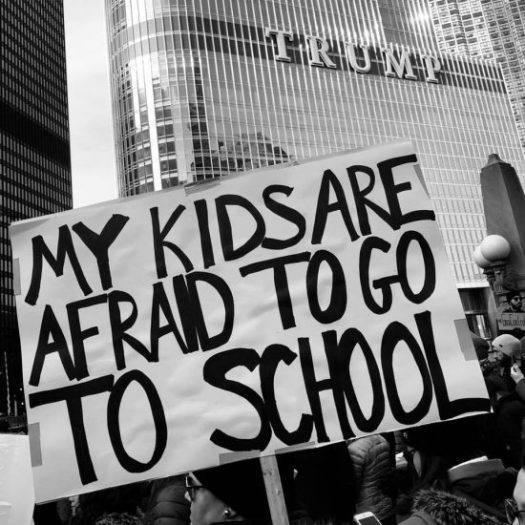
Photo taken by Sheila Quirke in Chicago, Illinois in February 2018, days after the Parkland shooting.

Connecting more dots, after I got my sons settled down with an after school snack, I was scrolling through Twitter when I saw this Tweet, detailing what teens are now experiencing as just part of day-to-day life in this new America:

https://platform.twitter.com/widgets.js

I’m not gonna lie, it was all a bit much for me last Friday afternoon.  Click through the link to see an anonymous kid describe what happens these days at the local laser tag place, why kids no longer eat potato chips a certain way, and the new use school districts have found for staplers.

What that child who wrote about being a teen in an American high school today  described is trauma.  That child is traumatized.  We are raising a generation of children who experience trauma merely by going to school.  That shame is ours to own.

And it isn’t only students.  Last month it was reported that teachers in a Monticello, Indiana elementary school were traumatized and physically hurt after being fired on with plastic pellets by local sheriffs during an active shooter drill.  You can see that story here.  Yesterday, a friend posted that a local suburb in Chicago would be conducting an active shooter drill for first responders that would include a military grade tank.  The community of Plainfield was notified ahead of time.  “Do not be alarmed,” they were told.  You can see that story here.

Well I am alarmed.  I am furious and I am alarmed.

When did we decide that it was more important to be prepared for school shootings than it was to prevent them?  When did we decide that SWAT drills with military tanks rolling down our suburban streets were okay?  When did we decide that it was normal for kindergarteners (like my son) to walk through a metal detector security gate  every day and that was nothing to be concerned about?  When did we decide that bullet proof backpacks were something worth investing in?

None of this is normal, but it has become normalized.  We are numb to it now, this new America of mass shootings.  Bit by bit, the news of them hits us less hard.  The next one, and there will be a next one, will be just another in a long and growing list.

I cannot assure my son that a bad guy with a gun will never shoot him, but I can guarantee, I feel it in my mother bones, that the way to help these kids is not to traumatize them with preparedness drills.  The help our children need is a government and culture that stands up and says enough.  Enough.

Beyond the Cover: What to Look for in a Children’s Picture Book

This is a guest post by one of my former high school English teachers who is now retired and a published author.  She was wonderful then and is wonderful now.  I hope you enjoy her words and wisdom as much as I do!

By Saralyn Richard

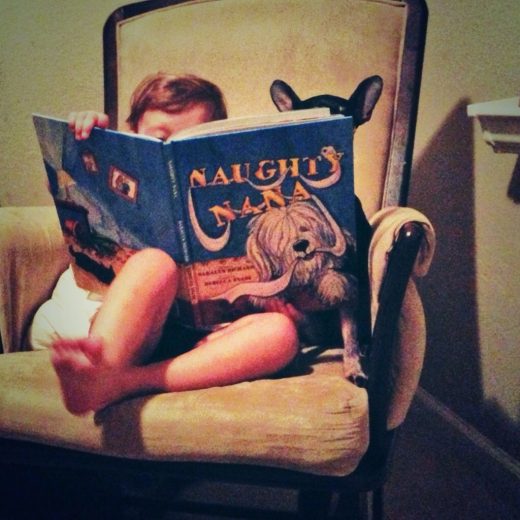
Before I wrote and published Naughty Nana, I selected a children’s book based mostly on the cover. If it was appealing, I was good, and I ended up with some real duds. Now, like a connoisseur of gourmet foods and fine wines, I’ve developed a more sophisticated palate, so I thought I’d share some of my new-found criteria for what makes a fabulous picture book.

1. How well is the book constructed? Whether the book has a hard or soft cover, it needs to be durable enough to withstand many page-turnings by hands, both big and little. Is the binding secure enough to keep the pages intact? What kind of paper does the book have? If the book is flimsy, it’s just not going to hold up.

2. Is the book colorful? Many picture books have only one or two colors, while others have four. In my experience, children enjoy books with multi-colored illustrations that come from combinations of red, yellow, blue, and black. If the paper is coated, it will take the inks and produce vibrant and shiny pages, the kind children are attracted to.

3. Does the book have at least one relatable character? Most picture books have a target audience of children aged 1-3, 3-6, or 3-8. The main character should be someone who is similar in age to the person who is reading or being read to. It’s also helpful if there is some age, gender, race, or religion diversity among the characters, so the book has a wider appeal and teaches children about people who
are different from themselves.

4. Is there a compassionate message? Most children’s books are entertaining and/or educational, but not all of them present readers with a positive message, something that points the way toward ethical behavior, kindness, friendship, or love. Children’s minds, after reading a bedtime story, should be filled with uplifting thoughts and the importance of doing the right thing. I’m convinced that is key to making the world a better place.

5. Does the book lend itself to conversation between the child and the adult reading it to her? Are there questions that flow naturally from the story? Can the child draw conclusions, make inferences and predictions, generate explanations, compare and contrast, and evaluate the story? The best picture books are open to interpretation, providing room for healthy discussion.

As you shop for quality books for the youngsters on your holiday list, keep these five criteria in mind: Construction, Color, Character, Compassion, and Conversation. Hit all five, and you’ll know you’ve got a winner!

************

image

Saralyn Richard is a former educator and author of Naughty Nana, a children’s picture book, ranked #30 on the Goodreads list for Best Picture Book. For reviews and book orders, GO HERE.