Donna’s Cancer Story: Recovery

This is the eleventh of thirty-one installments of Donna’s Cancer Story, which will appear daily in serial format through the month of September to recognize Childhood Cancer Awareness Month.  Each post will cover one month of Donna’s thirty-one months of treatment. 

Just a day after the dismal day I wrote about yesterday, Donna seemed to turn a corner.  Our stem cell doc thought some of the intense pain and discomfort Donna had been experiencing, the writhing and moaning, could be attributed to lactose intolerance.  Quit the dairy, he advised, and within a few days she should feel better.  We did and she did. 

Turns out that the part of our body that breaks down lactose is the lining of our small intestines.  The potency and toxicity of Donna’s stem cell transplant chemotherapy caused her intestinal lining to shed, leaving her no means to process the lactose her body was craving.  Donna was so hungry after her return home and we had been more than happy to accommodate this hunger with her favorite foods:  milk, mac-n-cheese, yogurt, cottage cheese — a dairy farmer’s dream.  And yet, that was the agent of the pain and struggle we had been seeing.  We made the necessary changes and Donna transformed before our eyes.  The eight hour sessions of misery in my lap shortened each day.  Eight hours became six then four then two then poof.  “Mama found a cottage cheese that doesn’t hurt my belly!” is something Donna would joyfully shout as she ran up and down the hall.

And suddenly we learned that Donna’s treatment was over.  We had been prepping for the second stem cell transplant, dreading it, knowing what horror the first one had brought.  The docs had left the decision to us, we were to decide to move forward with the second one or take a gamble on one and done.  For the first time, Mary Tyler Dad and I disagreed.  We were torn, but knew that consensus was crucial.  That was its own special kind of hell.  But early one morning, Donna’s oncologist called to tell us that the team had taken the second transplant off the table.  They had just reviewed all numbers and determined that second transplants had a 20% mortality rate.  Given that no one knew if it carried any benefit (some cancers are only cured with two), the team agreed it was too risky.  Hallelujah. 

Donna feeling better

Hallelujah, hallelujah, hallelujah, hallelujah, hallelujah.  And so began our life after cancer, though that brings its own fears and concerns.  For the first time in eleven months, there would no strategy, no tools to fight the beast.  We were left to hope and believe that the beast was gone.  Papillary meningioma, that had had its way with Donna, had left the building, but we struggled trusting this.  We were shell shocked and thrilled and tired.  So very, very tired. 

Donna, though, was wired.  She felt better each day.  She was making up for eleven months of slogging through the muck of cancer.  She was two and wanted to play and play and play.  Each day brought more and more Donna back to us.  Skinny and pale with sunken eyes, Donna came back to us.  Stubble appeared, pink cheeks and lips returned, her eyes brightened.  Donna had never been more beautiful. 
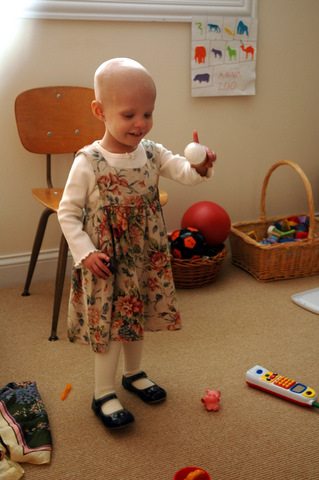
Donna in linen dress

As we stumbled through these first official days after treatment, it took Mary Tyler Dad and I some time to get our bearings.  It felt like whiplash.  Just days earlier, we worried about two dots on the lungs, a second transplant, and Donna dying, but here in front of us was a bald headed spitfire.  She didn’t have time for our trauma.  Donna had things to do.  We tagged along.  Donna showed us the way.

While active treatment was over, there was still the daily insults of cancer.  Closets and tables full of medical supplies, lots of daily medicines to endure, weekly port access, and trips to the hospital for check-ups and occasional platelets.  When Donna’s home health nurse came, Donna would shyly cling to my legs.  She knew that Phyllis’ visits meant a needle poke.  As Donna gained health, her fight returned.  We had a routine that involved bringing Donna to her changing table, removing her top, which Donna hated.  I always imagined she felt so vulnerable with her port visible.  I would place my body weight over her legs to prevent kicking and hold her arms at her waist.  Donna, through her tears, would say, “One, two, three,” and that was Phyllis’ cue to poke.  It was a quick process, but we all hated it.  Moments after it was finished, Donna would sit up, get her shirt on, and be done with it, wanting to show Phyllis some new book or toy she had received.  I could not have been prouder of my girl.  Phyllis was amazed by her.  One day, after we saw Phyllis out — can you believe I was worried about manners at this time? — Donna shut the door and said, “You don’t like to do that, but you know you have to.”  She.  Was.  Amazing. 

I wrote at the time, “I am astounded by her brain and how it works and how it changes as it grows.  I am left in awe knowing how much trauma that same brain has been in over the past year and yet it still functions so beautifully.”  Donna, like any two year old, was working to become more independent.  She was playful, funny, clever, testing, silly.  She used to nap with a foam letter from her bath toys that she would gently place on the pillow next to her and cover with its own blanket.  The letter would change daily.  Life was so very sweet. 

One afternoon we had a clinic visit to check numbers and visit with our oncologist.  The nurses agreed to change Donna’s needle as it fell on a home health day.  As we walked into the tiny lab in the oncology clinic two of our nurses were prepping for Donna and in the background was Blue Oyster Cult’s “Don’t Fear the Reaper.”  With my straightest of straight faces, the indignant and morally superior one, I said to the nurses, “I can’t believe you are playing that song in a pediatric oncology clinic.”  Stare.  Our perfect nurse Tara said, not skipping a beat, “But it’s the cowbell version!”  We all bust out laughing and crying together.  Yes, life was sweet. 

Making pumpkin muffins with Donna

Tomorrow:  Family Portrait


Donna’s Cancer Story: Transplant, Part II

This is the tenth of thirty-one installments of Donna’s Cancer Story, which will appear daily in serial format through the month of September to recognize Childhood Cancer Awareness Month.  Each post will cover one month of Donna’s thirty-one months of treatment.

Donna hurting

The cracks were beginning to show.  Cancer can be relentless and a stem cell transplant is not for the faint of heart.  By the time we were discharged, Donna had spent thirty-one days in the hospital.  Each day was harrowing in its own way.  This type of post can’t do it justice, and honestly, the transplant alone could use a book.  Or manual.  Yeah, a manual for those who come after Donna, might be better. 

In the broadest of strokes, these are just a few of the things that happened in the tenth month of treatment:

  • Both Christmas and New Year’s were spent in isolation.  Santa still found Donna and New Year’s Eve was spent in the company of some of the most amazing families I’ve ever met.  Being bored, I planned a Happy, Hopeful New Year’s Eve party for the staff, patients, and families, complete with invitations, bubbly cider in plastic champagne flutes, music, decorated IV poles, dancing, and a seriously amazing vibe.  Possibly the best New Year’s Eve party, ever;
  • A first bacterial infection complete with 104.7 degree fever;
  • Mary Tyler Dad nicknaming me “the Mayor of 4 West” because of my tendency to chat up all the other Cancer Moms;
  • “Poop soup,” which is as it is named.  Copious amounts of the stuff that flowed like green beer on the 17th of March;
  • Donna losing 12.5% of her body weight in three weeks and falling to 21 pounds;
  • PT to re-learn how to walk and stand.  This was the third time Donna learned to walk — the first at 12 months, the second after the initial surgery, and again after  almost thirty days of lying in bed.  She took my breath away each time;
  • Suctioning liters of mucus from her mouth.  A vile green bile that came from the depths of hell, or her guts, but for Donna, that was the same thing;
  • A relapse scare one week after discharge that required an urgent MRI.  While Donna was showing some of the same symptoms at her initial diagnosis, the scans came back clean;
  • The appearance of two “worrisome” dots on a post-transplant CT.  Those damn dots would not be resolved for two weeks while we waited to see if they would grow.  They simply disappeared, though we lived in grave fear during the wait;
  • Needing to prep our home for Donna’s return.  That involved professional cleaning of all carpeting, rugs, upholstery, and air ducts.  Grandma washing or boiling or bagging each of Donna’s gazillions of toys.  God bless her.  Returning home meant we were spared a stay at a transitional home, or temporary patient housing close to the hospital that is almost always required for transplant patients because of the frequent need for blood products and concerns about depressed immune systems.  We lived just twenty minutes away, had moved into a freshly rehabbed home just six months earlier, didn’t smoke and had no pets.  We were solid pediatric cancer citizens.

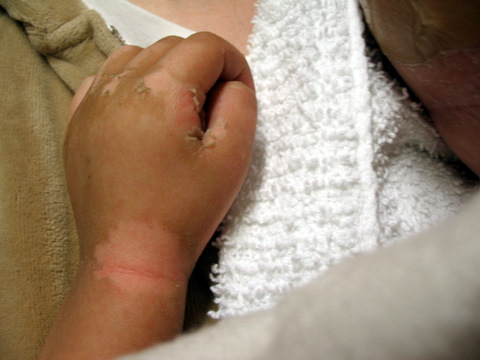
My head spins.  A transplant is beyond exhausting, and as hard as Mary Tyler Dad and I had it, it was but a candle to the wildfire that Donna fought.  Heat is a good analogy.  This photo is a closeup of Donna’s hand while in transplant.  The burn you see is a result of the chemo excreting itself transdermally.  The toxicity of the chemo was literally burning Donna’s skin from the inside out.  And what you see on the hand was duplicated on her ankles, knees, waist, feet and neck.  Good Lord, cancer is a beast. 

skin burned from chemo

I could write more, but today there is no need to recreate the wheel.  The following is an excerpt I wrote in Donna’s caringbridge journal that perfectly captures the anguish we all felt.  It was written on the last day of this tenth month. 

I feel like the worst mother possible to Donna these days. I find her frustrating and irritating and draining and unquenchable. I can not meet her needs right now. No one can. She feels terrible and does not have the tools to express that or deal with it easily. What I can do is be there with her and keep her company. That I am doing. With difficulty, but I’m doing it. And I’ll keep doing it. As long as she needs me there.

I’m also jealous of [Mary Tyler Dad]. Ridiculous, but true. In this sixth day of Unhappy Donna, he gets to go to work. He gets to go to the grocery store. He gets some space and freedom that I am missing and needing so completely. My gig is to be with the girl. And she needs someone all the time. Always and all ways.

Her pattern is that mornings are pretty good and she tanks in the afternoon before rebounding in the evening. [Mary Tyler Dad] described me as having whiplash and it is the perfect description. Round about 7 or 8 each night she perks up immensely and is ready to play and eat and socialize. I’m standing there reeling wondering what happened to the girl who just spent the past 6-8 hours wriggling or wailing in my arms. Where did she go? I’m so happy that she is gone, but it is hard to shift gears quickly. 

I continue to believe that this can not be the norm for stem cell recovery, but am told repeatedly that it is. I find it condescending and dismissive for the docs to repeatedly tell us that Donna is handling all of this just great. How is this clingy, miserable, unhappy, twisted in pain, sad Donna handling all of this so well?

This afternoon Donna settled down for a nap after a much improved morning. No dairy products in her little system since yesterday. I had such hope for the afternoon. After 20 minutes of napping, over lunch I heard her cries, “Mommy change my diaper!” Poop! Hooray! With no movement since Friday, poop is welcome and something to celebrate. While changing her diaper, Donna uttered through tears, “You are not quite ready for a nap!” I felt in my bones that 20 minutes was all she would get today. She was okay for about half an hour before she started crying and wailing. She wants to go for a walk, she wants to play in the park, she wants to go downstairs, she wants to go for a drive, she wants to go on an errand. Anytime we would make a move in one of those directions, Donna would demand a new direction.

Finally she agreed to act on an errand (a quick trip to the dry cleaner), but on the way there cried and complained that I was driving the wrong way and she wanted to go home. My clothes weren’t ready (I wanted to throttle the gal behind the counter – – does she have any idea how difficult it was to get out of the house and into her store?) so we settled on a drive.

Donna took a cat nap after 20 minutes of silence, but quickly woke up wailing for Daddy, screaming, “Want to go to the hospital right now!” This poor, sad girl. I cannot describe what it is like to see your child suffer and know that you are incapable of making it better. My guess is that she felt rotten and knows the hospital is the place you go to feel better. For a 2 yo to know this is heartbreaking. Heartbreaking. And I’m the witch that won’t take her. I’m the horrible person that explains that we go to the hospital tomorrow. What must she be thinking about that? That I won’t bring her to the place that makes her feel better?

These are the moments of desperation. I can not help my girl. I can not relieve her suffering. I, in fact, prolong her suffering by rationally explaining that we will see the doctors tomorrow. It feels like certain hell. We are together in hell and it is cold and miserable and lonely and isolative.

And even on her worst days, Donna was still the coolest person I knew. 

Rockstar Donna

Tomorrow:  Recovery

Donna’s Cancer Story: Transplant, Part I

This is the ninth of thirty-one installments of Donna’s Cancer Story, which will appear daily in serial format through the month of September to recognize Childhood Cancer Awareness Month.  Each post will cover one month of Donna’s thirty-one months of treatment.

I’ve never run a marathon, but I have seen a daughter through a stem cell transplant.  So there’s that.  After the decision was made to transplant Donna’s own stem cells back into her body after a mega-dose of chemo, we tried to prepare for the unknown.  That’s a hard thing to do.  We met with the docs, we asked to be connected with another family that had been through the same with a young child.  We tried to focus on the 85-95% of children that survive their stem cell transplants. 

A week or so before the scheduled date of admission to Children’s Memorial to begin the chemo, we had a sit down with the stem cell doc assigned to Donna.  While we waited in the meeting room, we couldn’t help but notice the Xeroxed flyer for a little girl’s memorial service tacked to the bulletin board behind us.  It was purple. 

The doc was very informative, though cool.  His manner was very different from our oncologist we had grown to love and rely on.  He talked stats and numbers and had a list of risks and side effects.  He calmly told us that the treatment would make Donna infertile.  That she would require hormone replacement therapy (HRT) starting in adolescence to develop along with her peers.  Puberty would not come naturally.  Donna would also require growth stimulants as the toxins would stunt her natural development.  Our girl who had always been petite and delicate would remain so.  She went into her transplant at 28 months and 24 pounds. 

This doc was tough, all business, minimal eye contact.  That kind of bedside manner is hard to take when you’re a parent, but you have to respect what this man does for a living.  One in ten of his patients die and they are all children.  It took a while, but in the end, Donna melted him.  He began to gift her books and she returned the favor with drawings or paintings.  Relationships are everything, even in cancer. 

We wouldn’t be admitted until late in a December evening, so on Donna’s last day at home we worked to create some holiday cheer for the girl.  In the morning we visited the Christmas trees at the Museum of Science and Industry.  We came home for a final nap in her own crib, woke up for dinner and got the call about 6pm that Donna’s room was ready.  It was snowing and beautiful.  A heavy, gentle snow.  We drove slowly along residential streets to look at the holiday lights.  There was no rush to get to the hospital we would call home for the next month.  Donna was happy.  We were anxious.

One of the many things that made us anxious was finances and medical expenses.  Our insurance company had denied Donna’s stem cell treatment as “experimental.”  The financial director at the hospital remarked that the denial letter was one of the “tightest” she had ever seen.  We consulted an attorney, but had no energy for that kind of fight.  With help from the financial office, we applied for Public Aid.  Say what you will about Governor Blagojevich, and there is a lot to say, but he had championed legislation in Illinois called All Kids that made it a legal requirement for all children to be covered under insurance.  That meant that because a for-profit insurance company had denied Donna’s medically recommended treatment, the State of Illinois assumed the financial burden for her stem cell transplant.  To the tune of $600,000.00.  From the bottom of our weary hearts, THANK YOU, taxpayers of Illinois.  Were Donna to be diagnosed today, this option would no longer be available to us, as families that fall above a certain income level are now disqualified; that $600,000.00 expense would fall to us.   

Over the next seven days, Donna received more chemo than seemed humanly possible.  The poison had names like etoposide, VP-16, thiotepa.  Thiotepa is an especially melodic string of syllables, isn’t it?  Thiotepa is a bitch.  While it is being administered over a series of four days, the strength of its toxins are so potent that Donna was required to take four baths a day.  At 8am, 2pm, 8pm, and at a ghastly 2am, Donna was carried to the tub to rinse and clease the residue that was excreted from her skin. 

 
stem cell transplant bath<
 

On Donna’s chest is her port, with the beloved tubie flung over her shoulder.  The arm has the PICC line that was installed specifically for the transplant, allowing another means into and out of Donna’s body.  Toxins in, blood out.  The blood is how progress is measured (through the presence or absence of white blood cells) and infections are identified.  Soon after this photo was taken, an NG tube would be placed.  Sixteen inches of tubing running from her nose, down the esophagus, directly into the stomach.  This was how nutrition was maintained during the transplant.  So many tubes . . .

After chemo was administered and a day of “rest,” Donna was moved to an isolation room.  This is where we would spend the remainder of Donna’s stem cell transplant.  The room is small, but private, so that is a bonus.  The photo below is a good shot of Donna’s small room, which had its own ventilation system and a small adjoining ante room, where visitors needed to scrub and gown every time they entered or exited.  When one child leaves and before another arrives for their transplant, the rooms are scrubbed floor to ceiling and the furniture is scrubbed with toothbrushes.  One errant, industrious germ is enough to kill a kid that lacks an immune system.  There are eight of these rooms at Children’s Memorial and they are almost always full. 

Donna’s room was decorated with “bubbles” from friends and family that had been requested on her caringbridge page.  Before we moved in, the Child Life staff had asked what licensed characters Donna liked.  The staff would then decorate the room before we arrived to make a cheerful home for Donna while she healed.  The thought of dozens of Doras or Caillous staring back at me for weeks was too much to handle, so I asked readers and supporters to send along their well wishes in a “bubble” to decorate the room.  They were beautiful and kept us company during some dark days.  Those bubbles now decorate the walls of our playroom.

IStem cell room

If you look closely, you’ll also see two pictures of Wonder Woman on Donna’s bed.  They were given to us by friends and were taped to Donna’s bed at each admission.  A reminder to all that Donna was a superhero, powerful, and not to be underestimated.  As I was packing for the transplant stay, I pulled out the Wonder Woman cards and Donna grabbed the one at her head where Wonder Woman is holding open the jaws of a dinosaur.  Donna looked at it and said, “She’s going to fight that beast away, but right now it’s scary.”  Amen, Donna.    

Tomorrow:  Transplant, Part II