Angels and Automatics: Lessons from Newtown

I haven’t stopped thinking about Newtown and all that was lost thirty-two days ago.  For a moment, America was shocked.  We shed collective tears for all those young lives lost.  We felt our vulnerability and it hurt.  It hurt like hell.  But like most metaphorical wounds, it healed, or has at least scabbed over.  We’ve gotten back to routines.  We drop our kids off in the morning at school and maybe are not worrying so much about what awaits them.  The rhetoric has become political.  Is the problem mental health?  Is it school security?  Is it gun control?  Most of us are comfortable letting the politicians and Facebook zealots figure it out.

What hasn’t gone back to normal are the lives of those families who lost a child.  They are thirty-two days into the ‘grief process’ that will never end.  The whole idea of a grief process has always annoyed me, even when I worked as a hospice bereavement counselor.  By definition, a process is linear, predictable, methodical.  Grief is none of those things.  Grief is the bucking horse that will not be tamed.  Grief is a wild ride that is at times bearable and at other times terrifying.  Three years into the greatest grief of my life, I’ve grown accustomed to it’s nature, but it is still a powerful beast that at times throws me off completely.

Yesterday an article came across my Facebook feed and I was surprised to read its headline, “Noah Pozner’s Mom Describes Newtown Victim’s Body, And Why We Should All Listen.”  I had never seen a story about the Newtown tragedy such as this headline suggested.  There are some things that are just not discussed, right?  Those twenty children are precious, they are “angels,” and angels don’t have parents talking about their mortal wounds in media interviews.  Right?

Wrong.

Noah Pozner is no angel.  He is a boy who senselessly and tragically died because a rifle was aimed at his face and then ten other places on his little body.  Veronique Pozner, Noah’s mother, wanted the governor of Connecticut to see her boy, her beautiful boy, as he was after the shootings.  She invited Governor Dannel Malloy to view Noah’s open casket.  In her interview with Naomi Zeveloff of the Jewish Daily Forward, Veronique Pozner captures something in words that I have thought often myself, though never so eloquently, “I just want people to know the ugliness of it so we don’t talk about it abstractly, like these little angels just went to heaven. No. They were butchered. They were brutalized. And that is what haunts me at night.”

I so understand her need for others to bear witness to the brutality of her son’s death.

After Donna died, there was a period where it made me terribly angry to hear her referred to as an angel.  During her shiva, people would use the expression with me and I would bite my tongue, knowing full well that my friends and family meant no harm whatsoever.  But I drew the line with our chaplain.  This dear colleague who knew Donna personally and listened to me struggle with my fear during her years of treatment used the dreaded “angel” in her comments for the burial service that I got to hear ahead of time.  I asked her to remove the word.  She completely understood and did so easily.

I know that there are many, many other grieving parents who feel the exact opposite of me.  Thinking of their child as an angel above brings them comfort and solace.  I would never wish to jeopardize that for them.  But for me, and possibly for Veronique Pozner, the term angel brings us no comfort when applied to our children buried in the ground.  And in drawing this comparison I do not mean to draw comparisons to our losses.  Noah Pozner and Donna died for very, very different reasons.  I would say apple and oranges, but that is much too benign a comparison.

When people refer to the Newtown shooting victims as angels, I think that speaks more to their needs than the needs of the families that survive.  If God above needed angels, did he need to transport them in such a violent way?  Where is the logic in that?  It makes no sense to me.

My sense is that Veronique Pozner wants us to know and understand the brutality of that sunny day at Sandy Hook Elementary.  By sharing the details of her Noah’s death, graphic as they are, she is not exploiting her son.  She is opening our eyes.

Semi-automatic weapons are a serious business.  They are not clean shots.  They are meant and intended for destruction on a massive scale.  The body of a six year old, the bodies of twenty six and seven year olds, and the wounds they were left with being on the receiving end of a wall of bullets, tell the true story of semi-automatic weapons so widely available in America.  It is a bloody and graphic and uncomfortable story, but it is one that needs to be told.  And we need to listen.

I support Veronique Pozner and I bear witness to her loss.  May Noah rest in peace, along with Charlotte and Daniel and Olivia and Josephine and Ana and Dylan and Madeleine and Catherine and Chase and Jesse and James and Grace and Emilie and Jack and Caroline and Jessica and Avielle and Benjamin and Allison.

Kraft och omtanke to their families and the community of Newtown, Connecticut.

Correction:  A few readers have commented that my use of the term “automatic weapon” was incorrect, that the Newtown shooter, in fact, used a semi-automatic weapon.   The New York Times tells me that it was an AR-15 semi-automatic rifle.   I have corrected three items in this post — changed “shotgun” to “rifle” in the fifth paragraph and added “semi” in front of “automatic” in two instances in the eleventh paragraph.  For the record, I do not believe the mistakes are reflective of anything other than my gun ignorance.  The intent of this post is about witnessing violence and the cost of weapons in our culture.  Whether that violence was the result of an automatic weapon or semi-automatic rifle seems to me semantics and nothing else.  MTM.

Donna’s Cancer Story: One Year Later

sand

I feel a little bit like I am walking on air this September, weightless, unanchored.

For the first time since 2006, I am neither living through nor writing about our time in Cancerville.  This year I am simply cutting and pasting.  Literally, cutting and pasting, moving the daily installments of Donna’s Cancer Story from this site onto the Huffington Post operating system.  This makes me grateful, relieved, able to expand my lungs in full breaths.

Cancer is a badass bastard.  And once you move to Cancerville, you never leave.  Your subdivison changes, but you never leave this place.  Since 2009, Mary Tyler Dad and I have lived in Grieving Heights, the subdivision everyone fears the most.  The resale values in Grieving Heights suck, as no one wants to buy there.

This year, with a little distance and minus the pressure of writing every day, I feel grateful to be grieving rather than terrorized by some of the day-to-day realities in Cancerville.  Many grieving parents might disagree with me wholeheartedly and I know some that would give anything, anything, for another hug or moment with their child.  The terror of living through Donna’s cancer was at times almost physically impossible to bear.  It would send me into a dark corner of my home, Donna and her Daddy playing somewhere else, he much more able to be with Donna in the dark times.  I would grab the phone and call either my father or my sister.  I would wail.  I would rock back and forth, trying to soothe the intense fear I felt, the terror, really, which is fear’s evil twin.

The grief I feel now, I manage with more ease.  I see grief as the endless landscape of the rest of my life.  I will always live in grief, it will never go away.  Donna’s Daddy will always live in grief, too.  Gratefully, we are there together.  His sadness mirrors my sadness and vice versa.  Sometimes I feel guilty for thinking that, let alone writing, that, in effect, acknowledging that living without Donna is easier than living with the thought of losing Donna.

Does that make any sense?  Am I a horrible person, cold and numb in my grief?

Three years ago we were nearing that last month of Donna’s life.  In the end of September 2009, she started to show signs of tumor progression.  Tilting her head to one side, her left arm weakening.  We could no longer ignore what would be imminent — our daughter’s certain death.  But still, she went to pre-school two mornings a week.  I drove her there, gym shoes on my feet, Mary Tyler Son in the car seat next to her, his stroller in the trunk.  The five weeks that Donna was in pre-school were some of the happiest of my life.  For three of those weeks, six days, I got to feel like a MOM.  Like a run ‘o the mill, harried housewife.  It was bliss.  True bliss.  I feel grateful every day for those weeks.

Two weeks ago, Mary Tyler Son started at the same pre-school.  Today is his sixth day.  He is so very happy there, just like his sister.

The process of writing Donna’s Cancer Story was intense.  Intense.  For the first ten days or so last September, I would, at some point over the course of the day, read thirty days worth of Donna’s CaringBridge journal.  Mary Tyler Dad and I were prolific.  In the absence of a religious or school community to rely upon, CaringBridge became our virtual temple, church, mosque.  For many periods, we would write almost daily updates, often late at night.  So I would read thirty days of that.  Then I would pour through thirty days of photographs from the same month to cherry pick two, three, or four to supplement the words I had yet to write.

Usually late, around 8:30 or 9 PM, I would sit down to write.  On some days, usually the ones I was working, I would not have had the opportunity to read through CaringBridge or sift through photographs until this time.  Each post took about 2-3 hours of reading and photo selection, then 1-3 hours of writing.  That was approximately 3-6 hours a day.  Every day.  By mid-September, I had lost the ability to stay up past 10 or 11.  I would read and photo select before bed, then rise early to write, on work days, that would be rising about 4 AM.  By the end of the month, that last week of September, all bets were off.  That’s when I stopped being able to get up early or stay awake late.  The last few posts weren’t complete until 3, 4, or 5 in the afternoon.  Last September nearly done me in.

All of this was possible because I am married to a gem.  A true gem.  Mary Tyler Dad supported my efforts, though no doubt, they were wrenching for him, too.  While he wasn’t reading the CaringBridge or looking through photos, he was reading my posts, and holding me in my tearful exhaustion, and both mothering and fathering our son.  I thank my lucky stars every day that I found him and that he found me and that we both recognized one another.

So a year later, Donna’s Cancer Story is not the wrenching labor it was last September.  The actual posting is more of a task, a technical chore, than an emotional odyssey.  I am not the wrung out dish rag I was last September.

This year, I feel focused.  Laser focused.  I am more aware and receptive to the stories strangers send me about their responses to Donna’s Cancer Story.  I have space to both hear and feel what Donna has meant to you.  I am grateful, so very grateful.  I am angry at the shameful lack of funding for pediatric cancer research.  I am sad for the forty-six families that today will learn their child has cancer.  I am devastated for the seven American families that will lose their child today.  I am proud, both of my writing and ability to bring people to Donna’s story, ensuring she will not be forgotten, at least not right now, and of Donna herself.  I am so completely proud of my girl.  She remains amazing, three years after her death, and you all see what we saw and were privileged to nurture and bask in — Donna’s wisdom, her wonder, her joy.

And our family is doing okay, good enough as they say.  At Donna’s memorial service I talked about our need to ‘figure it out,’ our life without Donna.  We are doing that.  Mary Tyler Son ensures that every day of his life.  We are not what we were, what we could and should have been, but we are what we are — a loving, grieving family, incomplete, but figuring it out.

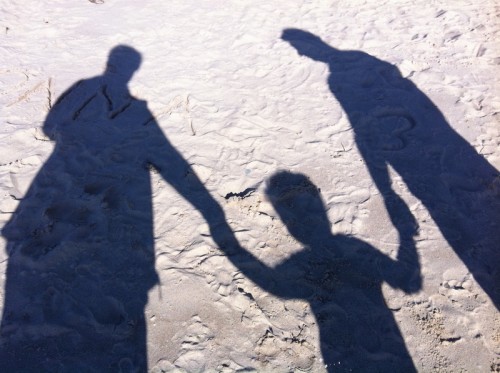
shadow

Profound thanks for witnessing our girl, our sadness, our loss.  Thank you. 


Yin, Meet Yang

Tomorrow marks my daughter’s 7th birthday.  I call it her would be/should be birthday.  People correct me, “No, it IS her birthday, it will always be her birthday.”  Factually, sure, yes, that is an accurate statement.  Donna’s date of birth will always be July 20.  Seven years ago right this instant, I was in the midst of 54 hours of labor, at the end of which was Donna.  Beautiful, crying Donna.  We opted out of knowing her gender before delivery, but, yes, I was hoping for a girl, and there she was.  Gorgeous.  Perfect.  Donna.

Donna’s birthday is now complicated.  Very, very complicated.  How do you recognize the birthday of a child who should be 7, would be 7, were she not buried in the ground?  This is a question that is not so easily answered.  We’re still working on it, Mary Tyler Dad and I.  In years past, and there have been only two birthdays without our girl, we’ve taken the day and spent it as a family doing things Donna enjoyed.  The zoo, a museum, a favorite restaurant.  In 2010 I honestly entertained the idea of having a party at Donna’s graveside, inviting close friends and family.  Then I thought about cutting a cake and singing “Happy Birthday” to a gravestone.  Yeah.  Nixed that idea pretty damn quickly.

Cancer can suck it.

Last year we went to Donna’s hospital and dropped off iPads that Donna’s Good Things donated to the Child Life staff.  We went to dinner at a cute shop named Donna’s Cafe Chicago that happened to be just blocks from my Dad’s place.  A baker gifted us the most beautiful cake with black birds on it.  That was nice.  We didn’t sing any songs in celebration, but Mary Tyler Dad and Mary Tyler Son and I sat and talked about Donna and ate a pretty cake. 

Thoughts of Donna are with me every day, throughout the day.  Sometimes they are heavy.  Sometimes they are joyful.  When July rolls around, the thoughts of Donna intensify.  Her birthdays are much more difficult for me than her death anniversary, her “remembery’ as we call it.  The thought of what should be is so much heavier to bear than what was.  What was was Donna’s life.  That is known territory.  What should be is more painful to consider.  So much was lost when Donna died.  Things that we cannot even imagine. 

And in the midst of all of this is life.  Life that needs to be led.  There is our boy, our beautiful boy, who is tending to his own life. 

This afternoon I will leave the office, pick up Mary Tyler Son, and head to a pre-school meet and greet with him.  I will celebrate his growth and all that will start for him in the fall.  His new school is Donna’s old school.  I will walk in that door and I will be ON.  I will smile and make chit chat with other moms and dads and compliment their kids and forget their names instantly.  I will be happy for my boy who will get to capitalize on his encyclopedic knowledge of dinosaurs and mammals.  I will feel the joy of his learning and growing.

But at the same time, I will be grieving.  I will look in the classroom that was Donna’s and remember what she wore on her first day of school.  I will think about how as we walked into the building the first time, she exclaimed, “Wow, it’s a skyscraper!”  I will remember the names of the children in her class and how they are in first and second grades now. 

This happiness and sadness, this darkness and light, that is the yin and yang of life.  It occurs for all of us, but somehow seems especially potent in mine.  As Donna grew in my belly, I cared and grieved for my Mom.  As Mary Tyler Son grew in my belly, I cared and feared for my daughter.  In the intense sadness and sorrow that followed Donna’s death, there was the joy and light that a ten month old Mary Tyler Son brought to us.  It seems that in my darkest moments there is always a light and in my brightest days there is always a shadow.  Yin and yang.

Cancer has brought much wisdom into my life.  Clarity.  I welcome the sadness of my grief just as I do the joy of my happiness.  There are chairs for both at my table.  Mary Tyler Son deserves no less of a mom than Donna had.  A wise Bosnian refugee hairdresser taught me that.  And trust me when I say that Bosnian refugees know something about life.  For me, the yin of my life is grief and loss and the yang of my life is joy and pleasure.  I am grateful for both, but more than that, I am grateful that I am not afraid of either. 

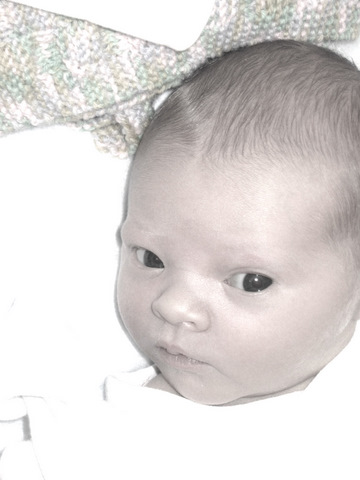
newborn Donna
Happy birthday, girl.  I miss you so.