In Defense of Caillou

Poor Caillou.  Seriously.  Poor little bald headed animated child.  People hate him the world over. Not dislike him, or feel mildly irritated by him, or, you know, turn the channel when he comes on the TV dislike him, but hate him, loathe him, and wish very, very bad things upon him.  Him being a fictional character.

What's not to like?
What’s not to like?

I don’t get it.  I never have.

The level of animosity reserved for this little guy astounds me.  You would think that a fictional four year old would push a few buttons, what with the whining that goes along with being four, but man, it would be easy to confuse him with, I don’t know, Hitler or ISIS, for all the hate and venom he incites in parenting circles.

Here is a sample from Urban Dictionary under Caillou:

A fucked up kid’s show about a spoiled little turd who gets upset when he doesn’t get his way.  If Caillou was real, I’d kill him.

Caillou is a soiled little shit TV show on PBS. Caillou can’t grow hair, not because he has cancer or progeria, but because he sucks, and even his own body recognizes that he does not deserve hair or food or love

A children’s show featuring an aggressive bald kid who is easily irritated and agitated when things don’t go his way.  Caillou made me search for my virginity.

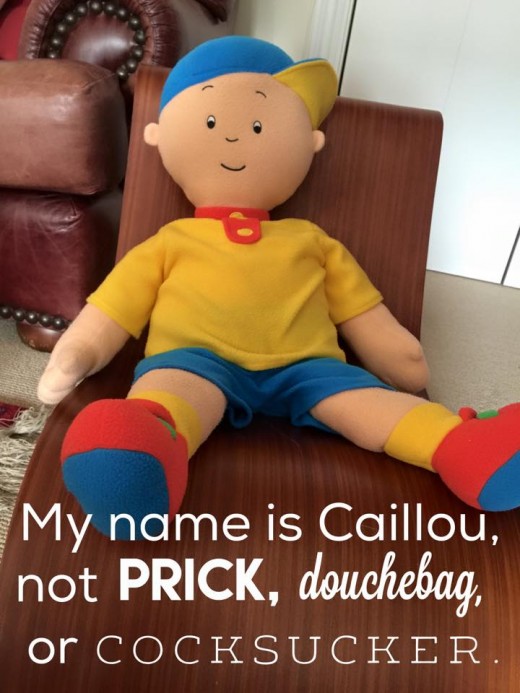
Then there was the anti-Caillou smackdown Buzzfeed ran last week.  Um.  Okay.  Well. It seems more than a few folks take their PBS really, really seriously. In other circles I have seen Caillou referred to as a prick, douchebag, cocksucker, asshole, uterus killer, fucker, and the list goes on and on and on with some decidedly unfriendly language not typically associated with kid’s TV.

If the point is that Caillou acts like a typical four year old, well, then, sure, I totally agree.  Most four year olds (at least the two I have parented to date; I still have a two year old in the pipeline) can be whiny and entitled at times.  It’s just part of the package.

Full disclosure, if you haven’t already noticed, I kind of dig the little guy.  I first started watching him in 2007.  Eight years and two toddlers later, I’m still watching. So are my kids.  Our brains aren’t bleeding.  I haven’t gone insane from the whining.  My kids don’t seem to have experienced any adverse effects of too much Caillou.

And laying all my Caillou cards out on the table, I actually like the show, especially compared to some of the other offerings in the kids’ entertainment arena.  Here’s why:

1. Caillou gets to have emotions.  Yes, he is whiny and entitled at times, but he also experiences guilt, regret, anticipation, joy, fear, curiosity, annoyance, gratitude, frustration, confidence, impatience, relief, and boredom.  I complied this list after watching just one 30 minutes episode.  Even better, the grandmother narrator — a kind, nurturing voice, labels Caillou’s feelings for those watching at home, e.g., “Caillou was upset his little sister took his favorite toy.”  Of course he was!  But then we get to watch him figure it out, too.

2.  I recognize the day-to-day family environment.  There is a loving mom and dad with grandparents close by.  You see the family doing chores around the house, and the grumbling that goes along with that.  The adults cook, clean, shovel, rake, grocery shop.  The adults get to complain, too, because, yes, it is a pain sometimes to be responsible, especially when your car breaks down.  The family eats together and celebrates together.  The show reflects my kids’ day-to-day and I get that might not speak to everyone, but it is a comfort to see your small world reflected on the screen.

3.  It’s quiet and simple.  There is a whole lot to mine from a kid’s simple experiences, a lot to learn from and consider.  When I think of shows like Wow! Wow! Wubbzy!, Sheriff Callie’s Wild West, or even the beloved Thomas or Dinosaur Train shows, basic lessons in social skills are encouraged through the use of robots, trains, dinosaurs, or animals. Caillou does all that through people.

Why is it more appealing to teach things like patience and sharing by adding an extra layer of difference?  Is it more palatable to learn about grumpiness or bullying from a train than from a kid who might act a lot like your own?

4.  Imagination is encouraged. In later episodes (admittedly, these are not my favorites), Caillou uses his imagination to explore being an astronaut or a rock star. Some of this is accomplished through reading books found in the library his Mom and Dad take him to — win win!

5.  The show features discipline.  This is one of my favorite aspects of watching Caillou with my little ones.  When Caillou acts like a jerk, there are consequences. When he grabs a toy away from his little sister or excludes a classmate on the playground, there is a price to pay for his poor behavior.  He can stomp his feet and not like the consequence, but they are still there.

As a parent, I love that.  And I honestly think it is productive and useful to see that 1) all kids misbehave sometimes; 2) there are ramifications to misbehavior; and 3) your parents are not the only ones who practice standards of behavior, discipline, and consequences.  Those are things other kids have to deal with, too.

Perhaps this post presents me as a Pollyanna.  Well, then, so be it.  I will own that shit. I’ve just seen the words “Caillou” and “cocksucker” attached one too many times for my liking.  And rather than tell all you Caillou haters to get a freaking grip, or, do as my husband joking encouraged, and theorize that anyone who hates Caillou really just hates their own kids, I will simply encourage you all to give it another look see, that Caillou show, and try and be just a teensy bit more objective towards him.

Honestly, he’s not all that bad.  And, more importantly, he probably resembles your own kiddos more than you realize.
Caillou2

Words on a Dress

This post is part of ChicagoNow’s monthly “Blogapalooza” challenge.  Bloggers are provided a writing prompt at 9:00 pm and must post by 10:00 pm.  Here is tonight’s prompt:

“Share your favorite quote (or quotes) — from a philosopher, author, comedian, politician, friend, family member, movie, whoever — and write in detail about why it resonates and has meaning for you.”

I got married in the spring of 2001, just shy of fifteen years ago.  Fifteen years ago, man. That is a long time.  I am proud of us, my husband and I.  We’ve weathered many storms in those years, and somehow, miraculously, have remained solid, together, married.

Back in 2001, it was my husband who was the creative one.  I was the sensible one. The social worker.  The career driven one.  My husband and I met through a classified ad in the Chicago Reader.  It was 1996, so that was pretty much pre-online.  We met through a freaking newspaper, people!  That is how long we’ve been together.

I make note of that, because in all the time we’ve been together, words have factored into our relationship.  In a big way.  It was my words on the classified page of a newspaper that attracted the love of my life to me.

One of the things that I loved about my husband from the get go was that he was a writer.  Not me, mind you.  Him.  He was the writer.  I was the fan, the groupie, the hopelessly straight girl from the suburbs who was attracted to creative types.

Six weeks after we met, my husband, then just barely a boyfriend, moved away to Europe for six months.  Our courtship was virtual, through words, and remains, to this day, the single most romantic period of my life.

The words we shared on a daily basis, me at my keyboard in Chicago, Jeremy at his keyboard in Amsterdam, are the foundation for those fifteen years of marriage.

When he returned, we moved in together.  It took a few years, but, finally, he proposed. I was inches away from popping the question myself, but, gratefully, he was first.  I know that is impossibly anti-feminist, but I’ll own it.

We wrote our own vows, of course, because, well, words.  They have always been important to us.  They are our glue, the adhesive of our understanding.  Words.

I had a complicated relationship with being a bride.  It truly did not appeal to me.  I felt, in many ways, like a prop, a symbol, a pretty girl in a white dress playing a part. One of the ways I marked the day as my own was with words.

My dress was made for me by a homemaker in Dyer, Indiana.  The fittings took place in her kitchen.  She had made my sister’s dress and my sister-in-law’s dress, too.  I was a challenging client, I think, because of that whole ambivalent attitude towards all things bridal.

The dress was plain satin.  No tulle, no train.  It was strapless with sweet scallops along the bodice.  Along the hem of the dress, in periwinkle blue embroidery, was a quote.  It was a line from an e. e. cummings poem.  My sister found the quote for me, she knowing me better than most.  As soon as I read the words, I knew they were the ones. A bit like the man I was marrying.

Always it’s spring, everyone’s in love, and flowers pick themselves.

Fifteen years later, those words encapsulate hope for me.  Hope.  More than anything else, the thing that has gotten me through life.

At the time, I didn’t know from hope. My parents were alive and well.  I hadn’t yet thought about motherhood, let alone burying a child.  Cancer was a bad thing that happened to other people. I was still naive.

Fifteen years ago, as I prepared for marriage to the man I love, the words meant something different to me.  They were about spring and potential and life and all things that are new and joyous and possible.

Wedding Dress

Hope evolves, just like life does.  The ten words that wrapped themselves around the hem of my wedding dress have evolved, too.  I may have lost my naivete to grief, but I still cling to joy, to life, to potential, and to that earnest love for a man who still stands beside me.


The Islamic State and Syrian Refugee Crisis for Dummies

It is shameful to admit, but there is so very much I do not understand about what is happening in the world outside my own four walls.  Being a Midwestern mom is no excuse for ignorance, so I found myself trying to learn more this weekend after Friday’s events in Paris, albeit in a Midwestern mom kind of way.

I fully appreciate that the methods I chose to learn are no doubt biased, based primarily on Google searches and some informative articles found peppered in my Facebook feed, but it’s a start.  There is some comfort to be found in learning that the world’s leading experts on the dire situation have no confidence that our political leaders are doing any better than most of the rest of us in understanding or responding to the threat or crisis.

Okay, let’s just jump right in and learn together.

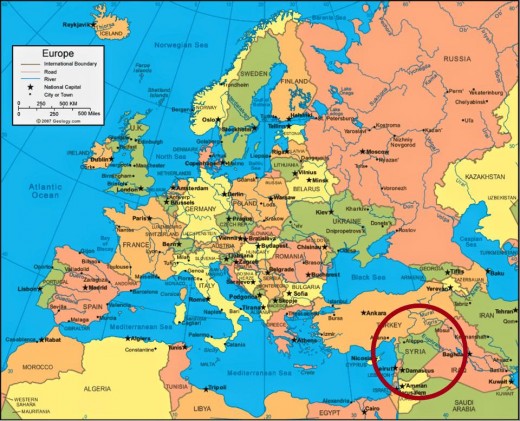
Map from geology.com.  Syria is circled in lower right corner.
Map from geology.com. Syria is circled in lower right corner.

Syria is located in the middle east, sandwiched between Turkey and Iraq.  When the Arab Spring began in late 2010 and other mid-east power systems were toppling (Tunisia, Egypt, Libya among others), the Al-Assad family that has ruled Syria since 1971 dug in its heels against protest and civil war resulted.

With all of the chaos and unrest in neighboring Iraq, the problems in Syria created a prime opportunity for the Islamic State to act and claim territory for itself, expanding its reach.  This is a crucial development to understand about how and why the Islamic State is different than the other well known terrorist threat of Al-Qaeda.

The Islamic State, also referred to as ISIS, Isil, or Daesh (read about the “branding” or name controversy HERE.), has goals and objectives that are significantly different than Al-Qaeda.  For one, the name is very significant.  Al-Qaeda operates primarily as an underground terrorist network whose objectives are often political in nature, including the destruction of western economic structures.

ISIS, on the other hand, has goals and objectives that are more religious.  To be legitimate and recognized by believers, the Islamic State requires a caliph and a caliphate.  A caliph is the chief Muslim civil and religious leader.  A caliphate is a form of Islamic government, including territory, ruled by the caliph.

There are strict rules about just who is qualified to be deemed the caliph.  The last caliph was taken down by the Turks in 1924 and his successor was named in the summer of 2014.  His name is Abu Bakr al-Baghdadi.  Africa, via Boko Haram, declared their own caliph shortly after, but has since sworn allegiance to Baghdadi as the one true caliph.

When Baghdadi publicly declared the Muslim caliphate in June 2014, an influx of true believers descended upon Syria, wanting to be a part of the uprising.  These are people — men, women, and families even, that wish to live under authentic Sharia law.  The coda of Sharia is ancient and based on teachings from the Quran.

Saudi Arabia, perhaps more than any other country, practices Sharia law, though the current caliph believes Saudi Arabia does not follow Sharia thoroughly enough.  If someone is accused of theft, their right hand is amputated under Sharia law.  Death is considered a suitable punishment for many perceived sins, e.g., not believing in Muhammad as the true prophet, leading a Muslim away from their faith, not following the teachings of the Quran, and a host of other trespasses.  Common forms of punishment practiced by ISIS include stoning, beheading, and crucifixion.

Note that the vast majority of Muslims do not advocate for true Sharia law.  HERE is an excellent article from the Council on Foreign Relations about Sharia law and how most Muslim countries live under some modified form of the law.

The Atlantic is providing some excellent commentary for those who wish to better understand the crisis and what is happening and why.  “What ISIS Really Wants” was published in March and, more than anything else I have read, enables the lay person to better understand the difference between the Muslim faith and the fanaticism of the Islamic State.   And “The Confused Person’s Guide to the Syrian Civil War” will help the lay person, or Midwestern mom like myself, untangle the conflict.

With all of the unrest, between civil war and the creation of the Islamic State, native Syrians are fleeing in droves creating the worst refugee crisis in Europe since World War II.  This animated video from In a Nutshell helps explain the proportions of the crisis.

The reality of this refugee crisis might have hit home for many of us mothers with the image of the three year old boy washed up on the shores of the Mediterranean Sea after fleeing Syria with his family.  The boy’s name was Alan Kurdi.  He was three years old and from Syria, with Kurdish ethnicity.  His family was working to reach Canada in hopes of a better life.

This boy has a name.  It is Alan Kurdi.
This boy has a name. It is Alan Kurdi.

The refugee crisis has put immense pressure on much of Europe.  There is growing backlash against the refugees and concerns about what the larger ramifications of absorbing so many people from such a different culture will have on European day-to-day life.  Anger and hatred is on the rise.

I have no idea how to address these concerns, the growing crisis of fundamentalism in our world, the isolationist response to other’s pain and sorrow.  No.  Idea.  At.  All.

I do know that after a weekend of poking around the Internet just a bit, I feel better informed and aware of the hows and the whys.  The hate I see reflected in my own Facebook feed has been defeating to me, friends and acquaintances spreading anti-Muslim sentiment.  More informed friends providing smug updates about how much more of the world than Paris suffers.  Others shaming anyone who dare place a French flag on their profile picture.

We are so very divided.  There is so much we fear that we don’t know about.  The first step, as in everything, is to learn.  I hope these insights have helped just a bit.