I don’t really know how to answer that question myself. “Fine,” is one way, which would cover the basics — income secure, food secure, housing secure. Not worrying about those things right now is a really, really good thing. Outside of basic needs being covered, though, I am feeling a lot less, well, secure.
All of us are walking through so much right now. Whatever your politics, whatever your science (because apparently, in 2021 America, we also have our choice of science), we are all holding on to a lot in this moment — these moments, the string of them, that just keep coming.
Sometimes I wonder how much longer we can sustain this degree of uncertainty, fear, anger, outrage, sorrow, hopelessness, distrust. That’s something I worry about a lot. There are other things I worry about a lot and was going to add a little list here with bullet points and everything, but who in the hell wants to read about someone else’s worry list right now? I like you too much for that.
In these days I find myself much more inwardly focused. I’m trying hard to take care of my family, I fuss over my kids. My world feels a lot smaller in general. It’s quiet this week and for the first time since March 2020, both my kids and husband are gone at the same time. My home and I are getting reacquainted. It’s good. It feels familiar and odd all at the same time. In no way do I trust that all this divine solitude will continue. Some shoe is gonna drop and it’s only a matter of time before it does.
That kind of captures how I am right now in a nut shell — always waiting for the other shoe to drop and being certain that it will, even if I don’t know when. Maybe you feel the same some days.
It does feel good to be here, in this space, with you, if there are any yous left, that is. It’s been so long since I’ve written in this space that I actually had to Google, “How do I write on my WordPress site?” It worked and here I am.
Take care of yourself. No, really. Take care of yourself. Know that, historically speaking, we are living through some really big deal things. Like catastrophic things. Also know that there is a nice lady in Chicago thinking of you. I hope you are well, or well enough.
Today I took a walk and made brownies for lunch and opted to write instead of watch an old episode of Bachelor in Paradise. All of those things are good things. Today they will be enough.
I wore this hoody on yesterday’s walk and for the first time in forever, some of the other walkers and cyclists actually smiled and waved at me when typically folks on the path work hard not to make eye contact. That’s a win.
Exactly 48 hours ago, a massive weather event known as a derecho (pronounced de-ray-cho) ripped through my little corner of the world, in the northern most point of Chicago. That was exactly 12 hours after hundreds of folks looted stores in and around Chicago’s tony Magnificent Mile.
Mondays in the year of our Lordt 2020 are hard, but this past Monday in Chicago was excrutiatingly, wrenchingly, brutally, achingly hard. Next level stuff, folks.
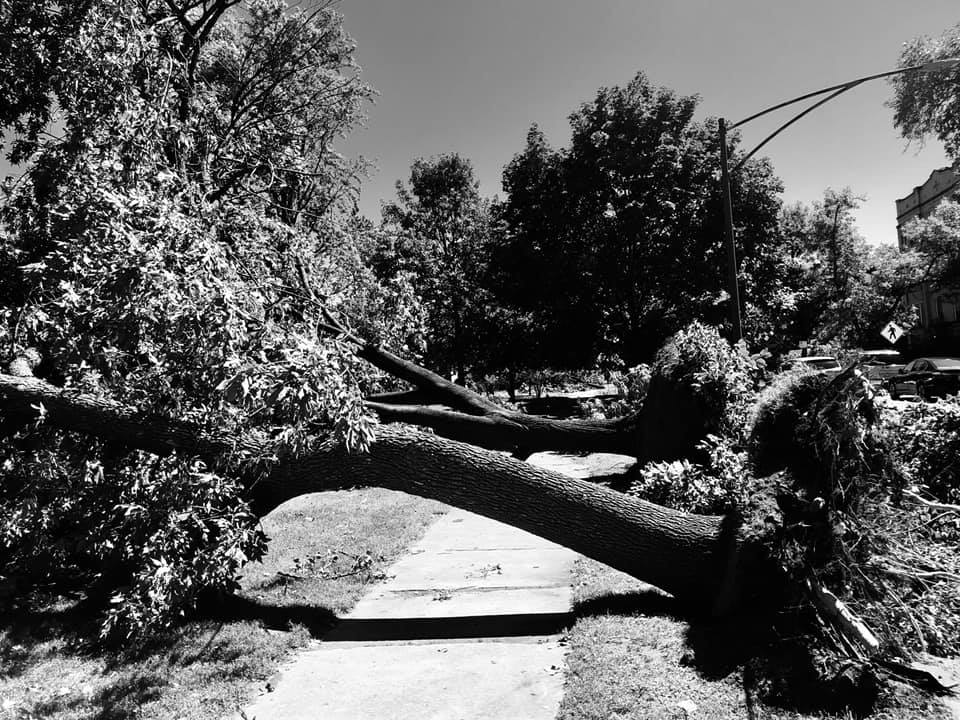
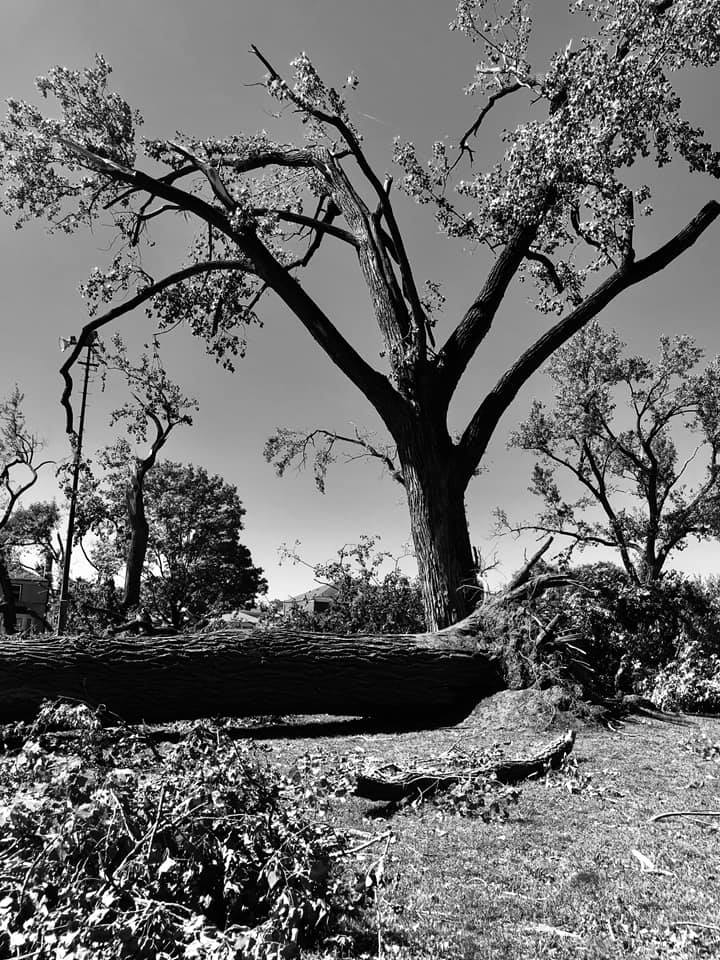
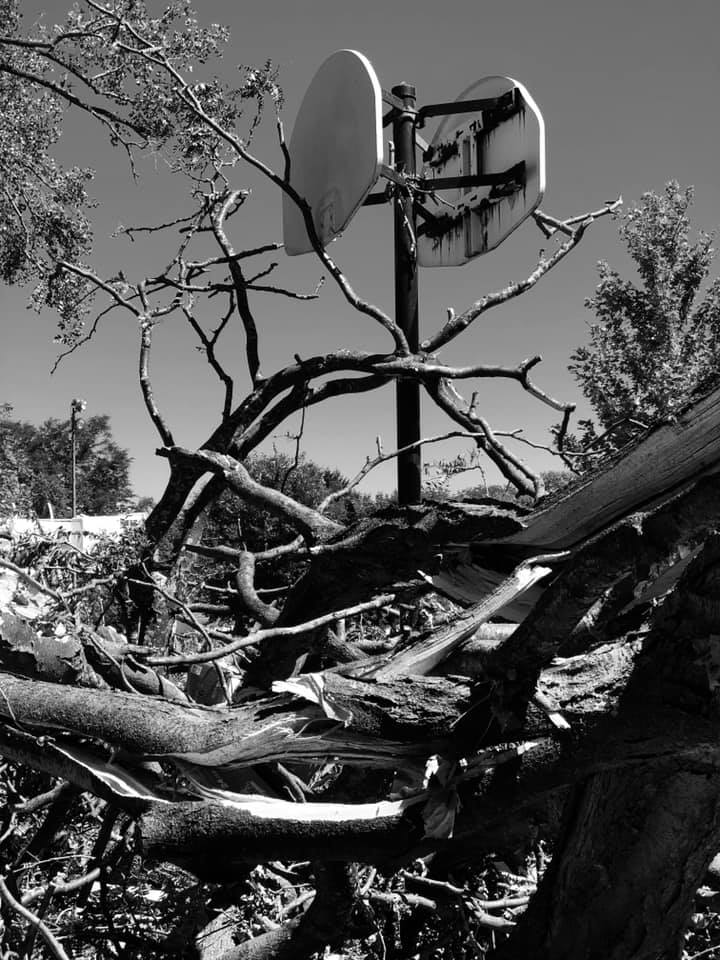
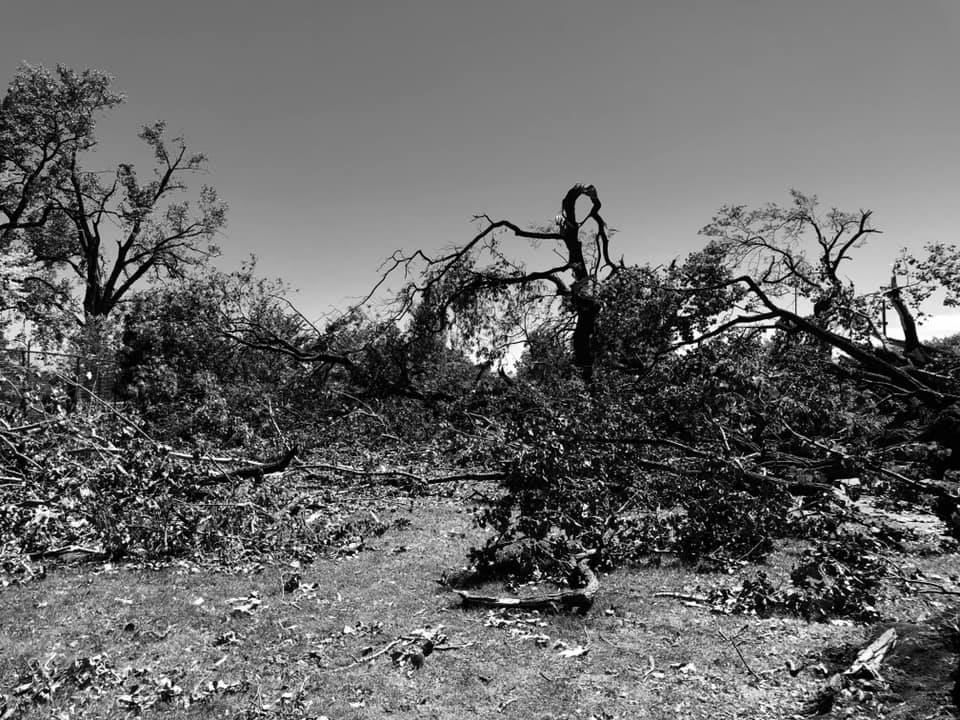
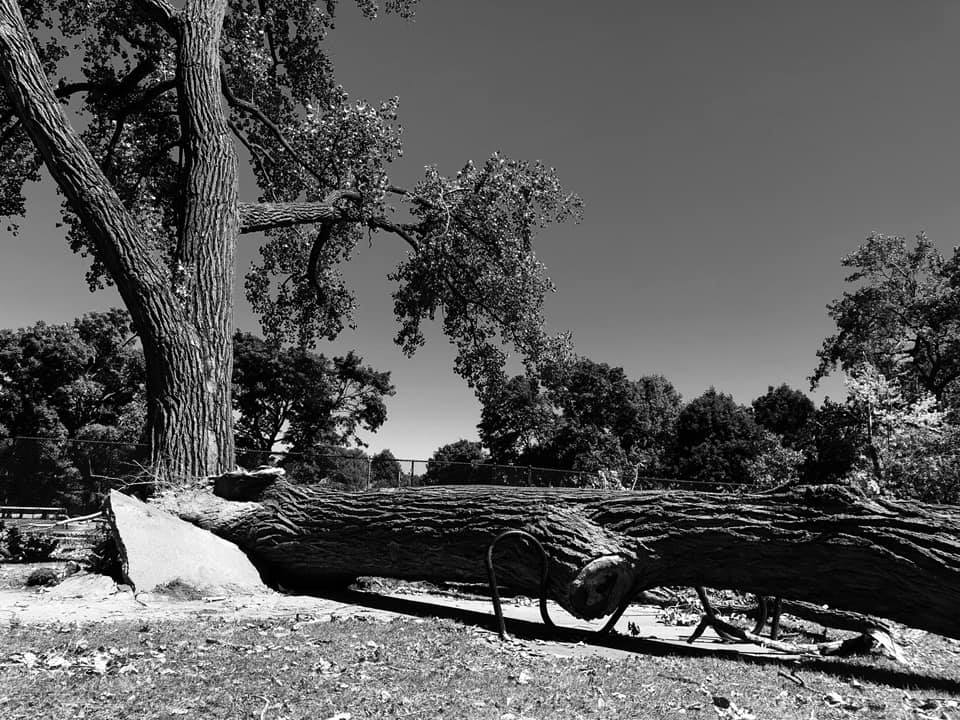
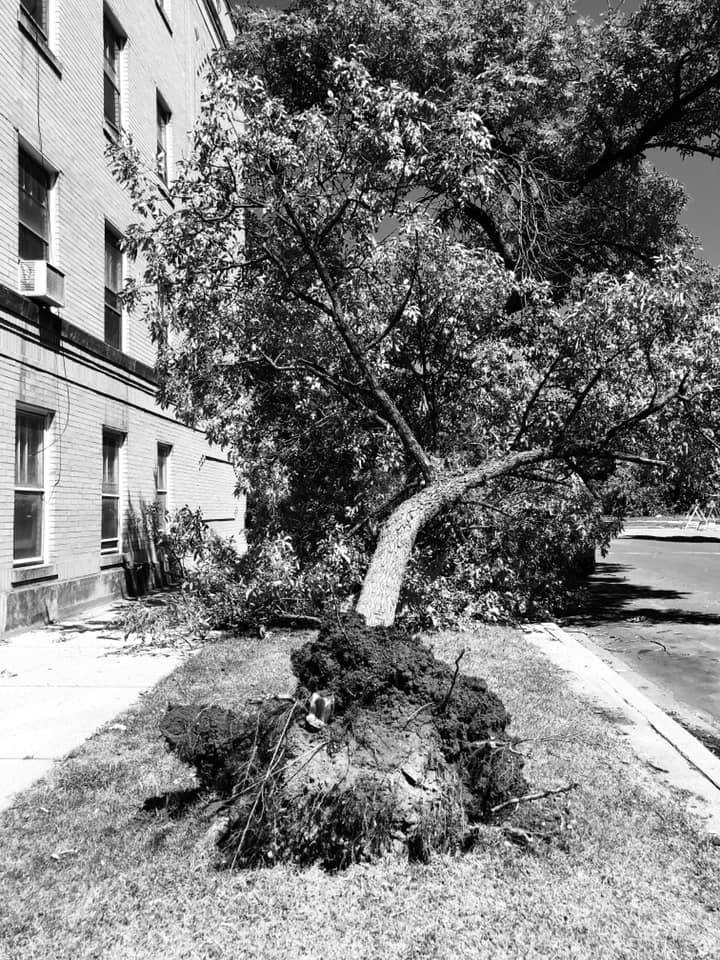
This morning was bright, sunny and unscheduled, so I convinced the kids to check out Rogers Park with me, a sprawling city park full of soccer fields, tennis courts, a playground, baseball fields, and a perimeter of massive mature trees. After I learned yesterday on Twitter that there was an honest to goodness tornado smack dab in the middle of that derecho that clocked in with 110 mph winds and touched down in the park just three blocks from our home, we walked over to survey the damage. I was not prepared for what I saw.
There is something visceral and profound when seeing what was once a collection of stately, dignified trees that, in a matter of minutes (seconds?) of devastating wind, have become uprooted and felled, no match for the cyclone that whipped through the neighborhood before circling out over Lake Michigan.
A hundred plus years of roots and growth are gone, violently, in an instant. It looked like arboreal hari kari writ large.
Walking through the fields, I had to watch carefully where I put my feet because the grass is strewn with roofing shingles, random pieces of what looks like dried insulation, metal remnants of street lights, and jagged branches that will smack you in the face if you step on them just so. A hurt and sadness grew in me in that grass, with my ginger steps working to avoid the botanic debris in every direction.
My older boy was satisfied to peer from across the street, but he reluctantly, at my request, joined his brother and I as we crossed into the devastation. He left within minutes. He was out, he’d had enough, just like the trees. I get it.
Looking around me as we walked through what can only be described as a tree cemetery, I couldn’t stop thinking of the glaring metaphors those unmoored trees presented in the midst of the chaos of 2020. It’s twee and maudlin and every other Victorian era word used to describe overwhelming self-involved sentiment, but gotdamm, self-involved sentiment is what I’ve got right now. I blame too much time alone, away from other humans whose socks I do not launder.
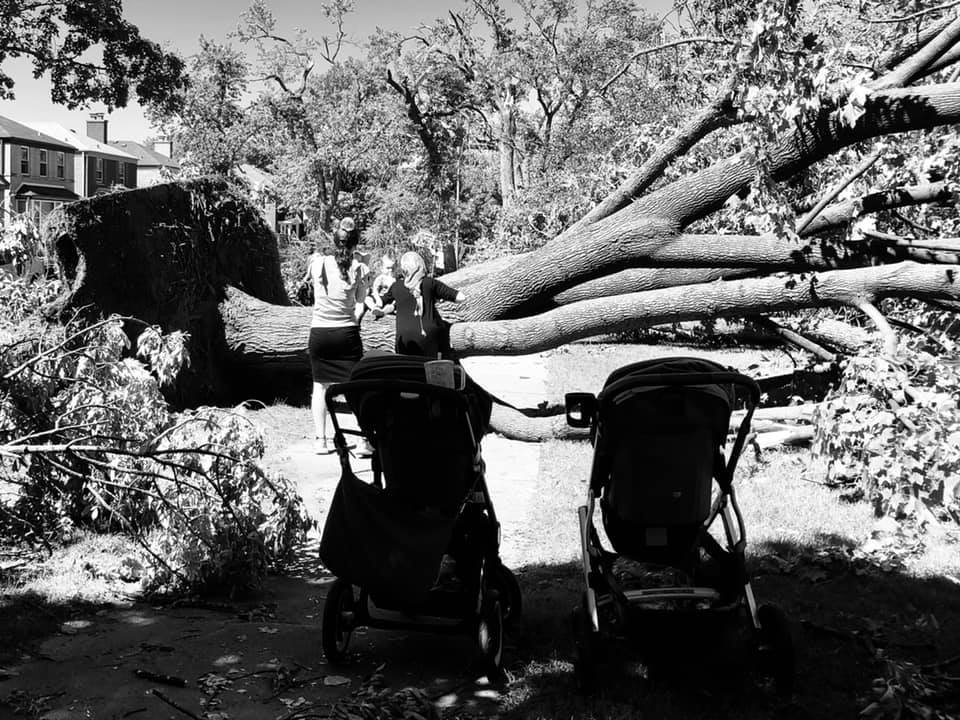
I feel those trees deeply. I relate to those roots, upturned and homeless, crying out for dirt and dark, just epically out of their element, left to languish and be gawked at, reduced to being the latest neighborhood selfie station in our Instagram world.
These young mothers popped their babies on the fallen limbs to snap their photos and remarked how “cool” the scene was.
Two weeks ago, George Floyd died in police custody. A Minneapolis police officer used a restraining tactic of placing a knee on his neck, applying pressure for 8 minutes and 46 seconds. Mr. Floyd was unconscious for nearly three of those minutes and for a full minute after EMTs arrived on the scene to provide medical care. Among his last words, George Floyd called out for his Mama.
Earlier that same day, Monday, May 25, 2020, Amy Cooper called 911 after a man requested she leash her dog while walking through the Ramble, a popular destination in New York’s Central Park. The two were alone in the area, beloved by bird watchers. Instead of complying with the law and leashing her dog, Amy Cooper instead called 911, raising her voice, sounding fearful and hysterial, reporting that an “African American” man was “threatening” her life.
In these instances, white people contributed to the trauma and death of Black Americans. Why? Because of racism, one of America’s original and seemingly intractable sins.
In the two weeks since, America has marched, gathered, protested, rioted, looted, took a knee, took a stand, yelled, denied, assembled, honked, held up a fist, threw bottles, ran away in fear, and been pushed in a thousand different ways — good and bad.
Friday afternoon, the hashtag #IAmASuburbanMom started trending on Twitter. That same day and through yesterday, I noticed pictures popping up in my social media feeds of protests in predominately white suburbs and neighborhoods of Chicago. I also saw photos and reports of anti-racism protests in small “sundown towns” in different states, referring to towns that Black Americans know are unsafe for them to be out in or travel through after the sun sets.
Is the tide turning? Maybe. Maybe not. As always, I choose hope.
Taken at a “Honk-In” protest in my Chicago neighborhood on Friday, June 5, 2020.
In that vein, I realized that a lot of folks, like those suburban moms and folks living in predominantly white locales, were looking to educate themselves and learn more about systemic racism and police brutality in America. I also know that most of my readers are white women and mothers and in a unique position to redefine and shape what their children are learning and exposed to about the truth and extent of racism and police brutality in America.
There is a lot of emotional labor involved in asking your BIPOC (Black, Indigenous, People of Color) friends and family to educate you about what they experience as a a matter of walking through their lives and days. Instead, white folks must learn to educate themselves and take the proverbial bull by the horns in working to understand racism and police brutality and how these ingrained systems can begin to be dismantled and changed.
Here are some resources that can be used by you and those in your circles. These are not exhaustive in any way, but they are a great place to start and learn. Share the information, start discussions or reading groups, talk with your kids and their teachers. Take a risk and challenge your uncle (cause we all have that uncle, right?) at the next holiday gathering.
Speaking up and showing up is so important. I stopped speaking up and showing up in this space regularly a few years ago after this President was elected. I regret it and am ashamed of it, but guilt is useless. What matters more is what you do today, tomorrow, and moving forward. Use your voice, use your power to change this world we share. Here is a place to start, read, and learn:
A Tale of Two Chicagos – a personal reflection on growing up white in Chicago and the racism that goes along with that
Another thing that has helped me tremendously is following along on #BlackTwitter. I guarantee you, it will be a gut punch of awakening, but crucial to grow and learn and evolve in the effort to be anti-racist. #BlackTwitter gives white people the invaluable opportunity to be the fly on the wall. Listen and learn, less speaking and more reading. That pit of defensiveness in your stomach may be very apparent. I encourage you not to act on that. Sit with it. Examine it. Try and understand it.
Also crucial to understand that Black Americans are not a monolith — there are progressive voices and conservative voices and young voices and old voices and male voices and female voices and LGBTQ+ voices represented here, but it barely scratches the surface of what can be learned by listening to and following Black voices on Twitter.





 Mary Tyler Mom