6 Valuable Tips for Talking About Race With Young Children

I live in Chicago, one of the most racially and class based segregated cities in America.  Knowing this, and loving this city despite its deep flaws, when we purchased a home, my husband and I opted to find a neighborhood that was diverse, both economically and racially.  It was no easy feat.

When we started raising children together, including one that came to us through adoption, the racial divide was seen in a stronger light.  When you adopt, part of the process is sitting down and considering who to adopt — a sick child?  a foster child?  an older child?  an African American child?  a Latino child?  a biracial child?

I can’t lie — having to provide an answer to those kinds of questions is like putting a magnification mirror right on up to your heart and conscience.  Answering those questions also forces a discussion about race that many folks might never engage in through their lives.  But why?  Why don’t we talk more about race in America?  I think the honest answer is because it is hard.  Really hard.

Recently, I had the opportunity to interview Dr. Jean Robbins, Head of the Early Childhood Division at Catherine Cook School in Chicago, who has expertise in this area.  If you want to talk about race and children, this is your gal.  Dr. Robbins has developed  a six point list of tips about how to address the subject with young children.  I find her tips to be concrete, accessible, and easy to implement. Here they are:

TIP 1: START EARLY

By the age of 3, children are noticing physical differences among people, including skin color. Many parents cringe when children (loudly) comment about these differences, when they should instead, very matter-of-factly, open up the discussion and know that their children can handle its complexity. For example, parents can simply explain to children, “an African American is someone who usually has brown skin and has great-great-grandmas or grandpas who came from Africa. All of our families came from a different country at some point!” Parents should also be aware that children can be very literal when it comes to race, so anyone with brown skin might then be African American to them.

My Son's hand atop the hand of his part-time caregiver.
My Son’s hand atop the hand of his part-time caregiver.

TIP 2: DO NOT SHY AWAY

Many parents are afraid to say the wrong thing, so they avoid conversations about race, but their silence sends unintended messages to kids. Silence tells kids that there is something wrong with or negative about people of color. Talking about race, on the other hand, stimulates curiosity and minimizes fears about race.

TIP 3: DRAW THE BIGGER PICTURE

There are daily opportunities to celebrate diversity and there is no need to wait for Black History Month. For example, taking your kids to museums, restaurants and cultural events across the city, or, watching movies and reading books about children from other cultures are all ways to increase awareness. Some museums, libraries, and cultural institutions offer free informative events for families during Black History Month.

TIP 4: BROADEN THE LESSON

Children like to learn about topics as they relate to their own lives. By framing American history around ideas of conflict, fairness, and sharing, even young children can understand lessons about any historical period. Keep it simple, but be accurate and honest. For example, maybe you pose a question to your child: “People who owned slave didn’t want to do the hard work and didn’t’ share the money with the slaves. Do you think that was fair?” This will open up broader discussions and encourage critical thinking.

TIP 5: MODEL LEARNING

Parents are examples for their children, and can be models of learning and curiosity. It is okay for parents to admit when they do not know something, and then suggest to their children that they find out together. Parents should not be afraid to say, “let me think about that” or “I’m not sure, let’s find out together!” A family visit to the library is a great way place to start.

TIP 6: ENCOURAGE SELF-EXPLORATION

We all bring diversity in one sense or another. Parents and teachers can encourage students to explore their own identities and reflect on what they learn about themselves. At Catherine Cook School, a Diversity Committee composed of parents, teacher, board members, administrators and staff members work together to integrate diversity themes, topics and activities into the curriculum starting in preschool. Together, we can teach children about their cultural and ethnic identities, even through cultural traditions such as cooking or the clothes we wear.

After our conversation, I was struck by just how rare it is to have a discussion solely about race, especially with someone of a different race. We need to change that.

One thing that struck me in our conversation was hearing Dr. Robbins acknowledge that for children, it can be hard to make the right choices — hard to share, hard to include all children, hard to always listen to our parents.  It is the same for us as adults.  It can be hard to always do the right thing or make the right choices. There is a parallel process there that we should not discount.  Discussion about race and acknowledging differences are hard, but so very valuable in the long run. From Dr. Robbins, “I’m the same.  My experience is different.  What is the sweet spot where we can connect?”

“Children will yell out.  ‘You are black!’ ‘Why is your hair so fuzzy?’  It will frighten teachers and adults.  But they are celebrating words and language. Encourage them to express their curiosity.  Children notice reality.”  Amen. Don’t assume, for whatever reason, that there is no reason to discuss race with your children.  As Dr. Robbins suggests, “Be ready to talk.  Ask questions, guide conversations, provide experiences, read books.  There is no excuse for not accessing materials about others.”
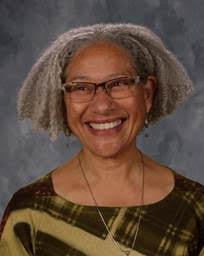
Dr. Jean Robbins

Dr. Jean Robbins has been the Head of the Early Childhood Division at Catherine Cook School since 2007, and has established best classroom practices, curriculum and supervision measures to make the school a leader in high-quality early childhood programming. Dr. Robbins holds a doctorate in Child Development from the Erikson Institute, an M.B.A. from Columbia University in New York and a Bachelor’s degree in Psychology from Smith College. Before coming to Catherine Cook School, she worked as a researcher on a variety of studies, including a national home-visiting program, an early childhood teacher preparation and diversity study in the U.S., and an early literacy and play study for Yale University. Dr. Robbins also served as Director of the Parents as Teachers First program at Chicago Public Schools, which was a citywide early childhood home visiting program.

Being a Real Mom

Earlier today a stranger on Facebook accused me of not being my youngest son’s “real” mom, my youngest son being adopted.  I deleted the post immediately.  I didn’t engage the stranger, didn’t argue the point, and won’t tolerate that nonsense.

I’ve been exposed to Internet hate before.  It’s anonymous and angry and the rule is that you’re supposed to ignore it.  For the most part, I do, but don’t kid yourselves.  If you are repeatedly the target of hate, even anonymous and virtual hate, it can have a negative and potentially harmful impact on you.

I’ve written about controversial issues in the past. Guns.  Abortion.  Politics. Adoption. And, yes, adoption is controversial.  I didn’t realize that before I became a part of the adoption community.  I was naive enough to write about our family’s wish to adopt, not thinking anything of it, full of hope and good intentions.

The Internet schooled me.

That schooling took a toll on me, despite my best efforts for it not to have an impact. For the record, after coming to adoption, I more fully appreciate the nuances and complicated nature of adoption. It’s not a black and white issue and there is tremendous pain and loss attached to it from everyone involved.

I’ve witnessed pain experienced from every side of the adoption triad — birth parents, adoptive parents, and adoptees.  I get it.  I’ve lived it.  And you just need to believe me on this front, as I will never, ever publicly reveal details about my personal experience with adoption, as they would hurt my child.

A real mother does not intentionally hurt her child.

A real mother anticipates her child’s needs.

A real mother protects her child from needless pain and conflict.

real-definition-black

There are times I am vulnerable enough to give in to the burden of the labels I carry.  It is terrifying to be a Cancer Mom.  It is complicated to be an adoptive mom.  It is relentless to be a grieving mom.  I am all of those things.

Somedays I would give anything to be none of those things.  Somedays I celebrate how being those things has shaped me in profound ways.

Because I have seen a child from birth to death, lowering her body into the ground with my own arms, I know I have strength.  Because I have stood in line at the Walgreen’s, trying to fill the prescriptions of my son’s Birth Mother while she sat in a room, holding the child she had just birthed, and signed form after form confirming her choice to place that child in the hands of another, I have humility.  Because I wake up each and every day bearing the weight of grief and loss of a child, but still manage to dress the kids and pack the lunches and fold the laundry, I have resolve.

Those experiences, painful and hard as they might be, give me perspective, something many people blissfully pass through this life without.  I rely on that perspective to cope with things like the Internet hate of strangers, or, at times, even the ill will of someone I know personally.

When someone suggests, because my youngest came to me through adoption, that I am not his “real” mom, I know better.  The hate in those words, the intent behind them — to undermine and intimidate, give me pause, to be sure, but armed with my life’s experiences and perspective, I know enough to reject them.

I am a real mom to all of my children.

These words I write tonight are as much for me as they are for those women sitting at home reading them, who came to motherhood through a different means and have had their status called into question.  You are a real mother.  People use the premise of “real” motherhood to hurt and belittle and diminish, but they are not true.

I’ve had enough of remaining silent on this issue, holding my tongue in favor of being diplomatic, empathic, sensitive, or thinking it was what my son needed.  What my son needs is a mom. That happens to be me, not through biology, but through love and care and connection.

And me being “Mom” in no way lessens the role my son’s First Mother had.  One is not better or worse, more or less significant.  The roles are separate, different, and necessarily dependent on one another.

I am as real as it gets.  I bleed, I poop, I feel.  I care for all my children — those I gave birth to and the one that grew in another woman’s womb. They are all mine and I love them each the best I can — with confidence, with compassion, with certainty.

People can try to diminish that love, but they will fail because they come from a place of ignorance and hate.  This real mom knows better.

A Tale of Two Chicagos

NOTE:  This blog post was honored with the Peter Lisagor Award for Best Individual Blog Post, Independent 2015 by the Chicago Headline Club and the Society of Professional Journalists.  

One of my potent memories of childhood is packing into whatever used Cadillac my Dad was driving at the time for a weekend day trip, Montovani or Percy Faith playing on the 8 track. We lived in the southern suburbs and would snake up the Dan Ryan, the most infamous of Chicago’s expressways, and head north.  My Dad was always behind the wheel and the windows were usually down, as both my parents smoked.

It was not uncommon for my Dad to exit at the Robert Taylor Homes, in the Bronzeville neighborhood.  These were a collection of high rise housing projects made warm and fuzzy by the 1970s sitcom, Good Times, but in actuality were a vertical concentration of poverty, unemployment, crime, and violence.  And, yes, the windows went up, and the doors were locked.  My young heart beat faster in the few minutes we drove down State Street before re-entering the expressway north.  The buildings were enormous and barren and monolithic and terrifying.  Even as a child, I recognized the disparity between “us” and “them.”  Even as a child, I thought in those terms, “us” and “them.”

Was that racist?  Yes, I think so.  How could it not be?  Every face staring back at me from the other side of the window was black.  I never recall my parents or any of us saying much of anything as we drove down those intimidating streets.  There were no racial slurs on those drives.  Just quiet and heaviness.  I have no doubt that we all breathed a sigh of relief as we got back on the expressway.  Was that racist, too?  Yes, it was.

Those drives would continue all the way north, eventually winding through the posh, leafy suburbs of Chicago’s North Shore.  Places with names like Lake Forest, Kenilworth, Glencoe, Winnetka.  The juxtaposition between the extremes of Chicago’s poverty stricken south side and its tony North Shore estates were jarring then, just as they are jarring now.  Chicago’s disparity of wealth has not changed, other than becoming more intractable.

An important point to make, too, is that my heart raced as fast in those leafy wide lanes along Lake Michigan’s shore, just as they did in the Robert Taylor Homes. The sense of “us” and “them” was absolutely no different as I watched the people in tennis skirts, Lily Pulitzer prints, and pink oxford cloth on the other side of the window.

Was that classist?  Yes, I think so.  How could it not be?  Every face staring back at me from the other side of the window was rich.  I never recall my parents or any of us saying much of anything as we drove down those intimidating streets.  There were no class slurs on those drives.  Just quiet and heaviness.  I have no doubt that we all breathed a sigh of relief as we got back on the expressway.  Was that classist, too?  Yes, it was.

When my Dad died last spring, I prepared a eulogy for his service.  Those long drives on rainy or sunny weekend afternoons would factor prominently in how I remembered my Dad.  I thought of those drives as a lesson my Dad was giving, not in words, but in drives, about some people having more than us and some people having less than us and that we should be grateful for what we had, modest as it might have been in a working class suburb filled with ethnic whites with Polish and Irish and German surnames.

My sister had a completely different take on those drives.  For her, they were about my Dad laying Chicago at our feet — all of it — the good and bad, posh and poor, ugly and beautiful, dangerous and refined, black and white, that Chicago had to offer.  All of it was ours.  We had as much stake in what happened at the Robert Taylor Homes as we did with what was going on in Wilmette.  All of it was Chicago and all of it was our home. Ours.

Thinking about our conversation, I believe that my sister’s sense of why those drives happened was more likely.  My Dad owned every room he ever walked in.  Every single room was his.  Wealth did not intimidate him.  Poverty did not intimidate him.  Color did not intimidate him.  A person’s circumstances, blessed or damned, did not intimidate him.  He was just as likely to strike up conversation with the black man on the street corner as he was the white man dining al fresco and find value in both.

I thought of my Dad last week as I made a drive down that same Dan Ryan expressway, this time headed south, not north, with the Englewood neighborhood as my destination.  I was hoping to talk with Tamar Manasseh, founder of Mothers Against Senseless Killings (MASK).  I had read a news report about Tamar and her efforts to create a grassroots network of moms patrolling violence plagued intersections on the south side in an effort to discourage gun and gang violence.  The mere idea astounded me and galvanized me simultaneously.  Motherhood is a powerful thing and Tamar was proving that.  (You can read my companion interview with Tamar HERE.)

Tamar Manasseh, founder of Mothers Against Senseless Killings (MASK) and the activist behind Moms on Patrol.

I’m not going to lie, as I exited the expressway, that rapid heartbeat I had felt as a girl on those drives returned.  I don’t recall ever feeling quite that well intentioned or quite that white — the embarrassing stereotype of the Lake Shore Liberal come to life.  Yep, that’s me.

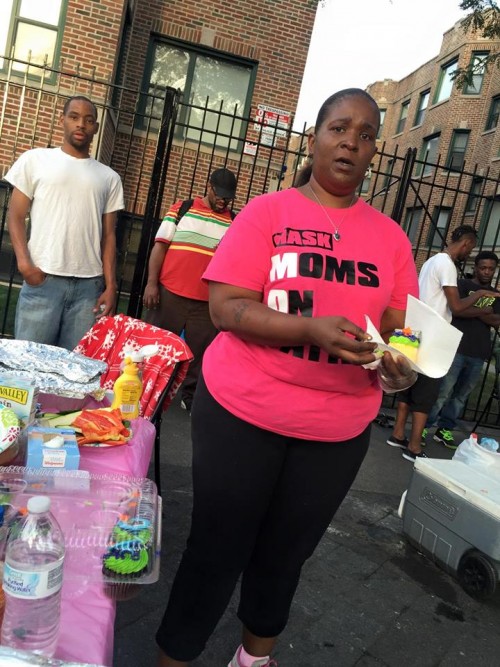
It was easy to spot the volunteers dressed in their hot pink t-shirts.  I turned onto Stewart and parked my ridiculous mom car.  True to form, I had brought along water and cupcakes to share.  WHO DOESN’T LIKE CUPCAKES?  Again, the stereotype I am makes me cringe at times.  I was grateful when a young man approached me.  It was clear that he was familiar with the somewhat pensive looking white lady type that I was.  With increasing coverage, more and more volunteers and donations are coming in to support the efforts of MASK.

Armed with a notepad and my iPhone, I set about the business of finding people who would talk to me.  It was easier than I thought.  The legit reporters with trucks and microphones and fancy cameras were across the street, panning the scene.  I was crouched on my knees, something no 45 year old woman can do for too long. People were happy to talk with me.

Tracy, PR Coordinator for MASK, and volunteer Mary.

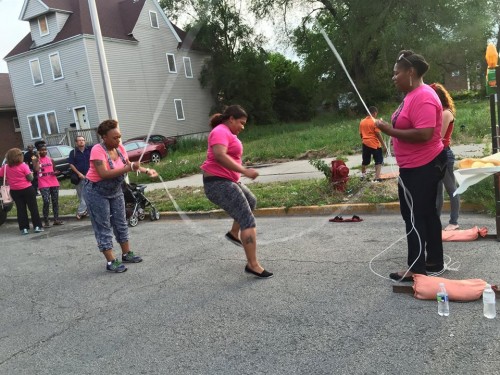
There was Mary, a volunteer since the effort started on June 29th after the shooting death of a young woman.  Mary’s son was murdered in 2001.  She runs a weekly grief support group at Mercy Hospital.  There was Tracy, a PR executive who volunteers for the campaign every night and manages their social media.  She wanted me to know about the transformation of the young men with gang affiliations who were now regularly coming by to be a part of the nightly watch.  As a sign of respect and cooperation, they were pulling up their pants and wearing shirts.  These things made them less threatening to their neighbors.

Tamar and her cousin Eddie.

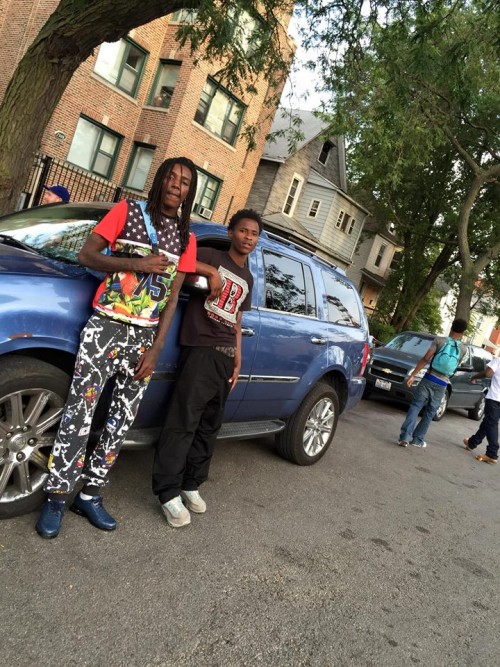
There was Eddie, Tamar’s cousin, who joined the Nation of Islam at 15 years old, three years after his own father was murdered.  There were two young men with dread locks who would not give me their names, but who believed that it would be “business as usual” once the moms packed up and went home.  There was the family down the street who did not want me to photograph them as there were drugs on the porch, but they talked to me about being able to let their little ones up and down the street this summer — something that had not been possible before.  There were the double dutch jumpers, middle aged women just like me, enjoying the pastime of their childhood, if a little more rusty at it.

Double Dutch on the corner of 75th and Stewart.
Dreads and cool threads.

There is no question to me that Chicago is deeply divided.  Talking with the good folks gathered at 75th and Stewart last week was like breathing air into a news report.  The “us” and “them” of my youth absolutely exists, but in those 90 minutes I was there, it was suspended.  What separates us is color and opportunity and school quality and access to resources and lack of hope and fear and racist institutions and drugs and crime and so many other factors that are too many to name.

Just as my Dad taught me on those drives so many years ago, this is “our” Chicago, not “theirs.”  When we acknowledge that what happens in Woodlawn and Englewood is just as relevant as what happens in Lincoln Park or North Center, and that the tragedy of one neighborhood is the tragedy of our entire city, only then can we truly call ourselves a Chicagoan.

Kim D, manning the food tables that provide a nightly dinner for volunteers and local neighbors.

If you would like to help the efforts of MASK, click here.

**********

You know who can subscribe to my blog?  ANYONE!  You don’t even have to be from Chicago.  Here is how:

Type your email address in the box and click the “create subscription” button. My list is completely spam free, and you can opt out at any time.