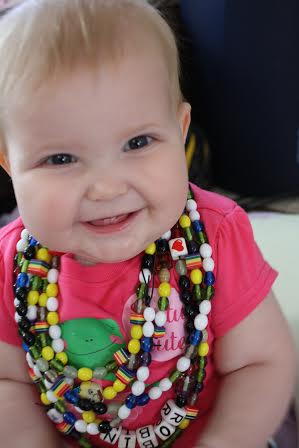
Peyton’s Story: The Definition of Hope

September is Childhood Cancer Awareness Month. Each day a different guest blogger will be featured who will generously share their personal experience with childhood cancer.  Stories are always more potent than statistics.     

By Lisa Hall 

September is Childhood Cancer Awareness Month! September is Childhood Cancer Awareness Month!

This is my mantra every September as soon as I found out that this is indeed an important month to recognize children and the challenges they face struggling with cancer. I share this on my Facebook page, I share this at my work and I share this to the public as I email government officials asking them to make  the above statement in front of other Government members.  I would like other people to proclaim this and not just because they are a parent who received the news, “there is a mass in your daughter’s head and we can’t remove it.”

This is the moment of greatest impact for us, my husband and I. We had many, many, many moments that hit us in the gut. For instance, when Peyton had to get her radiation mask made.  What a difference there is between a children’s hospital and an adult cancer institute.

At the children’s hospital, she received some lovely sleepy gas for her first ever sedation.  At the adult cancer institute they don’t house the gas for children. They poke a 4 yr old child repeatedly (who is screaming and crying) until they find her tiny vein. Then tell me, “Good job, Mom!” Then Mom has to walk into a waiting room where Dad is white hot mad because he could hear our little daughter screaming and crying and he was helpless.

That’s the story I am going to share with you. The first moment we felt completely helpless and hopeless.

In May 2010 I had noticed a slight eye turn in Peyton. It wasn’t something I could just ignore, so I booked an appointment with an eye doctor. Initially the optometrist said she would just need glasses for a far sighted condition. I just needed to bring her back in a week to be fitted for glasses.

One week later there is a head tilt as well as the eye turn. The optometrist books an appointment for us to see an ophthalmologist in just under three months, stating that she thinks there may be a greater need to have the eye turn examined. That it’s a pretty normal occurrence and easily fixable. The tilt? Well that’s just Peyton compensating for the eye turn.

PEYTON1

August 4, 2010. By now the eye turn and head tilt remained and now Peyton started to have a slight facial droop. We didn’t notice it at the time but as we look at the Canada Day picture above, it is clearly there. We spent hours in the waiting room of the ophthalmologist and when he did see Peyton he was quick to notice the head tilt and the facial droop. His best guess was that she had palsy of the 7th or 8th nerve in her brain. He called down to the connecting children’s hospital and told the doctors that our daughter needed to be seen NOW. We even had a security escort through the winding corridors to the emergency room of our children’s hospital.

When family arrived to provide some support, my husband and I went out into the parking lot and I broke down and cried. I was terrified that she might have to have her brain cut in to. Why did this happen? I wept. I worried. What I would give today for it to be just a palsy of the 7th or 8th nerve.

A couple  of days later, we are brought in for Peyton’s MRI and she is kindly and gently put under with gas before being poked and sedated. When she woke we were in for an incredibly huge surprise. We hear screaming, we hear yelling. I am brought into the recovery area to a manic child. ‘This is not my daughter,’ I think to myself, ‘What has happened?! Why is she like this?’

Peyton is beside herself and she cannot be calmed no matter what motherly technique I try. I feel absolutely helpless. Little did I know at that moment that that was a small taste of what “helpless” actually is.  A nurse and I strap her into a stroller for safe transport up to her room.  We are literally walking like we are training for the speed walkers championship for the elevator.  A doctor in scrubs comes running alongside us. My husband looks at her and demands to know why our child is acting this way. We are told right there, in a corridor of the hospital, steps away from an elevator that will whisk us off to a place where I can hold my child and comfort her….”there is a mass in her brain. It swelled up during the MRI and this is what is causing her to act in this manner. When we get her upstairs we will give her steroids to relieve the swelling.”

No time to process this. No time to cry. No time to actually breath.

Helpless, definition:  1. unable to help oneself; weak or dependent. 2. without aid or protection. 3. deprived of strength or power; powerless; incapacitated: 4. affording no help.

In that moment we were all of these things.  “There is a mass in her brain.” The next hit came when they actually described to us the type of brain cancer our sweet daughter had. DIPG. She’s is terminal. Helpless. The average survival is 6-8 months.

Helpless is now coupled with the word hopeless.

Hopeless, definition: 
1. Having no hope; despairing.
2. Characterized by despair.
3. Having no possibility of being solved or dealt with; impossible.
4. Having no hope or chance of changing or improving

The story could end there. We chose for it not to.

Disney smooches from Mom and Dad

A new word rose up. Hope. The root of that earlier compound word that tries to strip you of your essence, but this word holds more power you see. It holds more power because with it, you gain a power inside you to muster an immeasurable amount of strength that will allow you to live through a myriad of things your four year old child will have to endure and you will be pushed to the sidelines to watch. You will find it in you to cheer and laugh. You need hope because (as stated in a quote I once read), you never know what tomorrow will bring.

So we made many, many memories. We found joy. We welcomed a new sister for Peyton. We endured because of hope. Peyton beat the average. She had a honeymoon phase for a delightful 12 months before the smallest of changes began to occur again. She remained with us 19 months after diagnosis and left us full of hope even after she left this world March 2, 2012.

My hope is a different kind now. I have many different hopes. I suppose those are what get me out of bed on the hardest days. But it is the strongest and most resilient word in the Cancer world.

Thank you for letting me share our story.
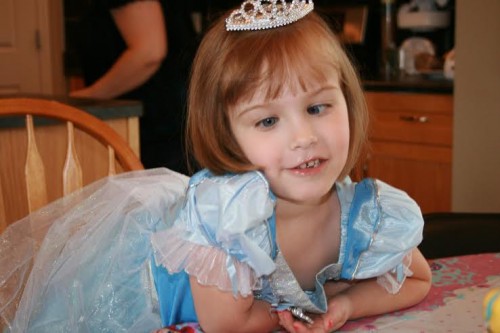
PEYTON3

**********

If you don’t want to miss a single entry in the September Series, consider subscribing to my blog.  Here is how: Type your email address in the box and click the “create subscription” button. My list is completely spam free, and you can opt out at any time.

Mighty Mikey’s Story: The Blink of an Eye

September is Childhood Cancer Awareness Month. Each day a different guest blogger will be featured who will generously share their personal experience with childhood cancer.  Stories are always more potent than statistics.     

By Chrissie Lograno-Weinstein 

I always said things change in the blink of an eye. It was true for Michael’s diagnosis and was certainly true during his cancer journey. We were reminded of that again in July, 2014 when Michael was eight years old & had been fighting brain and spine cancer, Diffuse Oligodendroglial-like Leptomeningial Tumors to be exact, for almost six years.

As of July, 2014 he had been on five chemo protocols which added up to more than 48 months on chemo, he had more than ten surgeries and was diagnosed with Autism, Cerebral Cognitive Affective Syndrome (essentially a TBI caused by the tumor) and Gastroparesis due to the brain tumor shutting down his gastrointestinal system.

Mikey in the transport van to Hospice House, May 2015

In February of 2014, while on chemo, Mikey’s tumors started hemorrhaging in his spine. His immune system was depleted, which made surgery much more risky. Thankfully, they were able to stop the bleeding and get a piece of tumor to do testing on. In talking to our teams at MSKCC, All Children’s and Golisano Children’s in March, after he recovered from surgery, we all felt that his tumor was so slow growing that he could stay stable enough to bounce back a little, get stronger, and buy us time to come up with a plan. We made the decision to take a break from treatment and just control pain and manage symptoms until scans in August.

On July 20th the palliative care doctor, Dr. Mac, came to our house. Michael’s decline was so atypical of a brain tumor patient & we knew we could be dealing with the slow and steady decline for years. Dr. Mac determined that Michael, who was chasing Katie & Timmy around the house during his exam, was still stable enough to be considered on ‘comfort care’ and hospice wasn’t necessary yet. We breathed a sigh of relief at the stability of our situation.

Four days later, in the blink of an eye, our world crashed right in front of us shortly after bedtime. Matthew and I both noticed a change in Michael’s breathing. I didn’t know what was causing it or why it was happening so I called Dr. Mac. I wasn’t sure how to describe it to him other than to say, ‘he’s taking 2 breaths then not breathing, then 2 breaths and not breathing’. The time in between breaths was just ten seconds when I timed them, but they felt like ten minutes.

With Dr. Mac on the phone, Matthew and I changed Michael’s position, we moved him from side to side and we elevated his head more. His breathing was more regular as we did that. On the phone that night Dr. Mac told me our game plan had changed and he would be out that weekend to talk to us about Hospice care.

On Sunday, July 27, 2014 Matthew and I met with Dr. Mac around our dining room table. My aunt took Katie and Timmy for the morning so we could talk while Michael slept. Words like Hospice, vagus nerve and DNR were discussed in the same place we had breakfast that morning.

In doing an exam and knowing the diffuse nature of Michael’s tumor, Dr. Mac said that the tumors were likely causing more pressure on the vagus nerve. We knew of vagus nerve involvement from the diagnosis of Gastroparesis in November of 2013, but we hadn’t expected much more to be affected so soon.

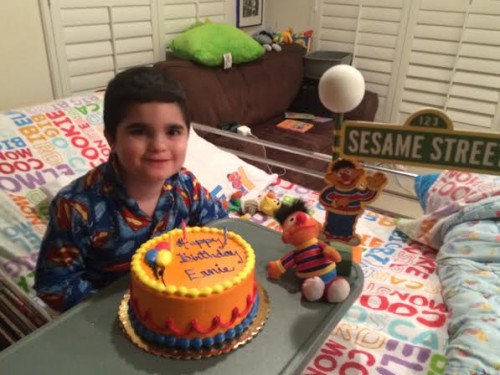
I couldn’t breathe. Hospice. Seriously? My son? He was only eight. He laughed and played and chased his brother and sister around the house. He lived up to his nickname of Mighty Mikey in every way. He taught his grandparents how to use an iPad for FaceTime and iMessage. He shopped on Amazon and E-bay like it was a full time job. He idolized anything Jim Henson created and sang Sesame Street and Muppet songs every waking hour. He had a larger than life personality and a hug that could melt the coldest of hearts. He was going to be the next Ernie Puppeteer on Sesame Street.

Mikey celebrating Ernie's Birthday.  Yes, Ernie's.
Mikey celebrating Ernie’s Birthday. Yes, Ernie’s.

Hospice? My son? Impossible. I couldn’t wrap my head around it. We didn’t tell anyone but our immediate family. In my head I felt like once we told other people it would be real. And it couldn’t be real.

Five days later Michael and I flew home to NYC where we met with his primary neuro-oncologist who agreed with Dr. Mac. We both said this was the conversation we hoped to never have. The vagus nerve was so compromised that the decline we would begin to see was going to happen faster than we had been accustomed to and cause more and more life threatening issues until, one day, the vagus nerve would damage so much that his body wouldn’t be able to compensate anymore.

No one could give us a specific time frame. We were told he probably had longer than six months, but he most likely wouldn’t be here the next summer. We were told to think about how we wanted to proceed, to decide what measures we wanted to allow to be taken.

We cried and hugged our neuro-oncology team in MSKCC, spent some time in our hometown of Rockaway Beach, NYC with family and our closest friends. Michael’s dream came true that week when an amazing friend took him to Jim Henson Company Workshop where he was able to actually see and touch the puppets he loved so much and considered his friends.

We flew home after a few days back in NYC. The reality was hitting. The DNR was signed after many tears and a lot of thinking. We had to deal with the fact that the brain cancer that was diagnosed when my little boy wasn’t even 3 yet, was destroying the one nerve that controls so much of the body. It had already taken over his gastrointestinal tract causing him to vomit upwards of 10 times a day. It was causing changes in his breathing that the doctors told us were only going to get worse. Over the course of the next nine months his legs stopped working; he developed tremors in his arms, hands and legs; his breathing got worse; his kidneys started failing.

Mikey celebrating his 9th birthday in Disney World with sister Katie and brother Timmy.

Through all of that we made sure to laugh and sing and play as long as he had the energy for it. He shopped on Amazon and E-Bay. We went to Disney World to meet Constantine of the Muppets and his puppeteer. We made hand print art and plaster hand castings. We went to Busch Gardens for the sole purpose of getting a picture of him with Ernie. We celebrated his ninth birthday, while he was a hospice patient, in Disney World. We had family and friends visit. We indulged his love of all things Sesame Street and The Muppets for as long as we could.

On May 13, 2015, holding my hand, and while he was being held by Matthew and myself, Michael, our Mighty Mikey, passed away. The cancer destroyed his body and took his life. Along with Michael’s birth certificate we now have a death certificate for our nine year old that reads, Cause of Death: Cancer of the Nervous System.

**********

If you don’t want to miss a single entry in the September Series, consider subscribing to my blog.  Here is how: Type your email address in the box and click the “create subscription” button. My list is completely spam free, and you can opt out at any time.
Robin’s Story: What Is the Cancer Mom’s Club Like for a Dad?

September is Childhood Cancer Awareness Month. Each day a different guest blogger will be featured who will generously share their personal experience with childhood cancer.  Stories are always more potent than statistics.     

By Ben Ulness 

Friday the 13th of July 2012 was the worst day of my little family’s life. It was the day our youngest daughter, our baby Robin, just nine months old, was diagnosed with a rare, infant form of acute lymphoblastic leukemia (ALL). It wasn’t supposed to happen to us. Cancer in children was just something that happened in those letters you get from St. Jude’s.

But it did happen. For the next two years we watched and supported Robin in the fight for her life.

Infant ALL is monster of a disease. Unlike the famous 80% survival rate for “pediatric cancer” that is bandied about, infant leukemias have a much less favorable prognosis — somewhere in the neighborhood of 40% overall survival. Because of this disheartening statistic, and the generally aggressive nature of the disease, all of the treatment protocols are also quite aggressive.

The practical side effect of this being that Robin spent almost four of her first nine months of treatment in the hospital, with roughly half of those in isolation. Isolation was also the theme outside the hospital, for all of us. When your kid has no immune system for months at a time, it’s nearly impossible to have any form of social life. Someone is always sick. Someone’s kid always has a runny nose. Much of the time we just didn’t have it in us.

To top it off, my wife Gayle and I kind of flipped the script when it came to caregiving.  When our first daughter, Daphne, was born, we made the decision, based on practical, and personality reasons, that I would become a stay at home dad. Even though our situation was somewhat rare and led to a certain amount of social isolation, it worked out well for all involved.

When Robin was born, we didn’t think twice about the arrangement. It was simply the way we chose to live our life. What we failed to realize (because why in the hell would anyone think that way?) is just how isolating our lifestyle choice would be when coupled with a pediatric cancer diagnosis.

The pediatric cancer caregiver world, for all practical purposes, is a mom’s club. It’s not a club anyone willingly joins. It’s just a result of how society, at this point in time, seems to operate. It’s almost assumed we’ll all just fall into Ward and June Cleaver roles, with mom staying at home being the primary caregiver, and dad going to work to keep the house afloat. When you reverse those preconceived roles, many of the support structures that have been constructed to help people get through their kid’s treatment vanish.

Robin and Dad
Robin and Dad

Gayle faced the same struggles that working dads face — the pressure of supporting the family, the guilt of not being there. Along with that, she had to deal with the added stress of being a breastfeeding mom, heading to the hospital for the overnight shifts, or taking leave when Robin went on hunger strikes and would only nurse. She also found that she often didn’t fit in with the other mom groups (both in the hospital and online,) simply because their experiences were so divergent.

She didn’t know the minutiae of Robin’s treatment, wasn’t there for all the usual mom social times during the many inpatient days, and given that Robin, being a baby, went to bed early, and was often in isolation, she just plain didn’t get around enough to make too many friends. Couple that with the almost universal drifting away of pre-cancer friends, and it all added up to a very lonely time for her.

My experience was simultaneously very different and quite similar. Stay at home dads are a rare breed to begin with, and pediatric cancer stay at home dads are even more rare. So, like Gayle, I found the existing support structures didn’t really work for me. It’s not easy for dads to join in to mom’s clubs, whether inside or outside the hospital world.

I tried joining a few online support groups for primary caregivers,but between the numerous “Things only a cancer mom can know” posts and the “Men!” posts I never really felt like I belonged. In the hospital, I was asked time and again if I was giving my wife the day off. “Nope, I’ve been to all but two of her appointments.” Scheduling took months to figure out that they should call me not Gayle, even though I was listed as the primary contact person.  I would chat with people in the halls or waiting rooms, but rarely get beyond the simple pleasantries.

We were coming at the childhood cancer world from a different place. So, I put my head down and went about the job of being the best caregiver my kid could ever have. No one, I’m quite certain, sets out to exclude anyone. It’s just people come from a certain place and when your world has come crashing down around you, you feel the need to connect with people with the most similar experiences. That usually wasn’t the random stay at home dad.

ROBIN2

We stuck it out. What else were we gonna do? Lonely or marginalized, it didn’t matter, this wasn’t about us. It was about Robin.  It was about doing everything in our power to not let cancer take another baby. On July 15, 2014, Robin finished treatment. She had her trials and tribulations, but never let cancer get the best of her.  She’s our tough little bird. There’s a long road ahead of her before we can finally use that most wonderful of words…cured, but for now we move forward with hope, and cautious optimism.

********** 

If you don’t want to miss a single entry in the September Series, consider subscribing to my blog.  Here is how: Type your email address in the box and click the “create subscription” button. My list is completely spam free, and you can opt out at any time.