RIP Children’s Memorial Hospital, 1882-2012

On Saturday, June 9, 2012, Children’s Memorial Hospital will cease to exist.  The end.  No more.

In its place will be the bright and shiny, state-of-the-art Ann & Robert Lurie Children’s Hospital of Chicago.  This is not a bad thing, and in fact, is a great thing that will benefit the children of Chicago and Illinois in countless ways.  And yet, I can’t deny the sadness this brings me.  With ‘Donna’s hospital’ closing, we lose yet another link to our girl.  Indulge me as I say goodbye before I say hello.

Diagnosed at 20 months old and in treatment for the remaining 31 months of her life, Children’s Memorial became a second home to Donna.  Within those walls we heard the catastrophic words, “there is a mass in your daughter’s head.”  Within those walls we cheered as our girl learned to walk a second and third time.  Within those walls we learned how to choose hope, in desperate and dire times.  Within those walls Donna laughed and played and cried and vomited and awoke from sedation more times than I can count, always asking for pancakes and milk.  She slept and woke, ate and drank, struggled and thrived.  She would shyly smile at her doctors and nurses, she would slowly charm her art and music therapists, she would walk lap after lap around 4 West/Oncology, pushing her shopping cart, Mary Tyler Dad and I pushing her IV pole, trying to keep up.

Blessedly, Donna almost always enjoyed her time at Children’s Memorial.  It could be three in the morning, a neutrapenic fever raging inside her, and we would pull under the canopy off of Fullerton Avenue, and Donna would greet the helping hand logo with her own helping hand, stretched high in salute.  What a dear she was.

She made the rounds, you see, spending time on the neurosurgery floor after each of four tumor resections (3W fishbowl, anyone?), inpatient chemo rounds and stem cell transplant on 4,  clinic and Day Hospital for outpatient chemo, ER visits (blessedly always expedited for cancer kids) on 1, procedure suite and recovery and MRI scans on 2, the first alarmingly terrifying days in the PICU after diagnosis, and day after day at the aphaeresis unit, trying to extract the elusive healthy stem cells untouched by her chemo.  Yes, we all made the rounds.

In trying to understand why change — positive change — would make me so sad, I think it is this:  Donna was very alive at Children’s Memorial.  The closing of this structure is another loss, another connection to Donna gone, poof, gone.  Ultimately, of course, the structure is bricks and mortar, I know this, I understand this, but these particular bricks and this particular mortar hold a lifetime of memories for me.  My daughter’s lifetime, to be specific.

And Donna, unfortunately, is not unique.  She is one of not hundreds, but thousands of children that have lived and died within the walls of Children’s Memorial Hospital.  The current building was built in 1960.  It is decidedly past its prime, but at some point, it, too, was state-of-the-art.  And almost certainly, there was a grieving mom somewhere mourning the loss of the buildings that had to be razed for pediatric progress to occur in the late 1950s.  That is life and that is change and that is progress.  Oh, but all that sucks sometimes, doesn’t it?

For me, the land at the crossroads of Fullerton and Lincoln Avenues is sacred ground.  Countless children over one hundred years have died in that space.  Just as sacred are the thousands upon thousands of children whose lives were saved in that space, which is legally nothing more than an address.  The children who died there are not buried there.  There are no laws or regulations limiting the development that will follow, such as would surely be the case for a cemetery.  Calling me a bleeding heart would be accurate.  My heart hurts when I think about that ground, the lives lost and saved, the tears spilled, both of joy and of sorrow.

In the midst of all the celebration, justified as it is, I want to take a moment and think of those children that were treated at Children’s Memorial Hospital over the past century.  I want to remember the parents that stood helplessly by as their child was passed to the hands of the doctors and nurses that could or could not save them.  I want to honor the lives that were lost and the lives that were saved within those walls and on that ground.  For just a moment, I want progress and change to stop, so that we can pay homage to what came before.

So, yes, bricks and mortar, and memories that do not exist within the walls, but within the hearts and minds of doctors and nurses and janitors and moms and dads and security guards and surgeons and clerks and brothers and sisters and patients, so many patients, and all those who walked the hard tiled floors, breathing, hoping, bargaining, praying, pleading, wailing, cheering, despairing.

Before we celebrate the inevitable progress and successes and losses that will come to Lurie Children’s Hospital of Chicago, let us remember and honor what was.  Bricks and mortar, but so much more.  So very much more to so many.  Sacred ground, at the intersection of Lincoln and Fullerton, amidst the bars and the condos and the college kids.

Sacred ground.

CMH Lobby

CMH Front Hall

CMH 4W

CMH Clinic

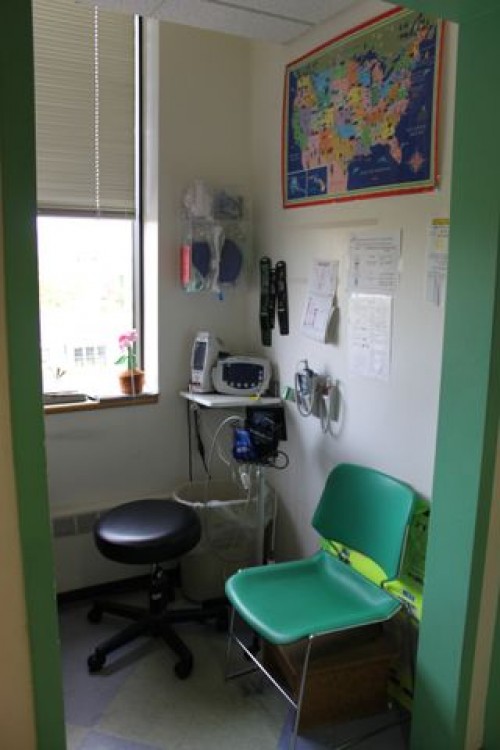
CMH Exam Room

CMH Vitals Room

CMH Purple Elevators

All photos courtesy of Lisa Watters.

You can hang with me on Facebook, or you can learn about my charity, Donna’s Good Things, or get a daily dose of Good News.  Mary Tyler Mom is one stop shopping.

Mary Tyler Mom Goes to Springfield

General Assembly
Photos by Kristen Schmid, courtesy of the University of Chicago Medicine

I’m a reformed political junkie.  Vice President of the College Democrats, yo, class of 1991.  We won’t talk about the fact that my boyfriend was a College Republican.  Somewhere along the line, I lost the faith.  Politics don’t move me the way they used to and I no longer believe what politicians tell me.  Don’t get me wrong, I vote and have opinions and still hope for brighter days, I just no longer feel politics is the way to get there.

All that went out the window when a fellow Cancer Mom contacted me in February about HB 4211, the Illinois Childhood Cancer Research Fund.  Laura, over at Ay, Mama, mother of Atia, and Director of Atia’s Project Ladybug Fund, graciously asked me if I would ever be interested in testifying in Springfield, Illinois’ capital, on behalf of an annual income tax return checkbox, enabling Illinois tax payers to donate $ to pediatric cancer research as part of their annual taxes.

Um.  Yes.  Yes, I would.

Well all of that came to fruition bright and early last Thursday morning when me and Laura made our impassioned pleas.  It was solemn, it was fun, it was empowering, it was a packed house.  I wrote in January that children with cancer need research dollars more than they need a bald Barbie.  I still stand by that and my testimony on Thursday was the proof of that snarky pudding. 

It is an emotional process to continue to tell Donna’s story.  Mary Tyler Dad and I say it is how we parent her now, and sad as that is, it is true.  In the absence of homework and tween drama and first dates and sibling squabbling, we have Donna’s Good Things.  We can’t hug Donna’s Good Things, or comfort it, or tickle it behind its ears or read it stories before bedtime, but we can nurture it.  We can support it and help it grow and develop.  It’s not enough, but it is something and it is what we have.

I am supremely grateful to Laura, my fellow Cancer Mom, herself a cancer survivor, for reaching out to me and including me and Donna’s Good Things in her initiative.  I like her.  She is smart and pragmatic.  In our first conversation she laid it out on the table:  Atia was treated at Comer Children’s Hospital at the University of Chicago; Donna was treated at Children’s Memorial, the soon to be Ann and Robert Lurie Children’s Hospital of Chicago (first week of June I will be writing about that transition).  Atia was alive; Donna was dead.  Together, we accounted for the majority of children with cancer being treated in Illinois.  She had me at “Hello,” to be honest.

Something that grieving parents fear is that their child will be forgotten.  And that is a very real possibility.  When Laura was testifying, she held beautiful Atia in her arms.  Atia shines brightly.  She is a gorgeous girl, full of life and pluck.  A lot like her Mom.  Her testimony was received well, people welling with Atia’s story, and questions were asked when she finished.  When I reached the podium, I introduced myself and opened with a punch, “My daughter, Donna Lubell, died of papillary meningioma, a rare and aggressive brain tumor, on October 19, 2009 at four years old.”  Eyes were averted.  I tried to make eye contact, but it was hard.  People don’t want to hear about children that die.  People don’t want to look a grieving parent in the eye.  It’s too harsh a reality.  Trust me, I know, I get it.  Sometimes it’s hard to look in the mirror.  Laura is not afraid to look me in the eyes.  And she appreciates the power and significance of educating people that pediatric cancer kills children.  Seven every school day.  One in five of every child diagnosed with cancer will die. 

Testimony

Donna’s story is now part of the congressional record for the State of Illinois.  That’s saying something.  And even if people could not look at me when I spoke, I could feel that they were listening.  And I could feel Donna, too, keeping me company, guiding me through the day.  And what a day it was.  I am honored to have testified beside Laura and Dr. John Cunningham, Chief of Pediatric Hemotology/Oncology at The University of Chicago Comer Children’s Hosptial in our attempt to make the Illinois Childhood Cancer Research Fund a reality.  Grateful thanks are also extended to our sponsor, Representative Cynthia Soto, of Illinois’ 4th District.  She could not be a more invested sponsor or a more gracious host to us in our visit to the Capital — even getting us a meet and greet with Govenor Quinn. 

I am so proud of what we did together, Laura and I.  I’ve said it before, but Cancer Moms are some of the most amazing people you will ever meet.  Never underestimate a Cancer Mom.  Word.  Thursday we were able to do something that could potentially make a vital difference in the lives of thousands of Illinois children.  Here’s to passage of the Illinois Childhood Cancer Research Fund, here is to the researchers that need our help, here is to the taxpayers giving generously, here is to the children, here is to Donna. 

We did it, girl. 

High Fve

Good morning, Mr. Chairman, and Committee Members. My name is Sheila and I am honored and humbled to be here today. 

My daughter, Donna Lubell, died of papillary meningioma, a rare and aggressive brain tumor, on October 19, 2009 at four years old.

Donna had an early prognosis of 2-3 months when she was diagnosed just under two years old.  Her oncologist at Children’s Memorial Hospital, the soon to be Ann and Robert Lurie Children’s Hospital of Chicago, gently told us that it would be perfectly reasonable not to treat her cancer, to bring her home and enjoy the time she had left.  We opted to treat, under the guidance of our team, and are so grateful we did. 

Though more than half her life was spent in that treatment, cancer did not define Donna.  Her bright and intelligent nature did.  Her astounding vocabulary and empathy did.  She was perfect measures of grit and grace.  She loved books and dancing and her baby brother Jay.  She was and continues to be a wonder to us and our guide.

Donna’s thirty-one months of treatment were an endurance test for our family.  They included four tumor resections, six rounds of inpatient chemotherapy, followed by six hospitalizations for neutropenia,  a stem cell transplant, twelve weeks of out-of-state proton beam radiation treatments, and four months of palliative and hospice care in our home. 

Her treatment team, lead by Dr. Stewart Goldman, had no roadmap to guide them.  There was no protocol for them to consult.  Every single treatment decision that was made was a shot in the dark, an educated guess, a hope, and a wish.  The thing that failed Donna was the science.  Her cancer was simply  better equipped than her doctors. 

Great and tremendous strides have been made in cancer research in the past few decades.  When children like Atia are diagnosed with ALL now, almost nine out of ten of them will survive.  Those are pretty good odds, until you realize that they apply to children.  Our children.  Your children.  Illinois’ children. 

I stand before you today not asking for $, but asking for opportunity.  The 248 children that were newly diagnosed with cancer at Children’s Memorial in 2011 need that opportunity.  Their families need that opportunity.  Give us this opportunity to better equip the doctors and researchers that treat our children.  Do it for Donna, and Atia, and for the thousands more that will follow them. 

My humble thanks to you.


Kids Looking Up
Things are looking up for Illinois kids.
Handshake with Quinn
Hand shake with Illinois Governor Pat Quinn
Ladies
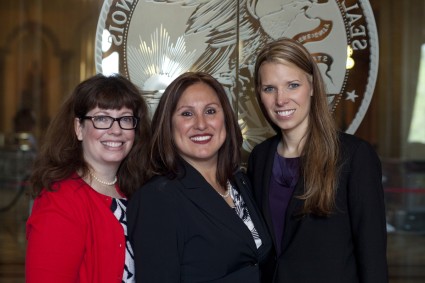
Mary Tyler Mom, Rep. Cynthia Soto, Laura of Atia’s Project Ladybug Fund

Donna’s Cancer Story: The Bubble

This is the twenty-eighth of thirty-one installments of Donna’s Cancer Story, which will appear daily in serial format through the month of September to recognize Childhood Cancer Awareness Month.  Each post will cover one month of Donna’s thirty-one months of cancer treatment. 

Swinging together 

During this period, Mary Tyler Dad and I opted to step inside what we called The Bubble.  The Bubble was a happy place.  Donna was with us there, so was Mary Tyler Son.  Cancer, the bastard, was not invited.  Yes, The Bubble was invitation only and it was an exclusive affair.  There was only room for four, so even close friends and family had to watch us from outside.  In The Bubble, it was always a perfect 75 degrees and sunny — kind of like San Diego. 

To be with Donna could be heartbreaking, and sometimes impossible, if we allowed ourselves to think about her death.  We learned to detach from the reality of her dying in her presence.  I think, if we were different parents, it could have easily gone the other way — detaching from Donna.  That was unacceptable.  She was like a joy magnet.  She kept us grounded.  She made everything bearable.  Mary Tyler Dad explains how The Bubble worked:

“You know, I’m able to forget how the situation is . . . that we’re teetering on the brink, with no way back when we fall.  It’s terrifying, of course, but it also reminds me to take as much delight as I can.  I love talking to Donna.  It breaks my heart that I can’t remember every single conversation we have, word for word, because they bring me such pleasure.  It’s easy to be exhausted, but it’s also easy to be delighted, and it’s vital to keep my head straight to let myself feel that delight.” 

The Bubble also had nothing to do with denial.  Mary Tyler Dad and I knew exactly what was happening.  We talked about it and sometimes allowed ourselves to imagine it together.  One day he recounted how he felt after taking six month old Mary Tyler Son for a walk to the park during Donna’s nap, “This is how it will be.  This is what life will be like without Donna.”  We both flirted with those thoughts.  Full disclosure, I had flirted with those thoughts since March 23, 2007.  Part of how I cope with hard things is to imagine them, try to feel and anticipate them, get comfortable with them. 

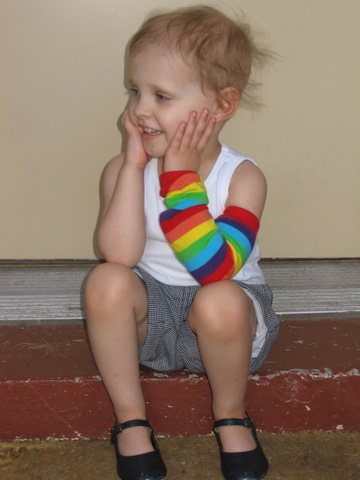
Rainbow Brite 

(Note to Cancer Parents:  baby legwarmers are fantastic picc line covers; Donna had a whole wardrobe of them that made her happy.)

So, yes, denial was not in play, but our defenses were alive and healthy.  The Bubble, because it was our defense worked beautifully.  I have some painful memories of not being very good at communicating with my closest friends or Donna’s other family during this period.  In their voices or their eyes I could see their profound sadness and loss.  I am ashamed of this, now, but shut myself down from that.  It was protective.  And, crazily, I felt responsible for their sadness.  I chose The Bubble because it was better.  Simple as that.  Donna’s sadnesses were related to silly things like having to get out of the tub too soon or Mary Tyler Son gumming up one of her books with his teething.  Those sadnesses I could handle.  We worked to maintain a schedule during these weeks, to create structure and normalcy for Donna.  The medication schedule called the shots, but we did what we could to work around them.  Normalcy and a schedule meant Mary Tyler Dad left for work in the mornings, me and the kids ran errands.  That helped preserve The Bubble, too. 

Sometimes, in the midst of the most mundane tasks, The Bubble was at risk by my wish to inform the folks we came in contact with with just what was happening.  Our dry cleaner or the nice lady at the McDonald’s drive through window or the cashier at the grocery story.  I fantasized completing our brief interactions with something like, “Hey, you know my daughter has cancer.  Yeah, and she is dying.  Right now her cancer cells are duplicating at an alarming rate and it will kill her.  Soon.  Isn’t that messed up?  I know, she looks perfectly fine!  Okay, thanks, and have a nice day!”   Sigh. 

During this month, Donna was the first child from Children’s Memorial approved for a new respiratory therapy meant to influence her immune system to fight the cancer cells specific to her lungs.  MD Anderson in Texas was calling the shots, e.g., running the study, and allowed Donna to use it under compassionate care standards, or off-study.  We were told she was the youngest child to receive it.  It is twisted when you hear that and feel a sense of pride.  The drug was leukine sargramostim and it was delivered via nebulizer.  Because it was so toxic, and I was nursing an infant, the treatments were given outside on our deck in the open air.  Mary Tyler Son and I could only watch from behind glass.  Donna would sit on her Daddy’s nap, studiously watch Dr. Seuss’s The Grinch Who Stole Christmas and Horton Hears a Who, and hold a purple dragon mask over her face while steam, the toxic treatment, escaped out the dragon’s nostrils.  This was a learned skill for Donna who historically hated masks.  She did what she needed to do.  As we learned from one of her favorite books at the time, this made her brave.  Yes, my girl was heartbreakingly brave, each and every time it was asked of her. 

Our days became a bit of a maze working around medications, but still, Donna’s quality of life was excellent.  She was sunny, funny, clever, bright, feeling well.  She loved her brother and liked nothing more than to stand over him and make him laugh with her protracted spelling of his name.  It never failed.  She would shout his name, then proceed to spell it, with squeals of delight pouring out of her baby brother.  The more he squealed, the more Donna rolled her letters.  That six month baby boy loved his sister so.  His eyes would naturally gravitate to her whenever they were in the same room.  They loved one another.

Brother and Sister

Often during these weeks, I would have to cancel or postpose hospice visits.  Technically, they were palliative visits, as Donna remained on treatment.  The fact that it was understood the treatment would not result in cure was immaterial.  The nurse or social worker would call and ask to come by.  “I’m sorry,” I would say, “We’re off to the acquarium, zoo, dinosaur bone museum, insert attraction of your choice here.”  They were imminently patient with us and I was grateful for that.  God bless home nurses and the work they do, but that job is just inherently difficult to schedule.  We knew from years of experience that if you schedule a home visit, you will wait.  Donna was too busy to wait.  She did not have time to wait. 

Donna’s fourth birthday was this month, too.  As lovely as The Bubble was, this birthday, her last, almost broke me.  I knew there was a lesson to be learned in having a terminally ill daughter who did not feel sick, but trying to learn that lesson with the artifice of “HAPPY BIRTHDAY!” was so very hard.  It felt cruel.  Donna’s birthdays had never been easy.  On her first, I was downed with a migrane.  On her second birthday, the idea of a third was questionable.  On her third birthday, we were planning a surgery just days later, thinking a fourth was unlikely.  On her fourth, we knew she would not see a fifth.  During these days, Donna started using the phrase, “When I’m 8, I will do this,” or “When I’m 10, I can do that.”  A piece of me died each time she said it. 

Four at Candlelite

But Donna did not know her fate.  She was a child proud to be growing up.  She was four!  She deserved a party.  She wore a hat.  We had some playmates over to build pizzas.  We smiled and ate cake and celebrated.  We went to the joy with Donna, clutching The Bubble the whole way. 

Tomorrow:  Whiplash