Donna’s Cancer Story: Surgery 2.0

This is the third of thirty-one installments of Donna’s Cancer Story, which will appear daily in serial format through the month of September to recognize Childhood Cancer Awareness Month.  Each post will cover one month of Donna’s thirty-one months of treatment.

Full disclosure here, I feel guilty about what you readers are experiencing with this effort of mine.  I’m a clinical social worker and know full well of a phenomenon called ‘vicarious traumatization,’ which happens when a trauma specialist spends day after day being exposed to another’s trauma.  Mea culpa, my bad.  But here you are, and here I am, so let’s get to it:
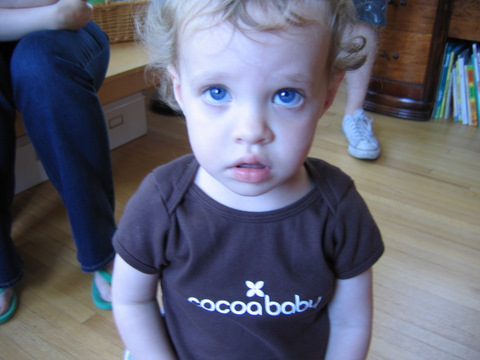
Donna looking up with big blue eyes

Whiplash is what comes to mind in this third month of Donna’s treatment.  The month started with a plan to temporarily relocate to Texas for proton beam radiation treatment at MD Anderson.    Yes, Houston, we have a problem.  Three days before our departure, Donna had an MRI at Children’s to establish a baseline for her treatment.  Before even leaving the hospital, our neurosurgeon called us to report that the “nub” of a brain tumor detected just 21 days earlier had experienced “explosive growth.” 

What unfolded in the next days is something I would not wish on any living soul.  Plans were quickly scrambled and a surgery was scheduled.  Just ten weeks after her first resection, Donna’s brain would be cut open in the exact same location.  This surgery took longer, though the recovery was much quicker.  Donna, the bull that she was, sailed through.  Her oncologist once referred to her as a “sweet princess” and I felt the need to correct him.  Donna was never a princess, she was more of a tough cookie.  Always had been.

On the heels of the surgery, while Donna was recovering in the neuro unit, the oncologist came by late in the afternoon a day or two later to toss out the suggestion that he would like to have a full body scan to rule out any migration of the cancer.  This sounded ominous to me.  Nothing like this had ever been mentioned or suggested before.  A pit embedded itself in my stomach and did not leave.  This photo was taken just minutes after that discussion.  Donna was in heaven and we were in hell.

Donna in the hospital

The CT scan revealed our worst fear:  Donna’s cancer had metastasized to her lungs.  I wanted to vomit, instead I started to gasp for breath and wailed repeated apologies to Mary Tyler Dad, “I’m so sorry, I’m so sorry, I’m so sorry,” over and over and over.  I felt guilty for something I had no control over.  I felt heartbroken that this was happening to my husband and daughter.  They did not deserve this. 

We were gently and compassionately advised by Donna’s oncologist that it would be perfectly reasonable to not treat the cancer and let Donna enjoy the time she had left to the best of her ability.  A prognosis of 2-3 months was given.  Alternately, we could pursue chemotherapy with no roadmap or certainty that it would help.  Papillary meningioma has a poor track record if not cut out.  It tends to migrate and be non-responsive to adjuvant therapies like chemo and radiation, but the sample numbers were miniscule (as the diagnosis is so rare.) We were offered the shot.  They discharged us with the assignment to think it over. 

And this is where the whiplash comes in.  How does one carry their child home from the hospital with no treatment plan and a prognosis of 2-3 months and “think it over.”  And Donna, bless her beautiful, innocent soul, had not a care in the world.  She was happy, felt great, was recovering nicely from her second craniotomy.  She just wanted to play and laugh and dance and read and giggle and be her own joyful self.  Here is a passage I wrote in our caringbridge journal from this month:

“There is a tenseness that does not go away, ever.  It is in our sleep, our wake, our breathing.  It is too difficult to imagine what we could lose and so we only deal with it in these incredibly potent, concentrated bursts of terror, doom, fear, and dread.  And then we have a tea party with Donna.” 

There were many tea parties with Donna this month, despite our dire circumstances.  Park visits, zoo visits, play dates.  It was spring, and trees and gardens were waking up.  Donna, you see, was still just 22 months old.  She knew what she knew and wanted what she wanted.  We did everything in our power to protect and preserve her childhood.  We needed her innocence just as she needed our protection.  Mary Tyler Dad said it best, “She is an opiate for pessimism and despair.” 

The family relaxes in the eye of the storm.

We took our cue from Donna, just as we had been advised to do by our wise and gifted nurse coordinator.  Donna was life.  She was so vibrant and vital and alive, that in the end, our choice to pursue chemo was made by her.  These days, the docs no longer tell you what to do, at least in our case where there was no track record of whether or not any of our options would work.  The choice was ours.  A game designer and social worker left to fend for themselves in this new terrain of medicine where the stakes were impossibly high.  Sigh.

Before chemo could begin, Donna’s disease needed to be “staged.”  Lord, how I hated that word.  Staging is a series of tests performed over a number of days to determine if and where the cancer has spread.  The anxiety will bring you to your knees.  Bar none, waiting for test results is in my Top 5 Worst Things About Being a Cancer Parent. 

Our timeline was so compressed that the docs admitted Donna to oncology before we had any results.  Chemo was ordered and administered literally moments after our oncologist gave us the good news that Donna’s bones had been spared.  Poor guy was tackled by me with hugs and wails of relief.  When the toxic chemo started to drip in Donna’s veins, she was sleeping.  I was huddled in a corner wrapped in a prayer blanket that had been gifted to me that morning.  There was a hush in the room  and the nurses silently completed their task.  The space felt sacred. 

Tomorrow:  Chemo


Donna’s Cancer Story: Relapse

This is the second of thirty-one installments of Donna’s Cancer Story, which will appear daily in serial format through the month of September to recognize Childhood Cancer Awareness Month.  Each post will cover one month of Donna’s thirty-one months of treatment. 

There is no simple, linear explanation for what happened during these weeks.  After the mysterious fevers wore off, Donna seemed to blossom and become more of herself.  Her cheeks pinked up, her hair, short until now, grew curls seemingly overnight.  She was active, silly, engaged and engaging.  I coined the term “brightful” to describe her lovely combination of clever smarts and playful joy. 

Donna on the red rocker

With a few weeks to absorb the diagnosis and Donna returning to her shiny self, we settled into Threat Level Orange and were relieved to be rid of the red.  Donna was afforded some time to recover from the surgery and started into pediatric rehab three mornings weekly at the Rehabilitation Institute of Chicago.  She loved her mornings there — it was like an indoor playground.  And quickly, she regained those physical skills she had lost, though stairs, running and jumping were still very difficult for her.  The structure of the schedule was also a blessing to us after the free for all of the past month.   

Donna putting letters on the mirror

The first post-surgery MRI date came and, teeth gritted, we went back to Children’s Memorial and watched our girl be put to sleep so that we could get a glimpse of what was happening inside her tiny, beautiful head.  We worried, though there was a sense that this first MRI was not to be feared as it seemed impossible that the beast would return so soon.  Home again in the afternoon with a drunk, post-sedation Donna requiring lots of care and attention, we got the call from the nurse coordinator that while not official, the scans looked clean.  Hooray!  A second call that evening confirmed that radiology also deemed the scan clean.  Double Hooray!  It felt like the piano above our heads was moved a little higher. 

Two days later, at the clinic for a follow-up visit, we learned that the original report was wrong.  There was a “nub” at the tumor site that did not look like scar tissue.  Donna’s neurosurgeon was who caught it, and with closer inspection, all others now agreed that Donna had relapsed.   

This news sent us into weeks of uncertainty.  No one could agree about how to proceed.  Add to that, Johns Hopkins now questioned the original diagnosis.  Our oncologist didn’t want to use chemotherapy, our surgeon didn’t want to operate, our radiologist couldn’t decide which type of radiation would be best.   

  Donna on the swing

Instinctively, we joined Donna in her blissful, toddler state of being.  We went to the zoo.  We treated Donna to her first ice cream.  (She didn’t like it).  We bought a video camera and started shooting.  We did what we needed to do to fill our days, Donna’s days, until we got her to sleep and we had some time to think and breathe and feel the fear that we kept at bay when Donna was with us.  And just when we thought we couldn’t take another moment of the hell that fear is, there was Donna, right in front of us, demanding us to be silly, to sing and to dance and to play.  How could we not?  So we did.  We played and worried.  Sang and fretted.  Snuggled and tried not to drown in the doom.

As days passed, a plan was cobbled together:  Donna would travel to Houston to receive proton beam radiation treatment at MD Anderson in Texas.  Hours were spent on the phone ensuring that Donna’s treatment would be covered by our insurance.  My social work advocacy skills were a welcome tool for these tasks. 

Mary Tyler Dad wrote in our caringbridge journal during this month, “Medicine, fear, and love.  That’s what we have right now, and enough of the third is helping us struggle through the first and the second.”  Amen. 

Tomorrow:  Surgery 2.0

Donna’s Cancer Story: Diagnosis

This is the first of thirty-one installments of Donna’s Cancer Story, which will appear daily in serial format through the month of September to recognize Childhood Cancer Awareness Month.  Each post will cover one month of Donna’s thirty-one months of treatment.  

This is Donna, my beautiful daughter, named for her grandmother, my mother, who died of a brain tumor when I was pregnant.  So many Donnas, so many brain tumors.

 Donna

Donna was diagnosed with papillary meningioma, an aggressive brain tumor on March 23, 2007.  She was 20 months old.  We learned this after an emergency CT scan was done and within moments a doctor said the words, “There is a mass in your daughter’s head.”  There is a mass in your daughter’s head.  It bears repeating because with those words our lives changed:  Just.  Like.  That. 

In the two to three weeks leading up to diagnosis, we began to notice changes in our girl.  She became moody, clingy, fearful, cranky.  Her appetite diminished and walking became difficult.  Donna was always what we called a “considerate baby.”  She was patient with her older rookie parents and had a sweet disposition.  Her personality and physical changes were concerning, but confusing, too — could they have been the onset of the terrible twos? 

No.  What we were seeing was the result of spinal fluid building up in Donna’s brain caused by the tumor growth.  Hydrocephalus can be fatal and often is.  Gratefully, Donna was admitted to Children’s Memorial in Chicago on a Thursday evening to fast track her for an MRI the next morning.  But by  six that next morning, Donna started vomiting and became unresponsive.  Her last words to me, slurred, were, “Change your diaper, change your life,” something I would say to her often.  She was rushed to the CT machine to determine what was happening.  I now understand the word ‘stat.’ 

Minutes after the confirming CT, Donna was rushed into surgery to drain the fluid building in her brain.  She was kept sedated over the weekend in the PICU and on Monday morning, bright and early, had her tumor resected.  All looked positive, as the neurosurgeon believed she had removed it all, but a diagnosis would take weeks to come back.  Even then, after Donna’s tissue was sent to Washington U. and Johns Hopkins, there was still some dissent amongst the experts.  Without a clear diagnosis, and then such a rare one, a treatment plan was not easily identified.  Watch and wait was the order of the month.  Watch and wait. 

After the initial ten day hospital stay, Donna returned home, but had several ER visits for mysterious fevers that resulted in hospital admissions.  Infectious disease was called in, but the only thought was that Donna may have had a virus.  Also possible was that the tumor that had been resected was in the left posterior fossa, where our temperature controls are housed in the brain.  No one knew. 

This picture was taken just minutes after we returned to our home from the initial hospital stay.  Donna is still in her gown from the hospital and the dressing on her head is from the first surgery to relieve the pressure from the hydrocephalus.  Our neurosurgeon used a dressing shaped like a heart.  We heart you, Dr. Bowman.  The relief in Donna’s face and posture was palpable as we carried her through the door.  I say carried because after ten days in the hospital and the few weeks of decline prior to that, Donna had lost the ability to walk.  Regardless, those were her books, her toys, her crib.  Donna was home. 

 Home from hospital

This is a photo of where the tumor was resected.  The cut is called a “hockey stick.”

Hockey stick scar

Tomorrow: Relapse